




Key Takeaways
- 25 columns: The standard Pakistani Nikah Nama runs from the place of marriage in column 1 to the registration fee in column 25, and a full translation covers every one of them.
- 4 signed originals: The Nikah Registrar signs and stamps 4 originals, sends the first to the local government, and gives one each to the bride and groom.
- 2-month registration window: The State Department lists a 2-month window to register the marriage, after which the local government issues the Marriage Registration Certificate.
- USCIS rule: 8 CFR 103.2(b)(3) requires a full English translation that the translator certifies as complete and accurate, plus a certification of competence.
- UK rule: Paragraph 39B of the Immigration Rules requires the original document plus a dated translation the Home Office can verify independently.
- Column 18 carries legal weight: The State Department notes that a husband grants his wife the right of divorce by writing "yes" on line 18.
- US pause lifted: The State Department's January 2026 pause on immigrant visas for 75 countries, Pakistan included, ended on August 21, 2026.
Draft Your Nikah Nama Translation Before You Pay for Certification
Upload a photo or PDF of the Urdu original, and JotMe returns an English draft that keeps the form's layout. Your translator checks a finished draft instead of typing all 25 columns from zero. Start free on Mac or Windows.
Download JotMe for FreeA Nikah Nama translation looks like a small job until an immigration officer sends it back. The Urdu original is usually handwritten, and its dower figures use lakh commas that confuse anyone who reads only Western number formats.
A single column decides whether the wife holds a delegated right of divorce, and a careless English version can misstate that term. US and UK officers both expect a full English translation with a signed statement, yet each country words that statement differently.
Pakistan adds its own layer, since the handwritten Nikah Nama and the computerized Marriage Registration Certificate travel together in most spouse visa files. Getting the translation right starts with knowing what the document is, because a translator who treats it like a simple certificate misses the dower and divorce terms that give it legal weight.
What Is a Nikah Nama?
A Nikah Nama records a Muslim marriage and its agreed terms. Muslims in Pakistan register it under the Muslim Family Laws Ordinance, 1961. Its 25 printed columns identify the couple and their witnesses, and the later columns set out the dower (haq mehr) the groom owes the bride and any right of divorce the husband delegates to the wife.
Pakistani courts treat a registered Nikah Nama as a public document with a presumption of truth, so its entries help resolve disputes over dower and conditions years after the wedding.
The Urdu wording itself varies. A 2025 Ministry of Law and Justice meeting found that the official gazette holds only an English version of the Nikahnama, and officials could not locate an officially sanctioned Urdu translation. Registrars across Pakistan fill in Urdu forms whose wording differs from district to district, so a translator works from the Urdu printed on the couple's own form.
The Nikah Nama is different from the Marriage Registration Certificate. The State Department's Pakistan reciprocity page names the MRC as the marriage document and explains that Union Councils, municipal corporations, the Capital Development Authority, and cantonment boards register Nikah Namas and issue MRCs. The Nikah Nama records the full marriage terms, while the MRC confirms the government registered it.
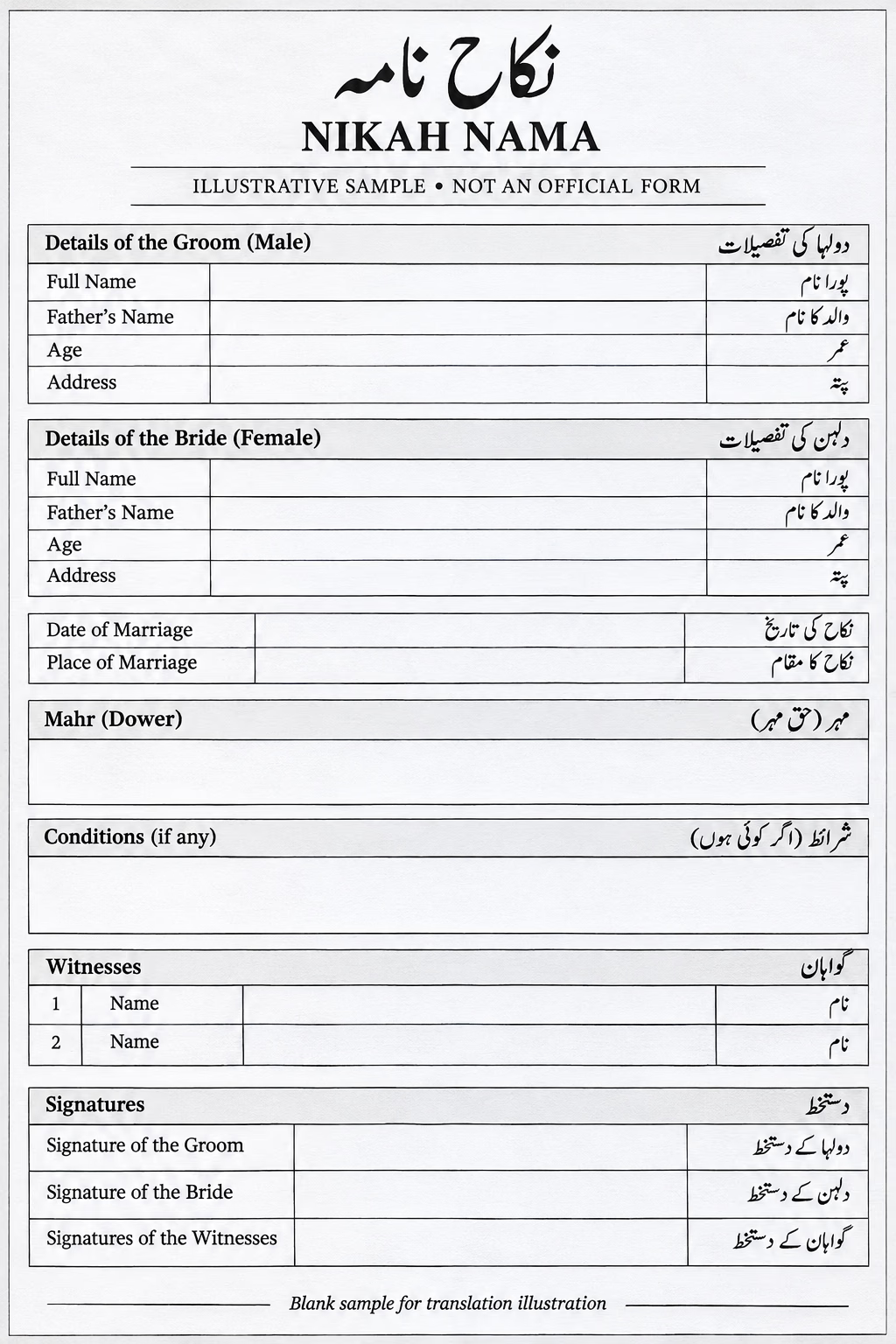
The bilingual sample below shows the layout translators work with. It is an illustration with fewer fields than the official 25-column form.
How Do You Get a Nikah Nama and Marriage Registration Certificate in Pakistan?
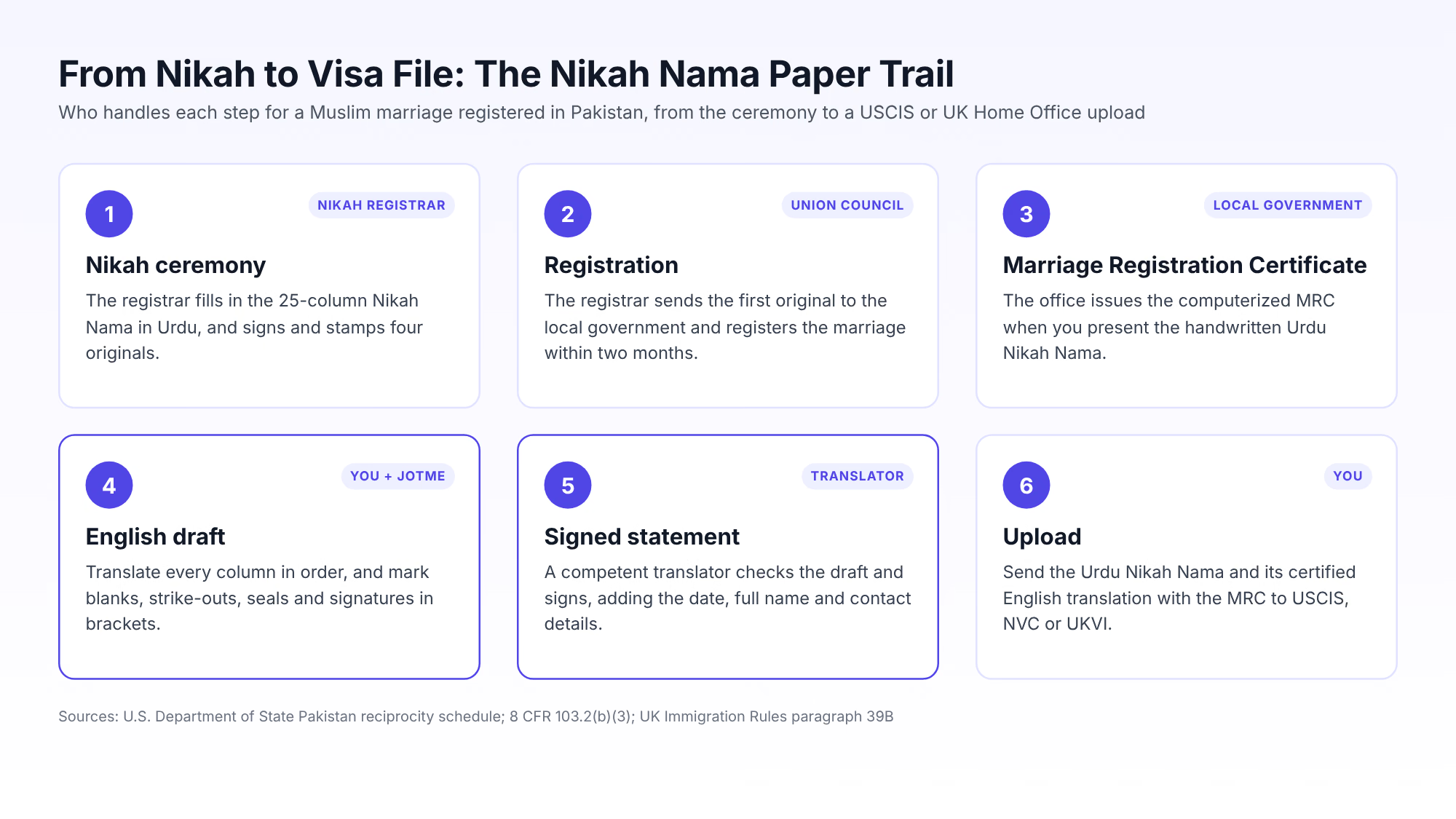
You get the Nikah Nama at the ceremony and the MRC from the local government office that registers it. The State Department lays out the official route on its Pakistan page, and the steps below follow it:
- Marry with a licensed Nikah Registrar: The registrar fills in the Nikah Nama in Urdu at the ceremony, and the couple, the witnesses, and any vakil sign it.
- Keep your original: The registrar signs and stamps 4 originals, sends the first to the local government, gives the second and third to the bride and groom, and keeps the fourth.
- Check the registration date: The State Department lists a 2-month window to register the marriage, so follow up with the Union Council if nobody has confirmed it.
- Apply for the MRC: Muslim applicants get the certificate from their local government authority by presenting the handwritten Urdu Nikah Nama.
- Order certified copies when you need them: The State Department confirms that certified copies are available, which helps if your original is lost or damaged.
Non-Muslim citizens follow a different route. The State Department notes that Ahmadis, Christians, Hindus, Parsis, and other non-Muslim citizens receive marriage certificates from their religious authority. Some Union Councils also issue civil Marriage Registration Certificates for Hindu and Christian marriages.
Neither country's translation rule asks for an apostille. The Apostille Convention entered into force for Pakistan on March 9, 2023, and the Ministry of Foreign Affairs issues apostilles for countries that request one, yet 8 CFR 103.2(b)(3) and paragraph 39B of the UK Immigration Rules both leave the apostille out.
How Do You Correct a Mistake in a Nikah Nama?
Fix the original before anyone translates it. A translation must mirror the document it certifies, errors included, so a wrong date or a misspelled name in the Urdu original stays wrong in English until the record changes.
- Start with the Union Council: Legalization guidance from the Italian visa center in Islamabad says only a Union Council official should make corrections, adding his stamp, signature, CNIC number, and the date of the correction.
- Go to the Deputy Commissioner for registrar errors: The Lahore High Court has said a party who believes the Nikah Registrar altered an entry can approach the Deputy Commissioner, the controlling authority for the register.
- Use the Family Court for disputed terms: When the couple disagrees about dower or special conditions, the Family Court decides, and an entry nobody challenges keeps its presumption of truth.
- Update the MRC afterward: Request a fresh MRC once the record changes, since the same guidance requires names and dates to match across the Nikah Nama, the MRC, and the passport.
Pakistan is tightening the process right now. In September 2026, the Supreme Court ordered Nikah registrars to use the prescribed Nikahnama, fill every relevant column properly, and train under their Union Councils. The Lahore High Court had already flagged mismatched Urdu and English wording in columns 13 and 16, and a law ministry committee has since recommended a standardized bilingual Nikahnama. Forms registered before these changes still carry blank and struck-out columns, so translators need a rule for each one.
How Do You Translate a Nikah Nama Column by Column?
Translate every column in order with its number, and mark anything the registrar left blank or struck out. The table lists each column of the standard form with its key Urdu term, the English rendering, and the error a translator is most likely to make.
| Column | Key Urdu Term | English Rendering | Where Translations Go Wrong |
|---|---|---|---|
| 1 | مقام نکاح (maqam-e-nikah) | Name of the ward, town, union council, tehsil and district where the marriage took place | Translating place names instead of transliterating them; copy the spellings the Union Council uses |
| 2 | دولہا، ولدیت (groom, parentage) | Name of the bridegroom and his father, with their residences | Spelling the name differently from the passport; match the passport and CNIC exactly |
| 3 | عمر (age) | Age of the bridegroom | Writing 04-07-1994 for a US reader, who reads it as April 7; spell out the month |
| 4 | دلہن، ولدیت (bride, parentage) | Name of the bride and her father, with their residences | Rendering "d/o" (daughter of) as "wife of" |
| 5 | کنواری، بیوہ، مطلقہ (kunwari, bewah, mutallaqa) | Whether the bride is a maiden, a widow or a divorcee | Turning kunwari into "virgin" when the form's own English word is "maiden" |
| 6 | عمر (age) | Age of the bride | The same day and month swap as column 3 |
| 7 | وکیل (vakil) | Vakil appointed by the bride, with his father and residence | Translating vakil as "lawyer"; in a Nikah Nama, the vakil is the bride's authorized representative |
| 8 | گواہان (witnesses) | Witnesses to the appointment of the bride's vakil, with their fathers, residences and relationship to the bride | Dropping the relationship field |
| 9 | وکیل (vakil) | Vakil appointed by the bridegroom, with his father and residence | Deleting the column when the form names nobody; write "[Left blank in the original]" |
| 10 | گواہان (witnesses) | Witnesses to the appointment of the bridegroom's vakil | The same blank-column mistake as column 9 |
| 11 | گواہان نکاح (marriage witnesses) | Witnesses to the marriage, with their fathers and residences | Merging all witnesses into a single line, which hides who signed |
| 12 | تاریخ نکاح (date of nikah) | Date on which the marriage was contracted | Confusing it with the registration date in column 24 |
| 13 | حق مہر (haq mehr) | Amount of dower | Misreading lakh commas: Rs. 1,00,000 means 100,000 rupees |
| 14 | معجل / غیر معجل (mu'ajjal / ghair mu'ajjal) | How much of the dower is mu'ajjal (prompt) and how much is ghair mu'ajjal (deferred) | Reversing prompt and deferred; the Arabic word spelled مؤجل means deferred, so the Roman spellings collide |
| 15 | ادا شدہ مہر (dower paid) | Whether any part of the dower was paid at the time of the marriage, and how much | Mixing the amount paid at the nikah with the amount still owed |
| 16 | مہر کے عوض جائیداد (property for dower) | Property given in lieu of the dower, with its description and agreed value | Confusing dower with dowry (jahez); if gold appears, keep "5 tola" and add grams in brackets |
| 17 | خصوصی شرائط (special conditions) | Special conditions, if any | Summarizing handwritten conditions; translate every line in full |
| 18 | تفویض طلاق (talaq-e-tafweez) | Whether the husband has delegated the power of divorce to the wife, and on what conditions | Writing "No" when the registrar struck the column out; write "[Struck out in the original]" |
| 19 | حق طلاق پر پابندی (limit on divorce right) | Whether the husband's right of divorce is curtailed in any way | Copying the column 18 answer into column 19 |
| 20 | مہر و نان نفقہ (dower and maintenance) | Whether any document on dower or maintenance was drawn up at the marriage, and its contents | Missing that nan nafqa means maintenance |
| 21 | موجودہ بیوی (existing wife) | Whether the bridegroom has an existing wife and the Arbitration Council's permission to marry again | Leaving a blank where the original says "No"; the column records whether a second marriage had legal permission |
| 22 | اجازت نامہ (permission letter) | Number and date of the Arbitration Council's permission | Translating "Nil" as an empty cell |
| 23 | نکاح خواں (nikah khwan) | Person who solemnized the marriage, with his father and residence | Calling the nikah khwan the Nikah Registrar; they can be different people |
| 24 | تاریخ رجسٹریشن (registration date) | Date of registration of the marriage | Swapping it with the marriage date in column 12 |
| 25 | رجسٹریشن فیس (registration fee) | Registration fee paid | Skipping the fee because it looks minor |
The text outside the columns counts too. Translate the registrar's stamp as "[Seal: Nikah Registrar, Union Council ...]" with its readable wording, and note each signature as "[Signed]" and each thumb impression as "[Thumb impression]". A translation that skips the seal or the margin notes fails the completeness test in both countries.
Columns 13 to 18 need the most care. The Supreme Court's September 2026 ruling singled out columns 13 to 16, which deal with dower, and the State Department's own Pakistan page explains that a husband grants his wife the right of divorce by stating "yes" on line 18. A translator who renders a struck-out column 18 as "Yes" or "No" changes the legal meaning of the contract.
What Do USCIS and the UK Home Office Require in a Marriage Certificate Translation?
Both countries want a full English translation with a signed statement, and they ask for different details in that statement. Any marriage certificate translation for USCIS falls under 8 CFR 103.2(b)(3), which requires a full English translation the translator certifies as complete and accurate, plus the translator's certification of competence to translate into English. The UK rule lives in paragraph 39B of Part 1 of the Immigration Rules, which requires the original-language document and a full translation the Home Office can verify independently.
| Requirement | USCIS (8 CFR 103.2(b)(3)) | UK Home Office (Immigration Rules, paragraph 39B) |
|---|---|---|
| Scope | Full English translation of the document | Original-language document plus a full translation |
| Accuracy statement | Translator certifies the translation as complete and accurate | Translator confirms it accurately translates the original |
| Competence | Translator certifies competence to translate from Urdu into English | For leave to remain and indefinite leave to remain, certification by a qualified translator and details of credentials |
| Date | The rule names no date, so add one anyway | The rule requires a date |
| Name and signature | Silent in the rule; sign and print your full name | Full name and signature of the translator or an authorized official of the translation company |
| Contact details | Unstated, though an address and phone number help USCIS reach the translator | Contact details of the translator or translation company |
| Notarization | The rule does not require it | The rule does not require it |
A single statement can satisfy both countries if it carries every element. Use the following as a starting template on its own page after the translation. For UK leave to remain or indefinite leave to remain, a qualified translator must also certify it and provide their credentials:
"I, [full name], certify that I am competent to translate from Urdu into English, and that the attached English translation of the Nikah Nama of [groom's name] and [bride's name] is complete and accurate. Signature: [signature]. Date: [date]. Address: [address]. Phone: [phone]. Email: [email]. Translator qualifications and credentials (required for UK leave to remain or indefinite leave to remain): [details]."
US immigrant visa cases add a consular step. The U.S. Embassy in Islamabad asks married applicants to bring their original marriage certificate with an English translation and a photocopy. Since the State Department names the MRC as the marriage document and ties it to the handwritten Urdu Nikah Nama, we recommend uploading the MRC alongside the Urdu Nikah Nama and its certified English translation.
What Are the Current US and UK Visa Rules for Pakistani Spouses?
Both routes are open to Pakistani spouses as of November 2026, and the US route reopened after a pause earlier this year.
- US immigrant visa pause has ended: On January 21, 2026, the State Department paused immigrant visa issuance for nationals of 75 countries, including Pakistan. Its update states that, as of August 21, 2026, the pause is no longer in effect under the court's order in CLINIC v. Rubio.
- Separate travel restrictions: A different measure, Presidential Proclamation 10998, restricts entry for nationals of 39 countries, and Pakistan does not appear on that list.
- UK income requirement: A spouse or partner applicant usually needs to show a combined income of at least £29,000 a year.
- UK English requirement: First-time spouse applicants usually show English at CEFR level A1 in speaking and listening, with A2 for the extension and B1 for settlement.
Rules change quickly on both sides, so check the State Department and GOV.UK pages again in the week you file.
How Can JotMe Help You Draft and Check a Nikah Nama Translation?
JotMe gives you a working English draft of the Urdu original in minutes. Certification stays with a human translator, who checks the JotMe draft line by line and signs the statement.
We ran our illustrative form through the desktop app. Phone photos and scans go through the Image option, which takes PNG, JPG, JPEG, or WEBP files up to 10 MB.
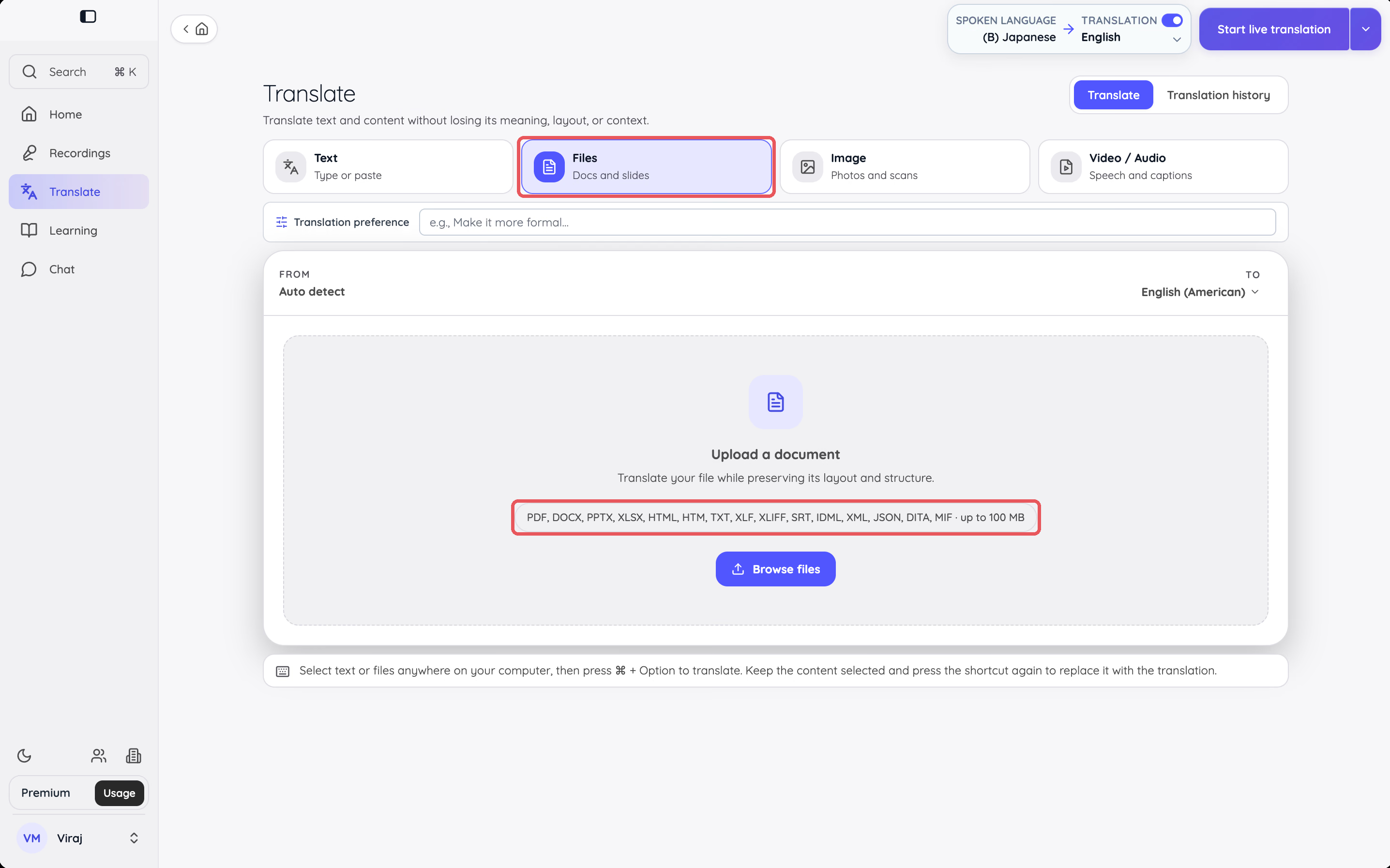
A scanned PDF goes through Files instead, which accepts documents up to 100 MB and keeps their layout. Our guides on translating scanned images and translating Word and PDF files cover both paths in more depth.
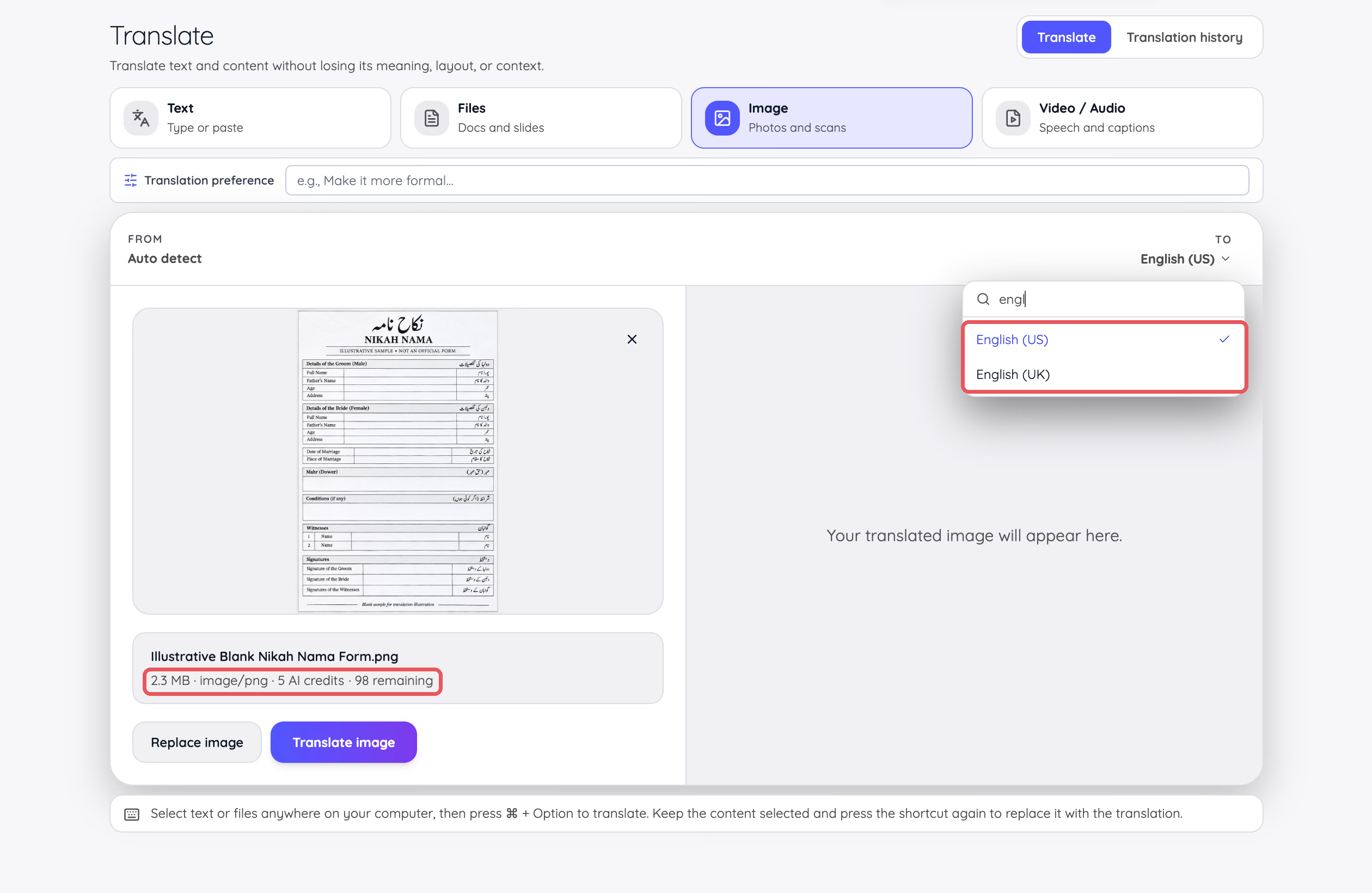
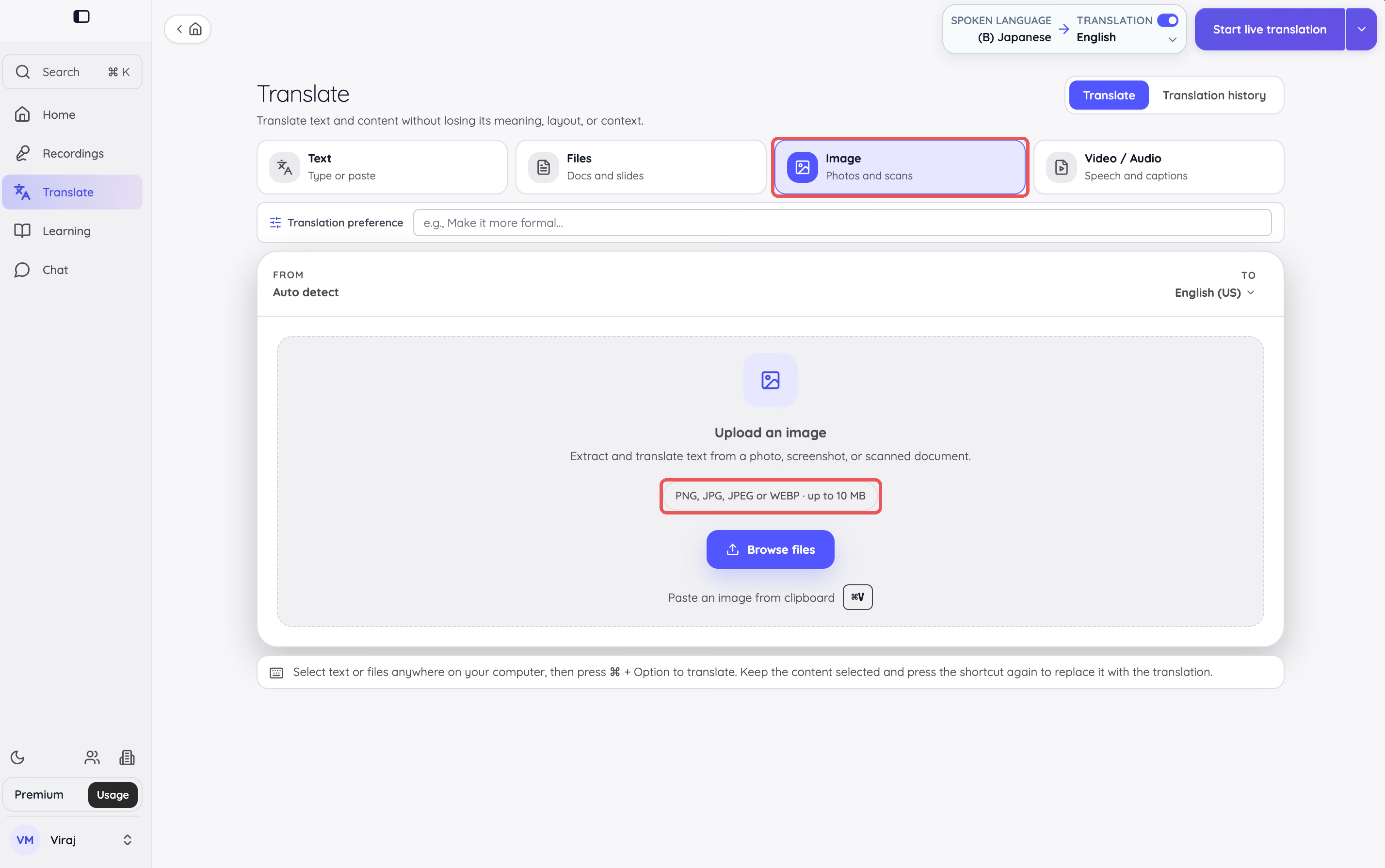
Leave the source language on Auto detect and choose the English variety that matches your destination: English (US) for USCIS or English (UK) for the Home Office. The Translation preference box takes plain instructions, such as "keep column numbers and write dates with the month spelled out." Our image translation cost 5 AI credits.
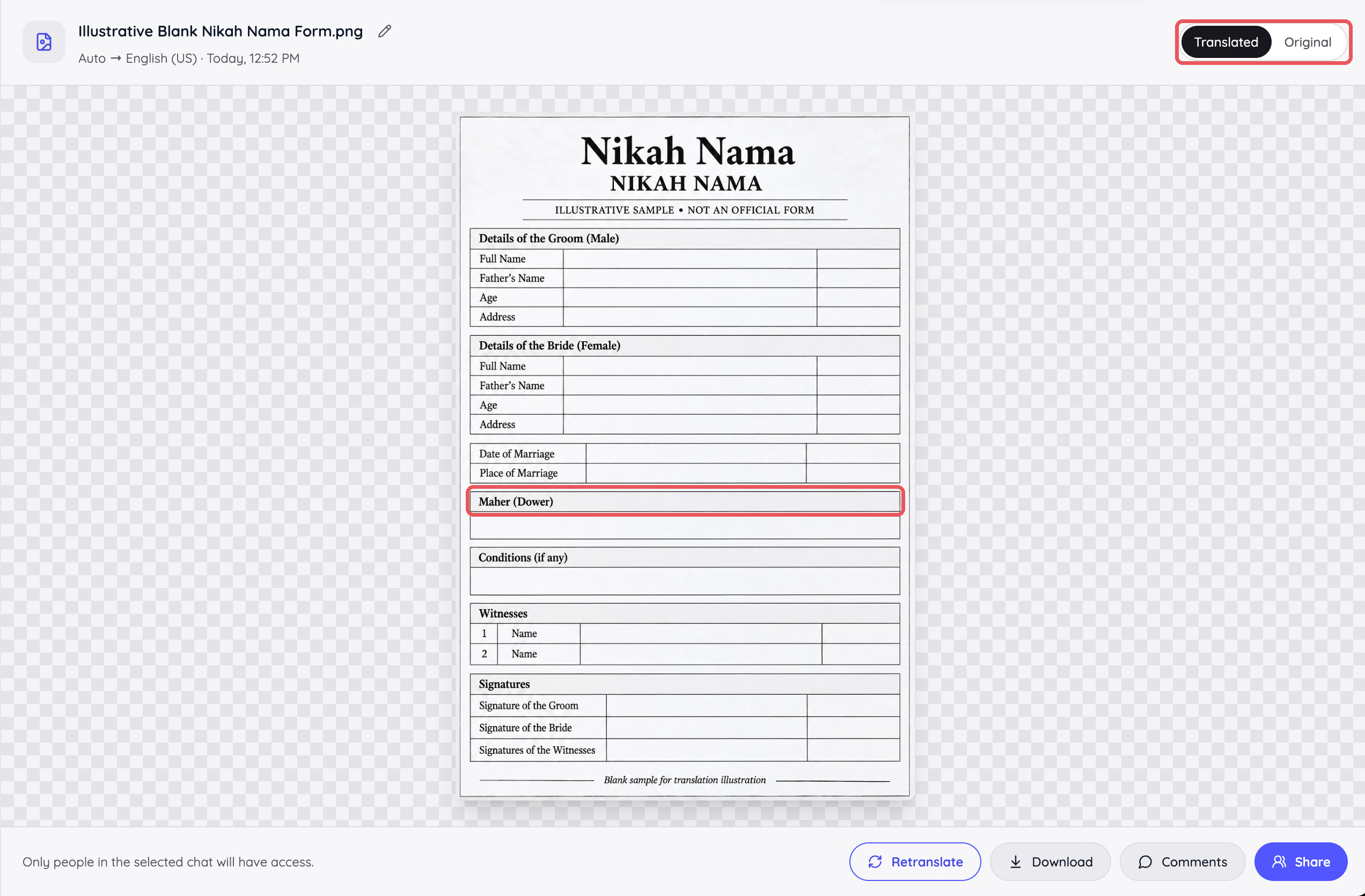
The draft keeps the form's structure, and a single click flips between the translation and the original for a quick comparison. Our test also showed why a human check matters: JotMe rendered the dower heading as "Maher (Dower)," while the English side of our form reads "Mahr (Dower)," so the checker standardizes a single spelling across every page.
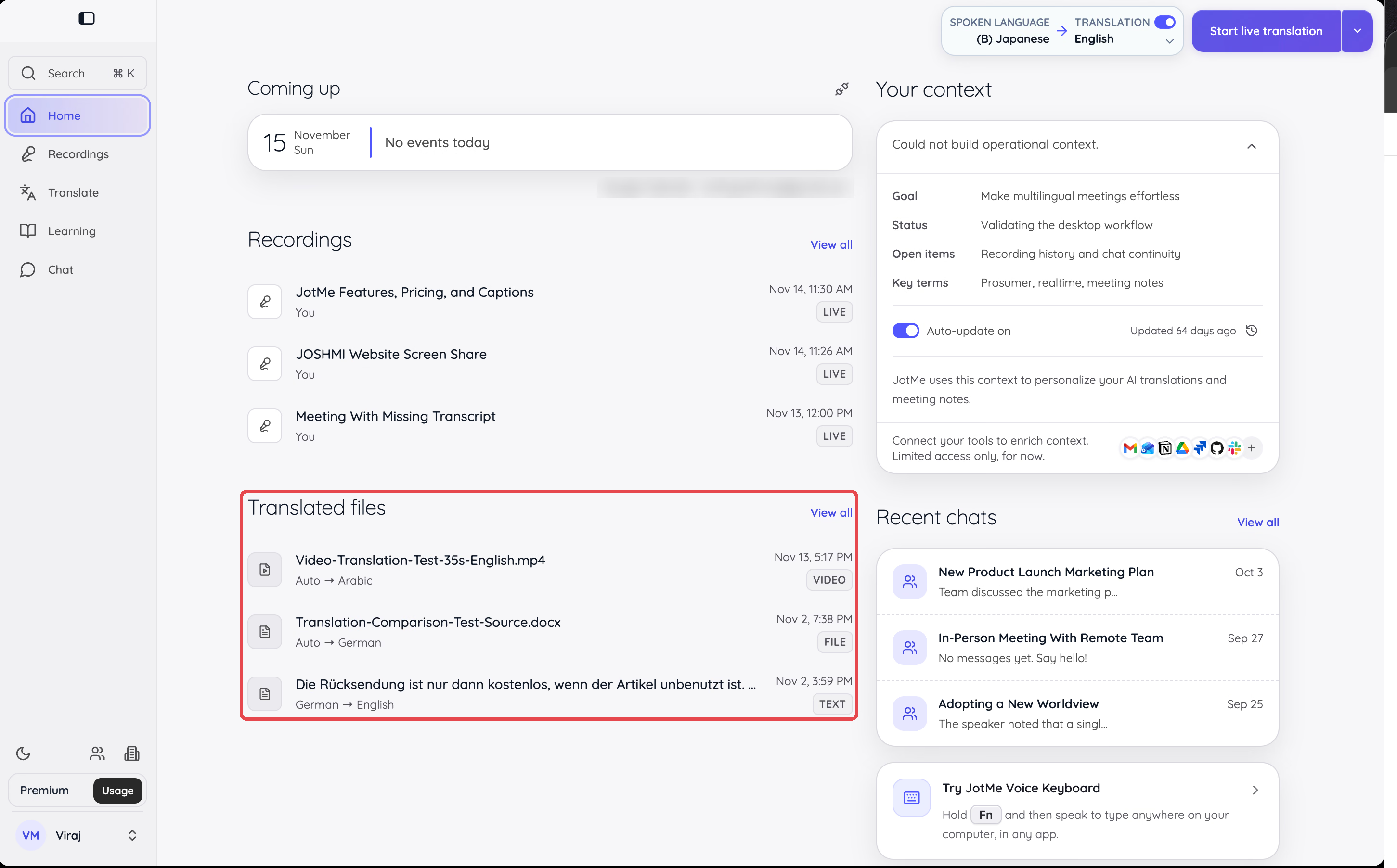
Every translation lands in Translated files on the home screen, so the person signing the statement can reopen the exact draft later. JotMe supports 200+ languages, and our language list shows what each feature covers.
To back-check a single rendering, such as a handwritten condition in column 17, paste your English line into our free English to Urdu translator and compare the result with the original Urdu. If Urdu-speaking parents join a call with your immigration lawyer, JotMe's Urdu to English live translation translates the conversation as everyone talks.
What Should You Check Before Signing the Certification?
- Every column present: All 25 columns appear in order, with "[Left blank in the original]" or "[Struck out in the original]" where needed.
- Names and places: Spellings match the passports and CNICs letter for letter.
- Dates: Each date shows the month as a word, and the marriage date and registration date appear in columns 12 and 24.
- Amounts: Lakh figures convert correctly, and the amount in words matches the figure.
- Dower split: Mu'ajjal reads as prompt and ghair mu'ajjal reads as deferred.
- Column 18: The English repeats exactly what the original says, including any conditions.
- Vakil: The translation calls the vakil an authorized representative.
- Seals and signatures: Each stamp and signature has a bracketed note, thumb impressions included.
- Consistent terms: Each name and each dower term keeps a single spelling from the first page to the last.
Turn a Scanned Nikah Nama Into an English Draft in Minutes
JotMe translates photos and PDFs while keeping the original layout, so checking the draft against the Urdu form takes a single read. Start free on Mac or Windows.
Download JotMe for FreeWhich Documents Should You Submit With a Nikah Nama Translation?
Send the full set, so the officer never has to ask for a missing piece:
- Urdu Nikah Nama: A clear copy of the registered original, with all 25 columns readable.
- Certified English translation: Every column, seal, and signature, followed by the signed statement.
- Marriage Registration Certificate: The computerized MRC from the Union Council or equivalent office, with a translation of any part not in English.
- Matching identity details: Names and CNIC numbers that agree across the Nikah Nama, the MRC, and both passports.
A Nikah Nama translation succeeds when it faithfully records the marriage terms, column for column, with nothing smoothed over. JotMe takes the slowest part off your desk by producing the English draft, and your translator spends their time on the checks that protect your application.
Prepare Your Spouse Visa Documents in English With JotMe
Draft English versions of your Nikah Nama and supporting documents, and keep every draft in a single history your translator can check. Start free on Mac or Windows.
Download JotMe for FreeFAQs
Can I Translate My Own Nikah Nama for USCIS?
The regulation asks for a translator who certifies competence and a complete, accurate translation, and it does not name who that person must be. A spouse who translates their own marriage record invites questions about bias, so we recommend an independent translator who can sign the statement.
Does a Nikah Nama Translation Need to Be Notarized?
Neither 8 CFR 103.2(b)(3) nor paragraph 39B of the UK Immigration Rules requires notarization. Both focus on the translator's statement, and the UK version adds the date, full name, signature, and contact details.
Is the NADRA Marriage Certificate Enough Without the Nikah Nama?
The State Department names the Marriage Registration Certificate as Pakistan's marriage document, and the local office issues it when you present the handwritten Urdu Nikah Nama. The Nikah Nama records the full marriage terms, including dower and conditions, so submit both with an English translation.
Can I Use a Translation Made in Pakistan for a UK Visa?
Yes, as long as it meets paragraph 39B. The rule focuses on verification, so the translation needs a date and the translator's confirmation of accuracy, full name, signature, and contact details, wherever the translator works. For UK leave to remain or indefinite leave to remain, the translation must be certified by a qualified translator and include their credentials.
Does a Nikah Nama Need an Apostille for the US or UK?
The translation rules for USCIS and the UK Home Office do not mention an apostille. The Apostille Convention entered into force for Pakistan in March 2023. Its Ministry of Foreign Affairs issues apostilles for destinations that request one; check the receiving authority's document requirements separately from its translation rule.
What Does Column 18 of the Nikah Nama Mean?
Column 18 records whether the husband delegated his right of divorce to the wife, known as talaq-e-tafweez, and on what conditions. A translator renders it exactly as written, including a strike-out, since the answer changes the wife's legal options.
Try JotMe
Accurate translation for your meetings, events, and everyday work, with AI Memory that remembers your context.