


Resources
Contextual and personalized translation: how JotMe uses your data to deliver nuanced translation

Taka Shirasu
July 8, 2026
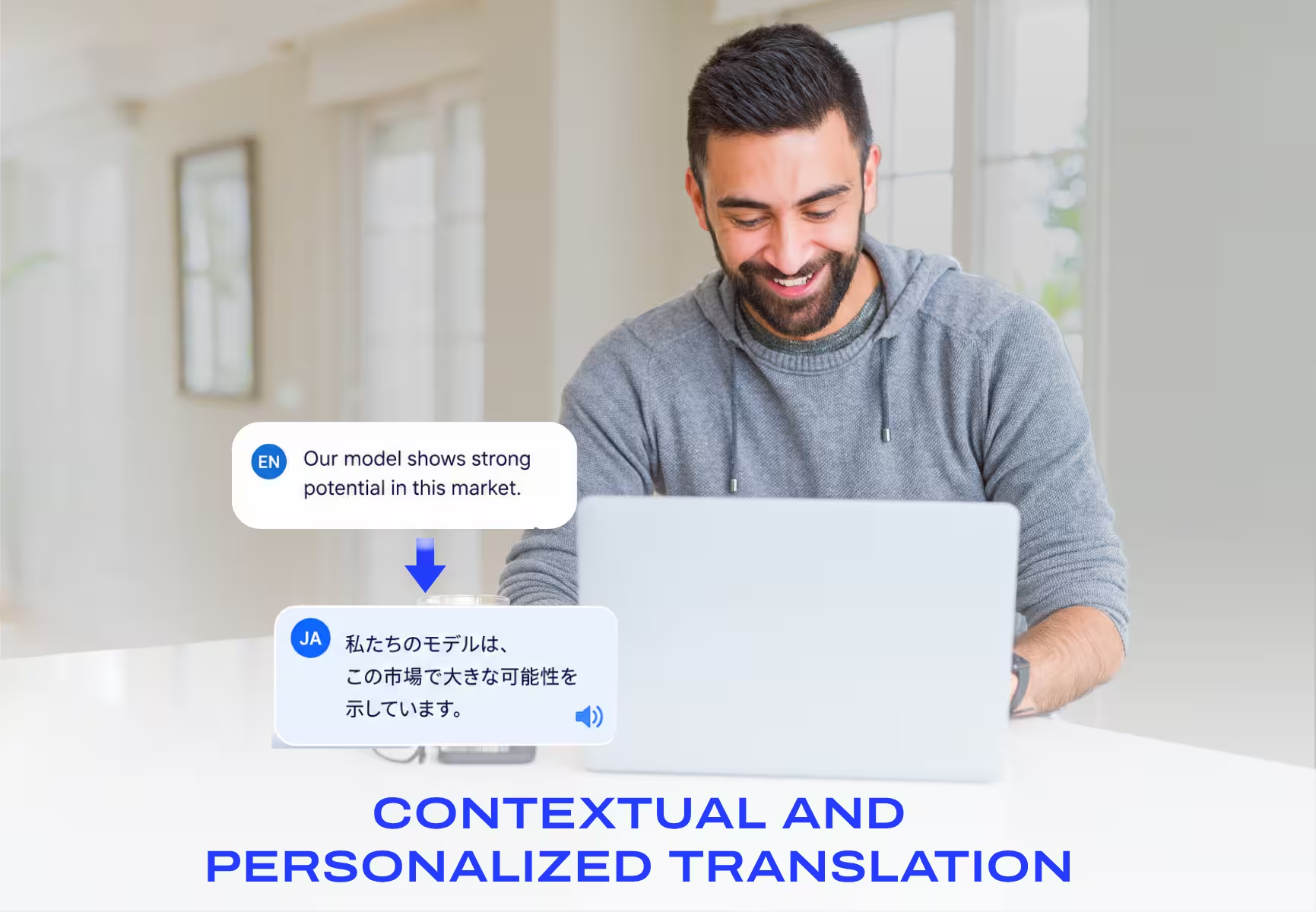
JotMe is known for ultra-accurate translation. You're in meetings where critical information can't be mistranslated every day or every week. That's the No. 1 reason customers choose JotMe.
So why are many AI translations still not good, even though they use AI?
In this article, I want to be transparent about how we use your data to make translations accurate for your workflow.
First, most translation tools already deliver grammatically accurate translations, so they are not necessarily wrong. The important thing to understand is that a single sentence can often be translated in many different ways depending on the context. Users often think a translation is poor because the AI doesn't know what they are trying to communicate or what information the listener has already absorbed.
For example, consider the sentence:
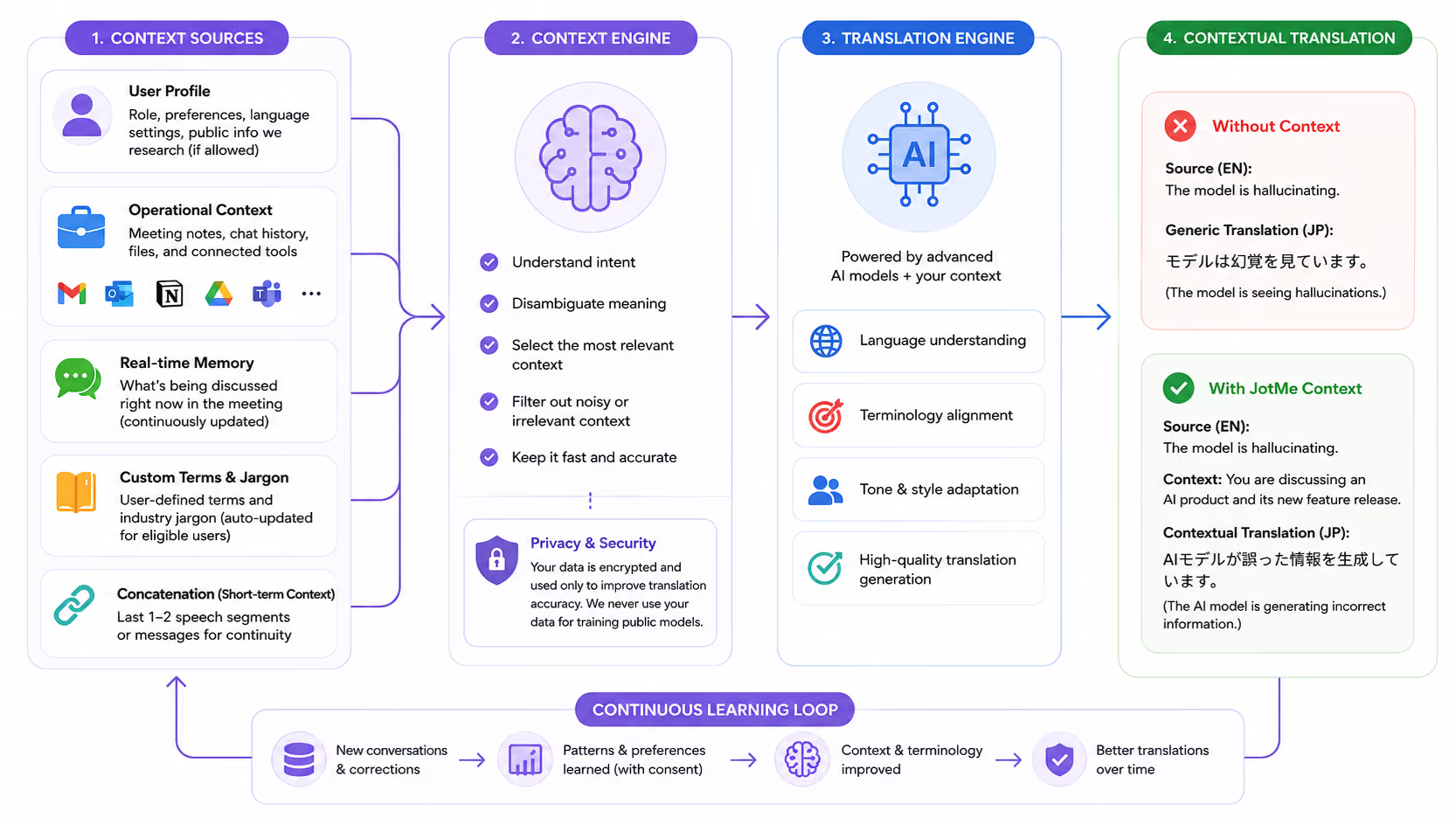
"The model is hallucinating."
Without context, "model" could refer to a fashion model who is hallucinating after taking drugs, or it could refer to an AI model generating false information.
If the AI translator knows that you've been working on an AI product and discussing new AI features, it will correctly choose the second meaning.
This is a simple example, but as conversations become more complex and involve more information, the problem becomes much harder.
Now that we understand this, let's talk about how we use your data at JotMe to deliver contextually accurate translations.
We Have Two Types of Translation at JotMe
We have two types of translation at JotMe:
- Live translation (real-time captions and voice-to-voice translation)
- Text translation (transcriptions, text input, and chat)
How Live Translation Uses Your Context
In short, we use the following sources of context:
User Profile
Everything we know about you from the moment you sign in. Our AI agents may also research publicly available information about you on the web to improve translation accuracy.
Operational Context
This represents what you do at work. We build it from your meeting notes, messages in JotMe Chat, uploaded files, and interactions with JotMe AI.
For eligible users, we also allow connections to workplace tools such as Gmail, Outlook, Notion, Google Drive, and Microsoft Teams to build a richer operational context.
Real-Time Memory
This represents what you're discussing during the meeting. It is continuously updated as the conversation evolves.
Custom Terms and Jargon
Users can add their own custom terminology and industry jargon.
For eligible users, we can also update these automatically using operational context.
Concatenation from Previous Speech
We include one or two previous translated segments so the translation flows naturally instead of sounding disconnected.
How Text Translation Uses Your Context
Text translation follows a similar approach, but instead of real-time speech memory, it uses conversation memory and previous chat messages.
User Profile
Everything we know about you from the moment you sign in. Our AI agents may also research publicly available information about you on the web to improve translation accuracy.
Operational Context
This represents what you do at work. We build it from your meeting notes, messages in JotMe Chat, uploaded files, and interactions with JotMe AI.
For eligible users, we also allow connections to workplace tools such as Gmail, Outlook, Notion, Google Drive, and Microsoft Teams to build a richer operational context.
Conversation Memory
This represents the ongoing conversation in the chat. It updates continuously as you chat.
Custom Terms and Jargon
Users can add their own custom terminology and industry jargon.
For eligible users, we can also update these automatically using operational context.
Concatenation from Previous Chats
We include one or two previous chat messages so translated conversations remain coherent and natural.
AI Has Improved Translation, but There's Still a Gap
AI has significantly improved translation quality, but there is still a gap.
As mentioned earlier, a single sentence can often be translated in multiple ways. Without enough context, an AI cannot know which meaning the speaker intends or which version the listener expects.
At the same time, simply providing more context isn't always the answer. Too much context can actually reduce translation quality—a problem often called context rot. Excessive context makes it harder for the model to identify the information that truly matters.
There's also a performance tradeoff. Live translation is a real-time AI system. The more context we provide, the longer it takes to generate a translation.
During our research, some experiments took over 30 seconds to produce a result, which is completely unacceptable for live conversations.
From our testing, a delay of around 1–5 seconds feels natural for most users while still allowing enough context to produce highly accurate translations.
Finding the right balance between context, speed, and accuracy is one of the core research problems we're solving at JotMe.
We'll continue investing in this work to deliver the most accurate AI translation possible for businesses.
See you next time.
Last updated on
July 29, 2026
Follow us on social media: