





Guides
Is Google Translate Accurate? [2026 Test]

Lovely Mangla
September 29, 2026
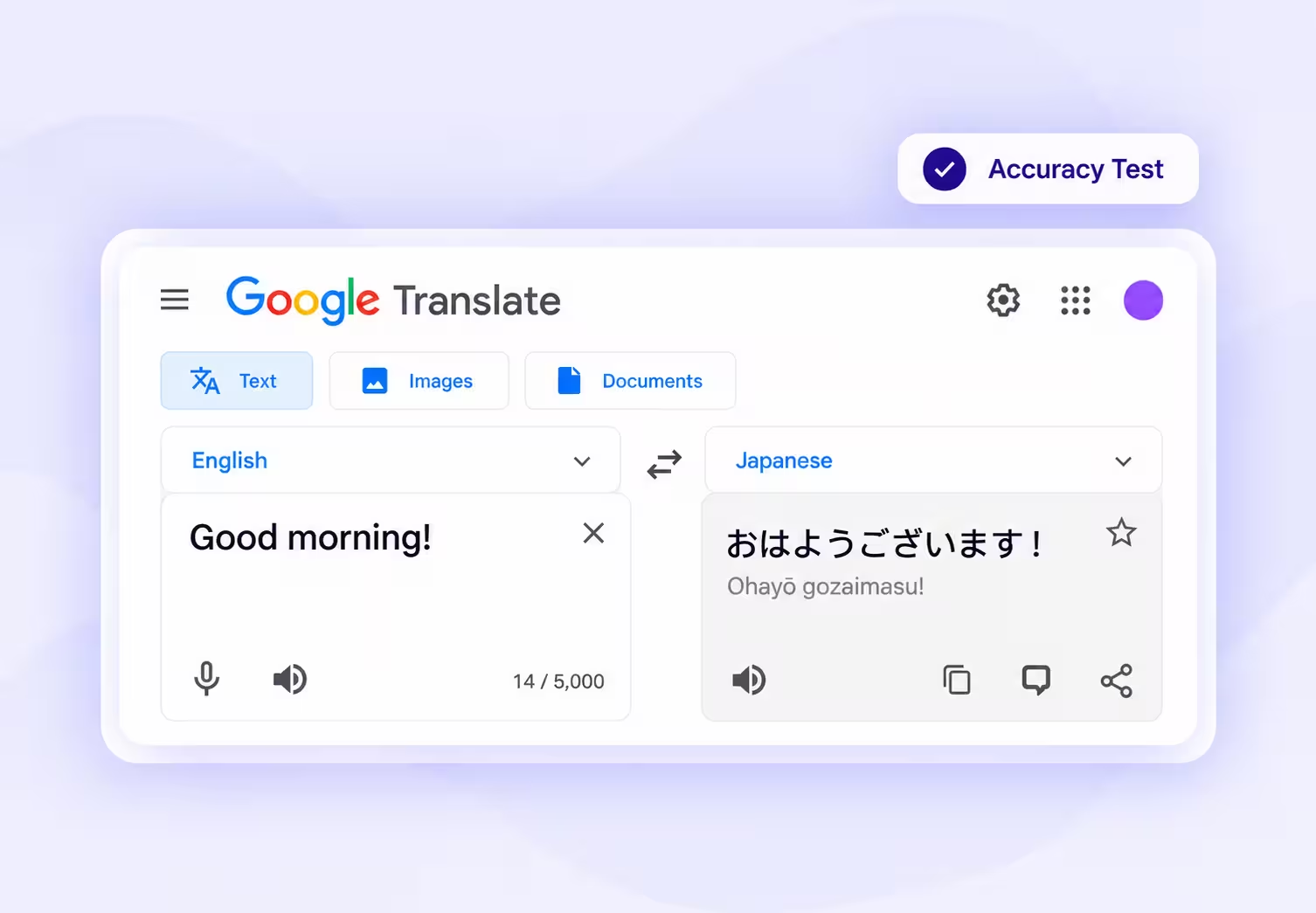
Yes, Google Translate is accurate enough for many everyday translation tasks, especially when you need to understand the general meaning of a message, sentence, or webpage quickly. The problem starts when a translation needs to preserve more than the basic idea, such as tone, context, regional expressions, names, numbers, or a specific instruction.
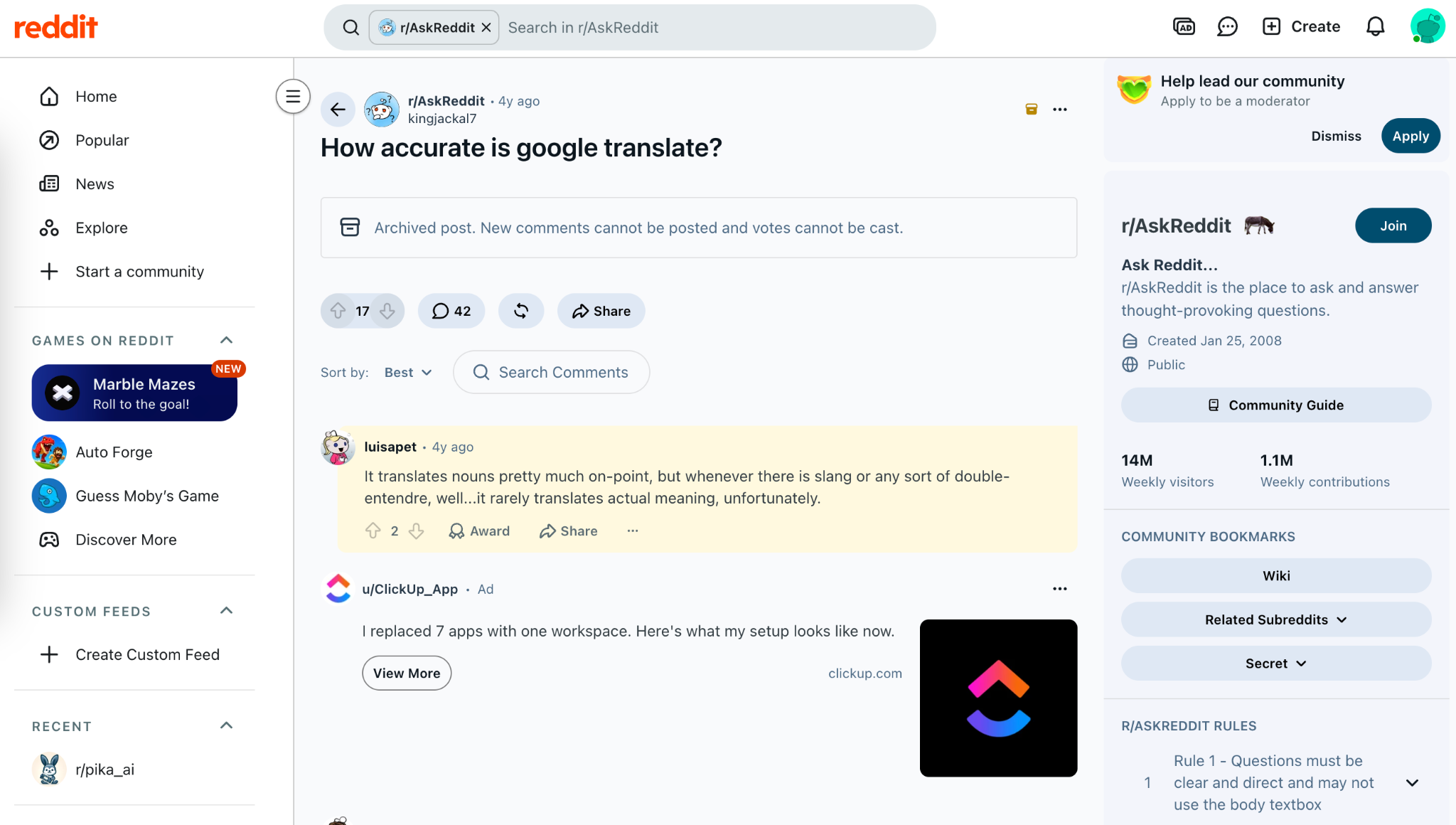
That is why the answer to whether Google Translate is accurate is much more than a simple yes or no. Real Google Translate users on Reddit have raised concerns about Google Translate’s reliability. In a Reddit discussion about whether Google Translate is reliable, one user summed up the practical limitation by saying: “It translates nouns pretty much on-point, but whenever there is slang or any sort of double-entendre, well...it rarely translates actual meaning.”
TL;DR
- Google Translate is generally accurate for straightforward translations, especially when you need the main idea of a sentence, message, or webpage.
- There is no single accuracy rate for Google Translate. Results can vary significantly depending on the language pair, context, sentence structure, and idioms.
- The biggest issues with Google Translate translations appear when meaning depends on context or nuance. Slang, regional expressions, omitted subjects, tone, and words with multiple meanings can produce translations that sound natural but do not fully match the original.
How Accurate is Google Translate
If you are wondering how accurate Google Translate is, we ran a series of Spanish-to-English translation tests to see how well it handles simple sentences, context, idioms, and more nuanced language.
Instead of relying on a single accuracy percentage, we wanted to see where Google Translate gets the meaning right, where it needs more context, and where a fluent-looking translation can still miss the original nuance.
So, let’s test Google Translate with several Spanish-to-English examples that represent the kinds of sentences people actually translate.
Spanish to English Simple Translation Example
Let’s start with the easiest Spanish to English example: a straightforward Spanish sentence where the meaning is clear, and there is very little room for interpretation.
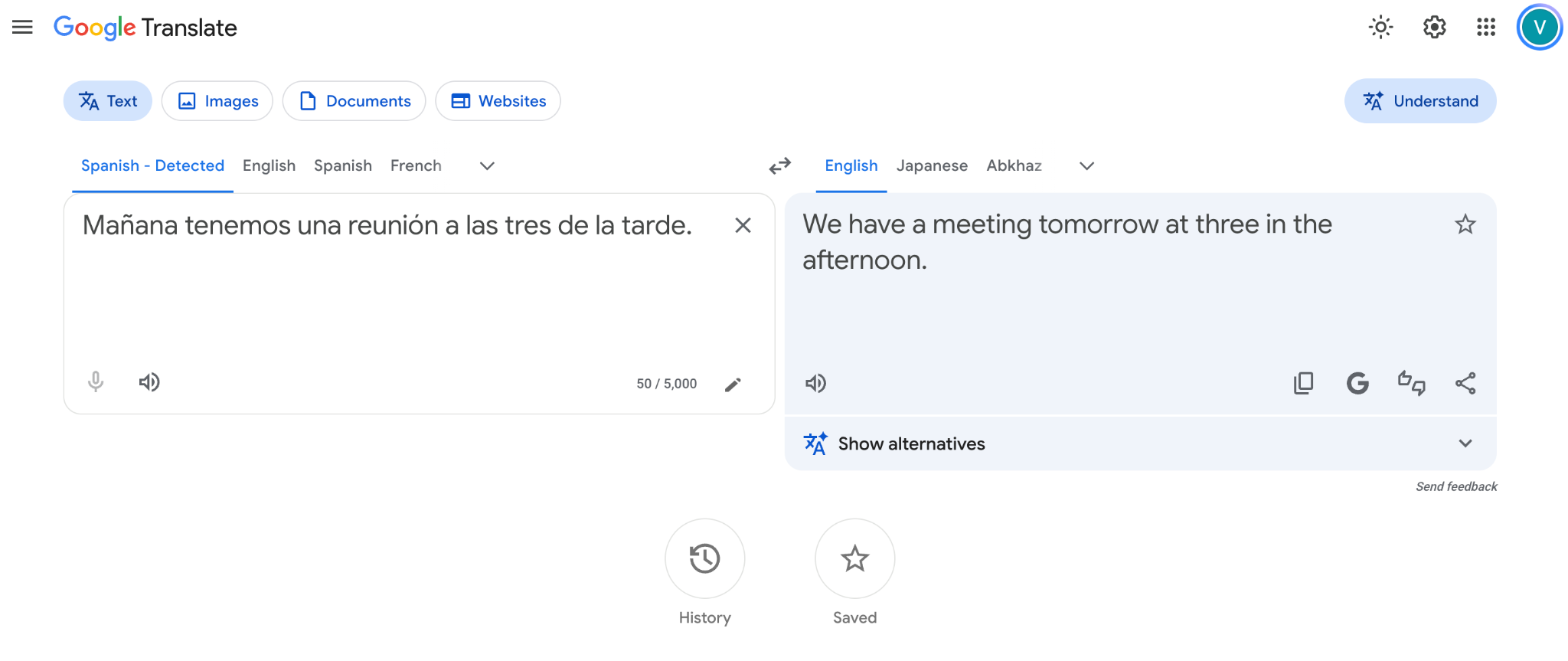
English Translation: “We have a meeting tomorrow at three in the afternoon.”
When we put this sentence into Google Translate, the translation app preserved the basic information without introducing unnecessary changes. The important details here were the day, the event, and the exact meeting time, which (as you can see in the image) are preserved during translation.
Spanish to English Ambiguous Translation Example
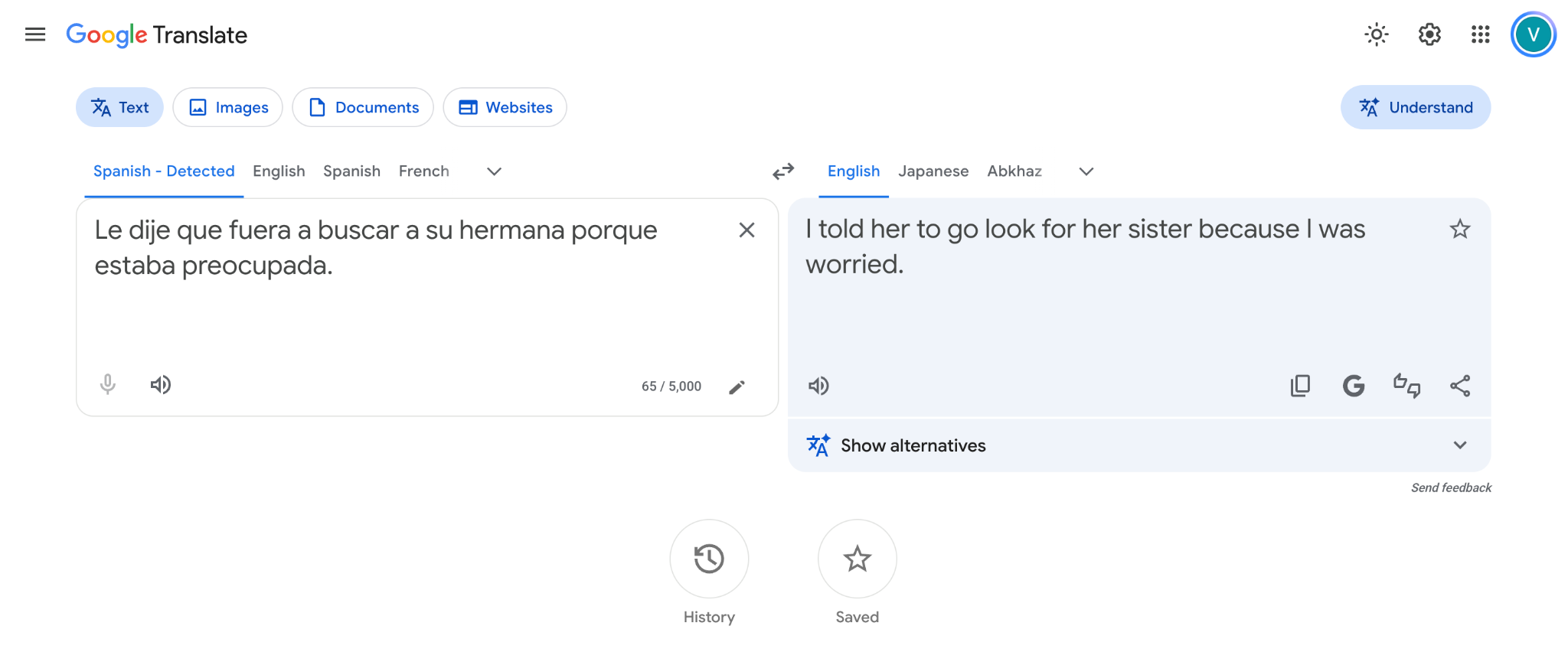
Here is another Spanish sentence where the main challenge is not vocabulary, but who a particular phrase refers to.
Google Translate: “I told her to go look for her sister because I was worried.”
Google Translate has therefore made an interpretation by rendering the phrase as “I was worried.” That may be correct in the original context, but the Spanish sentence alone does not give us enough information to confirm that interpretation with certainty.
This is a useful example of why Google Translate accuracy cannot always be judged by looking for obvious grammatical mistakes. The output can sound perfectly natural while making a contextual decision that the original sentence leaves open.
If you know who was worried, the best way to reduce this uncertainty is to make that information explicit in the original sentence rather than asking the translator to infer it.
For example, if the speaker was the person who was worried, the Spanish sentence could be rewritten as:
We then retested the revised sentence with Google Translate:
Google Translate: “I told him to go look for his sister because I was worried.”
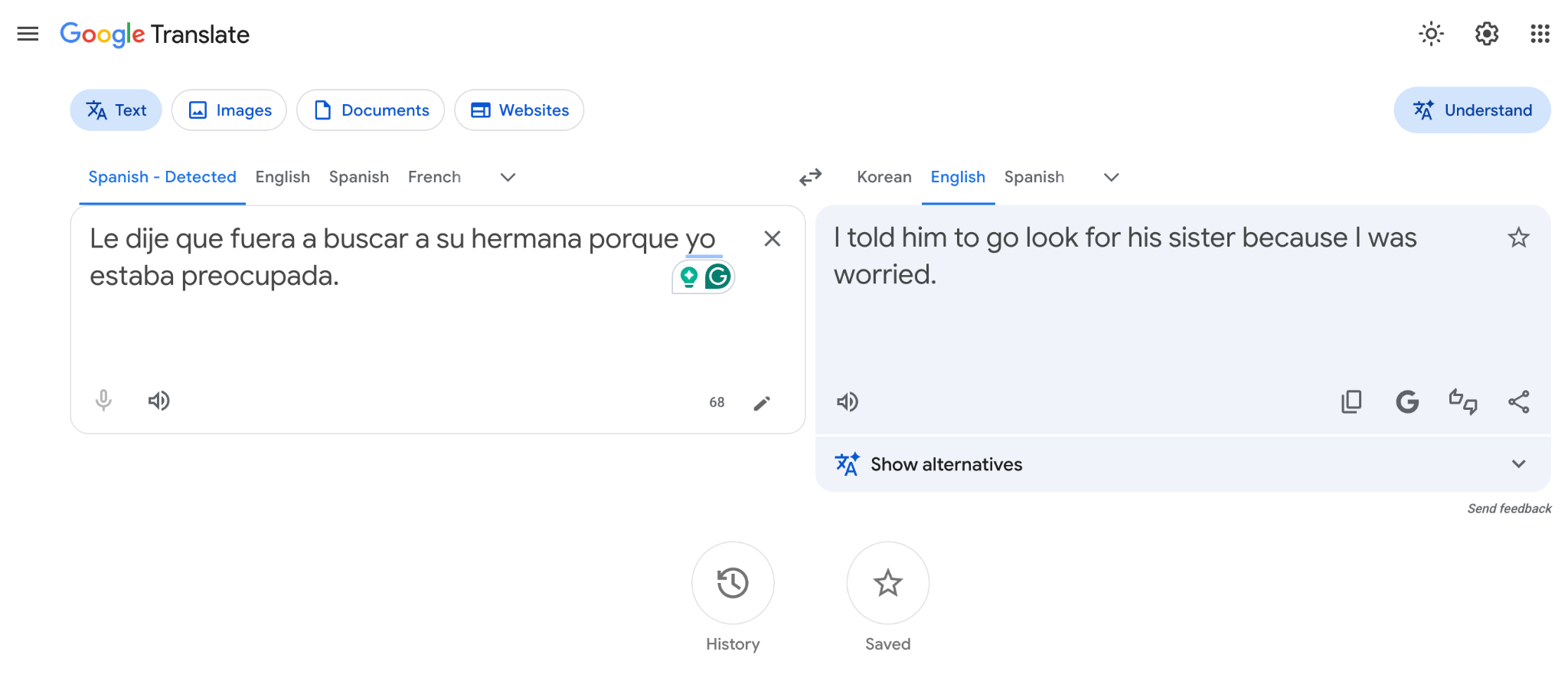
When the output seems uncertain, first check whether the original sentence contains enough information to support the interpretation. If it does not, make the intended reference explicit and retest the translation.
Spanish to English Negation Translation Example
For the third test, let's make the sentence difficult in a different way by introducing an implied contrast.
Google Translate: “It's not that I don't want to go, it's just that at this point it doesn’t make sense anymore.”
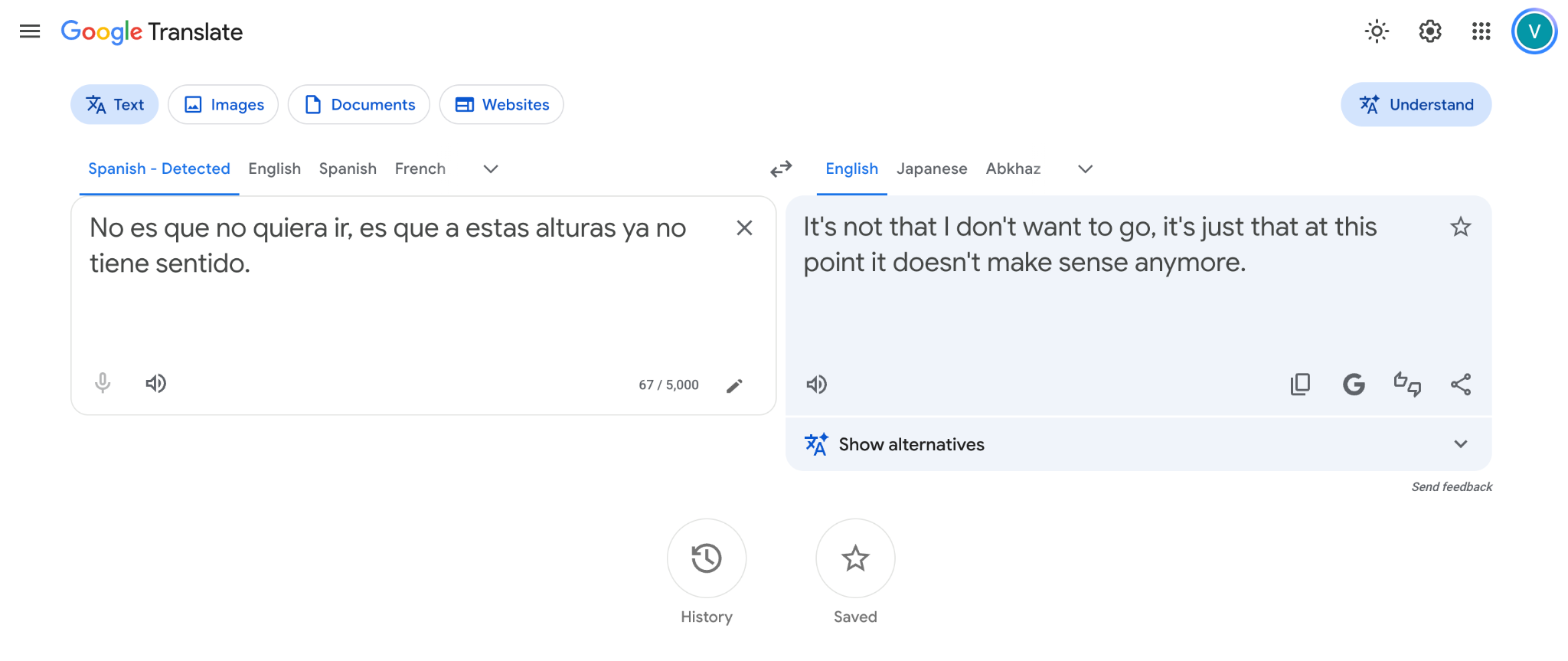
Here, Google Translate does a good job of preserving the structure of the original sentence. The speaker is not saying that they do not want to go. Instead, they are explaining that going no longer makes sense given the circumstances.
This test shows that a difficult sentence does not necessarily produce an incorrect result. In fact, this is an example where Google Translate successfully handles layered meaning, which is important when evaluating whether Google Translate is accurate beyond simple sentences.
This matters at work because negations and conditions often carry commitments, such as whether someone has agreed to a deadline or declined it. A dropped or misplaced negation could reverse that meaning, so conditions and commitments are worth checking in any translated workplace message, even when a test like this one goes well.
Arabic to English Idiom Translation Example
Let’s now translate from Arabic to English to see how Google Translate handles a culturally specific expression rather than a straightforward sentence.
Google Translate: “Don't sell water in the water carriers' quarter.”
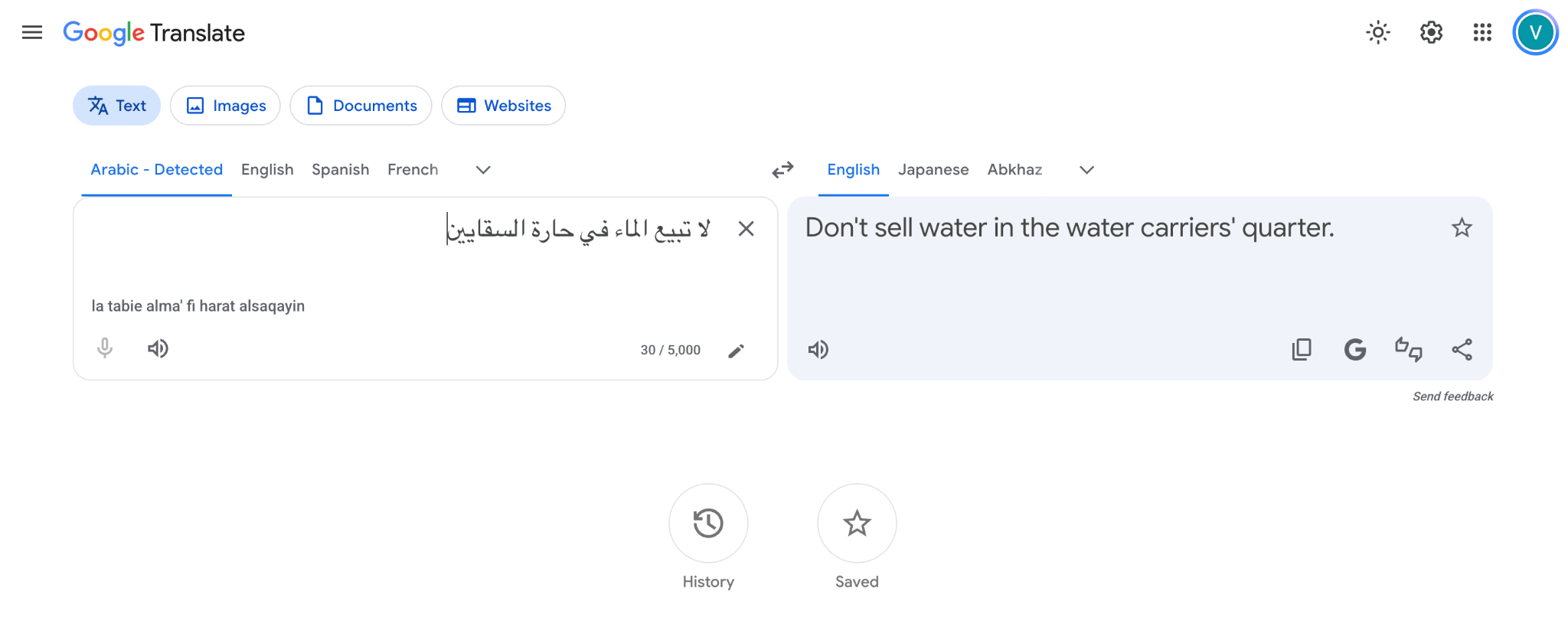
The translation is understandable at a literal level, but the important question is whether it preserves the expression’s intended meaning. The Arabic phrase is an idiomatic expression that refers to offering or selling something to people who already have plenty of it or do not need it.
By translating the words literally as “water” and “water carriers’ quarter,” Google Translate preserves the surface meaning but does not explain the cultural or figurative meaning behind the expression.
This is an example of why Google Translate accuracy is not simply about whether the English sentence is grammatically correct. The output can be a faithful word-for-word translation while still requiring additional context or explanation for someone unfamiliar with the original expression. For this task, the literal output on its own is not enough: an English reader would need a short explanation or an equivalent English expression to understand the proverb.
What Our Google Translate Test Shows
After testing these different examples, the main takeaway is that Google Translate can handle straightforward Spanish-to-English sentences more easily than sentences that depend heavily on context, idioms, or tone. That does not mean every difficult sentence will be translated incorrectly, but it does show why a single accuracy percentage cannot tell the whole story.
The main weaknesses appeared when the source sentence left important context unresolved or when the meaning depended on a culturally specific expression. In the ambiguous Spanish example, Google made a plausible but unconfirmed choice about who was worried, while the Arabic idiom was translated literally without conveying its figurative meaning.
An accuracy result also depends on what was tested and how it was judged: the language pairs, the type of text, who reviewed the output, and whether correctness meant meaning, fluency, or both. Results from different tests therefore cannot be treated as one universal accuracy rate for Google Translate.
How we tested: We evaluated these selected Google Translate examples, typed into Google Translate's text translation tool, covering straightforward translation, contextual ambiguity, negation, idioms, and cultural expressions. Each example was assessed against the original meaning and intended context, based on meaning and context rather than grammar or fluency alone. These are selected examples that illustrate strengths and limitations. They are not a statistical sample, so we do not report an aggregate accuracy rate, and because they are typed-text tests they do not show how Google Translate performs in live speech translation.
What Affects Google Translate Accuracy
Google Translate’s accuracy depends heavily on the conditions surrounding the translation. Google Translate accuracy can vary based on the language pair, the amount of context available, the presence of idioms or cultural references, and the tone or formality of the original message.
These factors matter because translation is not simply a process of replacing one word with another. A translation can contain grammatically correct English and still miss who a sentence refers to, what an expression means, or how formal the speaker intends to sound.
Language Pair
Google Translate does not necessarily perform identically across every language combination. Different language pairs have different grammatical structures, vocabulary, writing systems, available training data, and levels of ambiguity, so how accurate Google Translate is can depend partly on which two languages you are translating between.
For example, consider the English sentence:
“Thank you for your help.”
When translating this into Spanish, the translator may need to determine whether “your” should correspond to the informal tu or the formal su.
English does not make that distinction in the sentence itself, while Spanish can require it depending on the relationship between the speakers.
The original English simply does not provide enough information to determine the intended level of formality. However, it demonstrates why translation accuracy can vary between language pairs: languages do not always encode the same information in the same way.
Context
Context is one of the biggest reasons a translation can be grammatically reasonable while still being wrong for the situation.
Imagine that someone writes:
“Can you send it tomorrow?”
The word “it” could refer to a contract, photograph, invoice, presentation, or something else entirely. A human participant in an ongoing conversation may immediately know what “it” means because they remember what was discussed earlier.
A translator receiving only that sentence has much less information to work with.
The same problem appears in Spanish, where subjects are frequently omitted because the verb can provide information about who is performing the action. The ambiguous Spanish example above shows this: the source sentence left the reference open, and the translation filled it in.
Idioms, Slang, and Cultural References
Idioms are another major challenge because their intended meaning may have little relationship to the literal words being used. Slang creates an additional problem because expressions can vary by country, region, age group, community, and situation.
For example, the Spanish expression:
Google Translate renders the expression as “He’s pulling my leg,” which is itself an established English idiom rather than a literal description of someone pulling another person’s hair.
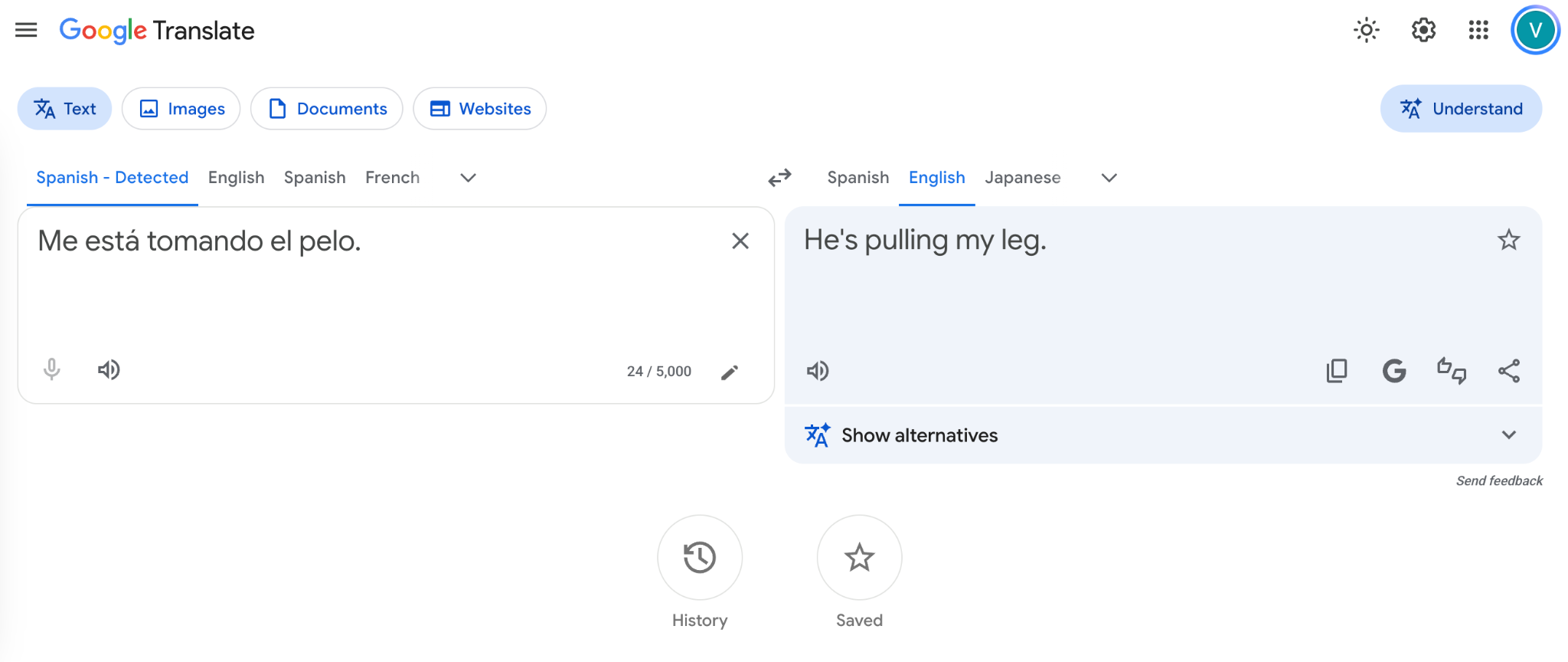
This example also shows why idiom accuracy should be judged by the intended meaning and context rather than by whether the English wording looks different from the Spanish. In this case, Google Translate successfully produces a familiar English idiomatic equivalent. The limitation is that a reader may still need context to understand exactly what the speaker intends by the expression.
Tone and Formality
A translation can communicate the correct factual information while still using the wrong social tone. This becomes particularly important when translating workplace communication, customer messages, emails, or conversations where the relationship between the speakers matters.
For example, compare these two English requests:
“Can you send me the document?”
and
“Could you please send me the document when you have a chance?”
Both requests communicate essentially the same basic action, but the second one is more polite and indirect. When translating between languages with different ways of expressing politeness, the translator has to preserve more than the basic request.
A Reddit discussion about Google Translate describes users encountering difficulty getting the translator to consistently choose between these forms, while another discussion explains that English's single “you” does not always provide enough information for a translator to determine which Spanish form is appropriate.
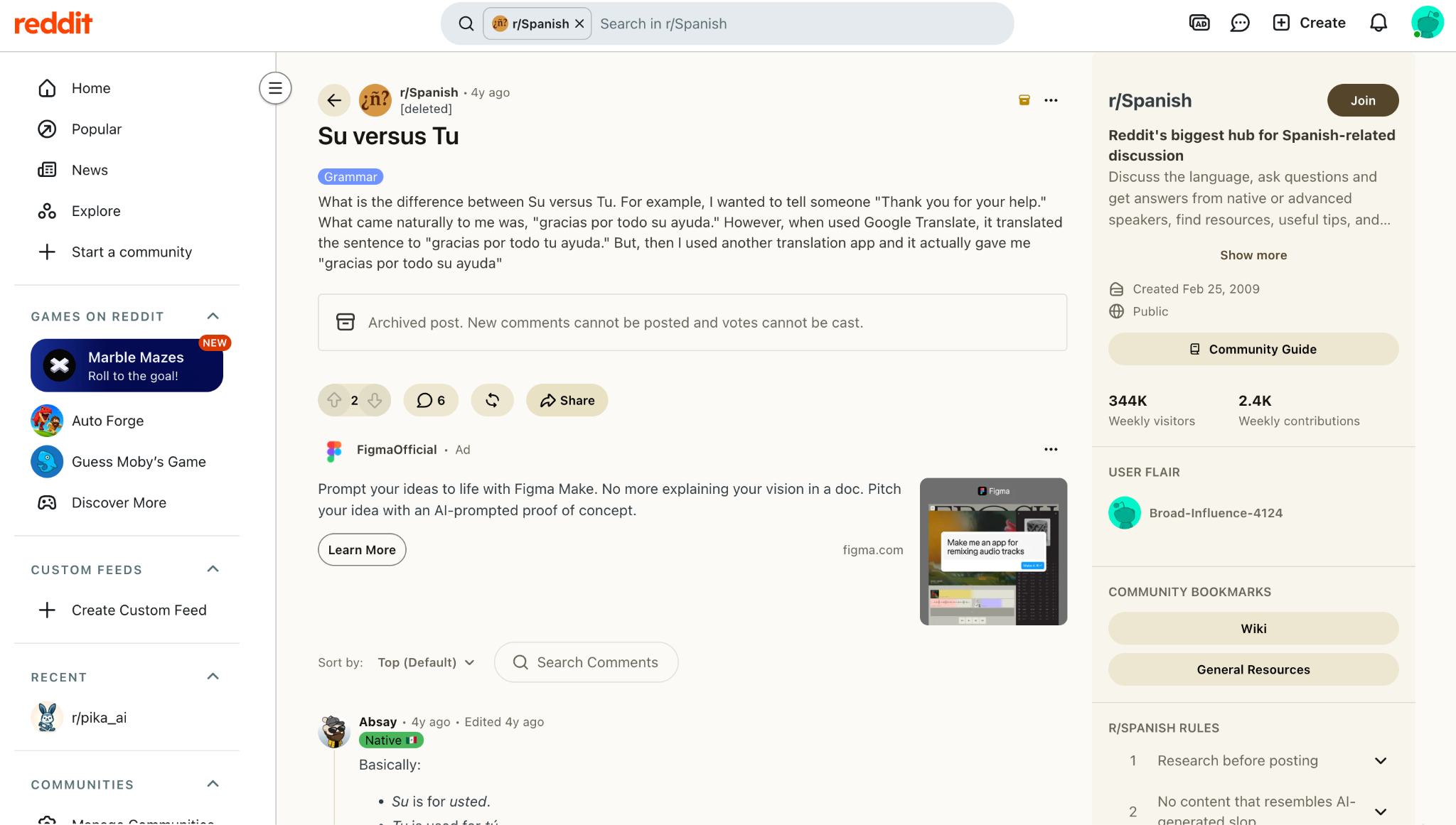
This distinction may not matter much if you are using Google Translate simply to understand a message. However, it can matter considerably if you are using it to write a message to a customer, manager, client, professor, or business partner.
Is Google Translate Accurate Enough for Work
Google Translate can be useful for workplace communication when the goal is to understand incoming information quickly. The risk increases when you are using the output as a final message without checking whether it preserves the original meaning and tone.
A Reddit discussion about Google Translate silently changing meaning gives a useful example. A user reported that Google Translate changed “Google DeepMind paper argues LLMs will never be conscious” into a Russian sentence saying that people with a Master’s degree in Law would never become conscious. In this case, “LLM” was interpreted as Master of Laws rather than Large Language Model.
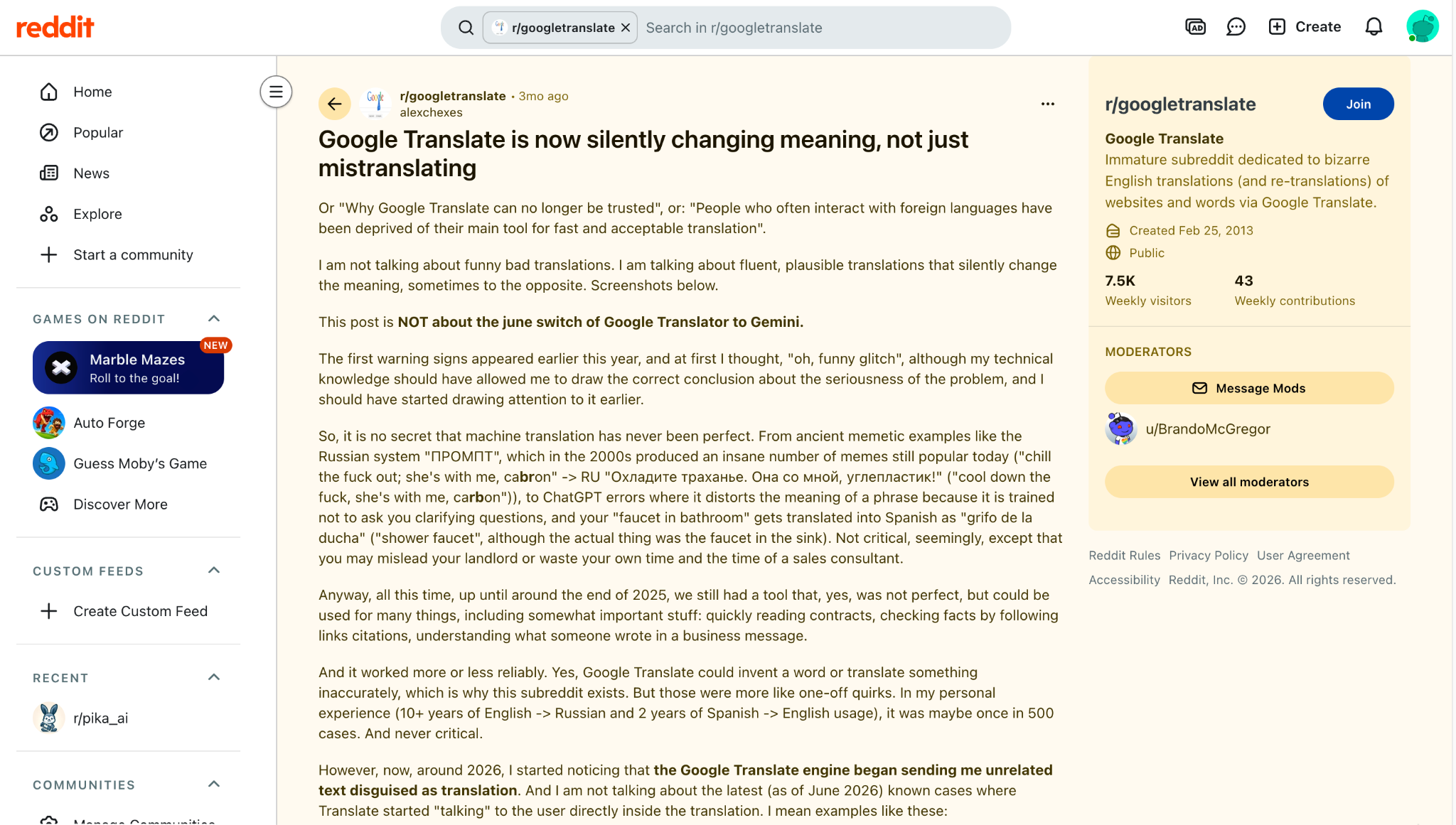
This is one user's report, so it shows the kind of error people worry about rather than how often it happens. The translated sentence does not look obviously broken. It sounds like a normal sentence, but the meaning has changed completely. If you do not understand Russian, you may have no easy way to notice the mistake, so important emails, contracts, instructions, and client communication should be reviewed before you rely on them.
When Should You Not Rely on Google Translate
Google Translate can be useful for understanding everyday content, but some situations require more careful review because a small translation error can have serious consequences.
Sensitive Information: Avoid relying on an unverified translation for private, confidential, or sensitive information where a misunderstanding could expose important details or create unnecessary risk. However, confidentiality is a different issue from translation errors. Before pasting private, confidential, or sensitive information into any translation tool, check how that tool handles your data.
Legal or Financial Documents: Contracts, agreements, invoices, tax documents, and financial instructions often contain precise language where a small change can alter the intended meaning.
Professional Communication: Emails to clients, managers, customers, or business partners should be reviewed for meaning, tone, and formality before sending.
High-Stakes Content: Medical instructions, safety information, immigration documents, or other consequential content should be checked by someone qualified in the relevant language or subject.
Customer-Facing Content: Website copy, product instructions, support messages, and marketing materials need natural, accurate language because awkward or incorrect translations can affect how customers understand your business.
Live Conversations and Meetings: Google Translate can be useful for quick live translations, but it may not be enough when conversations move quickly or depend on context, tone, and industry-specific language. A small translation error during a meeting can change the meaning of a question, instruction, or response, making it harder to follow the conversation accurately.
JotMe also offers an AI live translation feature that is designed to account for context, tone, and technical terms rather than translating each phrase in isolation.
How Can You Tell If a Google Translation is Wrong
A Google Translate result can sound fluent while still missing an important detail, so reading the English output alone is not always enough to judge Google Translate accuracy.
Check Critical Details: Start with names, amounts, units, dates, deadlines, addresses, and other identifiers that should remain exact. These details are easy to overlook but can cause practical problems if they are translated incorrectly.
Check the Intended Action: Make sure the translation clearly communicates who needs to do what, by when, and under which conditions. This is especially important for instructions, workplace messages, appointments, and other situations where a small change can affect what someone is expected to do.
Resolve Missing Context: Pay attention to pronouns, acronyms, references, and other details that may depend on the surrounding conversation. If possible, provide more context about the audience, situation, or level of formality before deciding whether the translation makes sense.
Use Alternatives and Explanations: If a translation seems unclear or could have more than one meaning, compare available AI text-to-text translator apps or use explanation features to understand how the wording was interpreted. These can help you investigate uncertainty, but agreement between different tools or a convincing explanation does not by itself prove that the translation is correct.
Ask for Bilingual Review When It Matters: For important business communication, legal or financial information, medical content, contracts, or anything else where a mistake could have serious consequences, ask a qualified bilingual speaker to review the translation.
Bonus Point:
Use Back-Translation: Translating the result back into the original language can sometimes reveal an obvious change in meaning, but a plausible back-translation does not confirm that the original translation was correct. Treat it as an additional way to spot potential problems, not as a reliable accuracy check.
If you need accurate AI translations that capture the meaning and tone, JotMe can help you. The text translation feature provides translation alongside explanations of meaning, tone, nuance, and context, making it useful when you need to understand what it means.
How Does JotMe Compare With Google Translate in Real-World Conversations
After testing Google Translate with simple sentences, ambiguous wording, idioms, and context-heavy examples, we wanted to compare how the two tools handle the same kinds of translation challenges. The comparison below looks at both the translated output and, where available, the explanation provided alongside it.
Consider the English idiom:
“Cut off your nose to spite your face.”
The expression describes hurting yourself or creating a disadvantage for yourself in an attempt to hurt or upset someone else.
JotMe also explains the translation:
“This phrase is translated literally to convey the idea of self-sabotage or harming oneself to spite someone else. In Korean culture, the concept of self-harm for the sake of revenge is understood, but the idiom may not be as commonly used. Therefore, the translation aims to maintain the original meaning while being culturally relevant.”
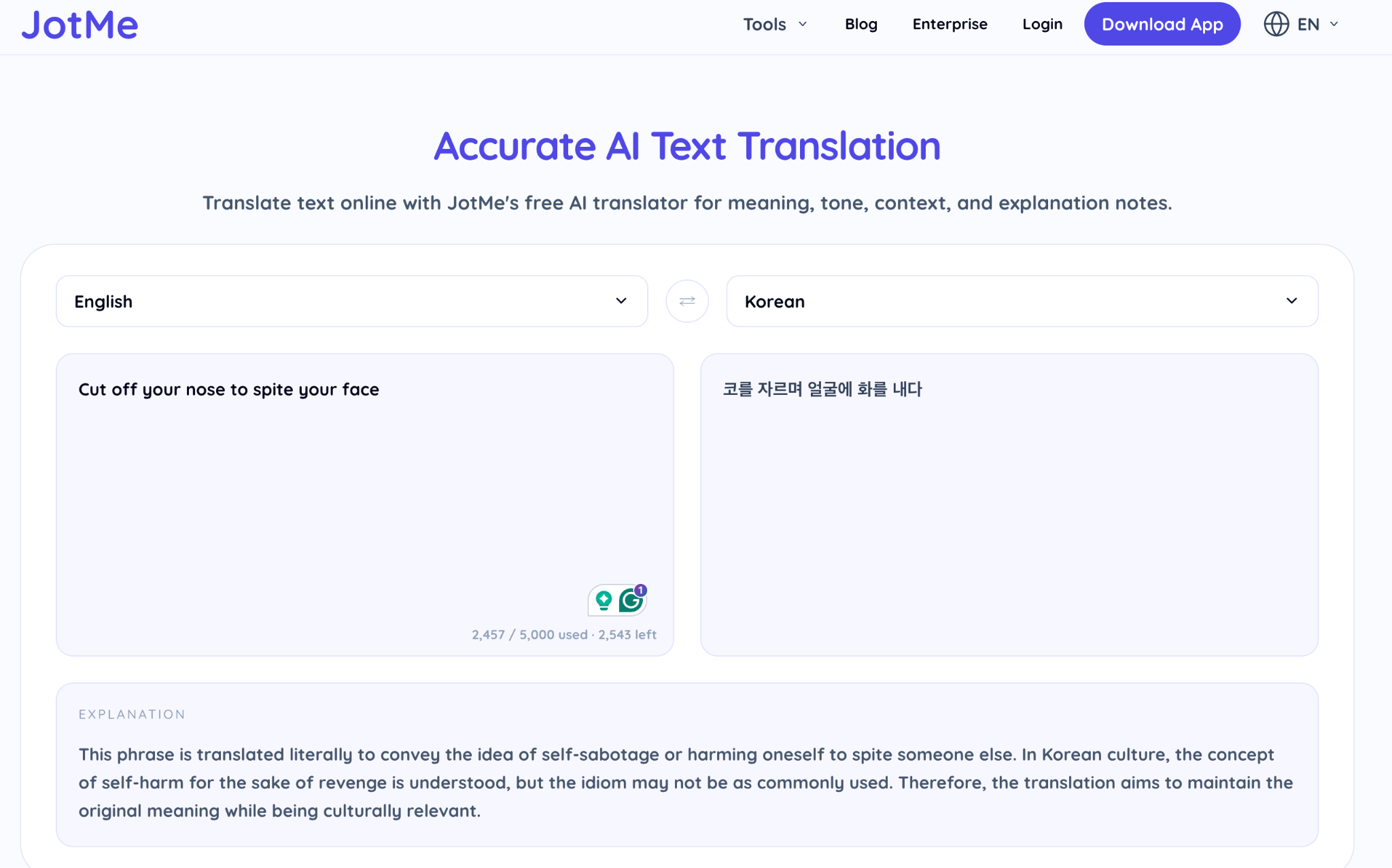
On the other hand, Google Translate translated it as:
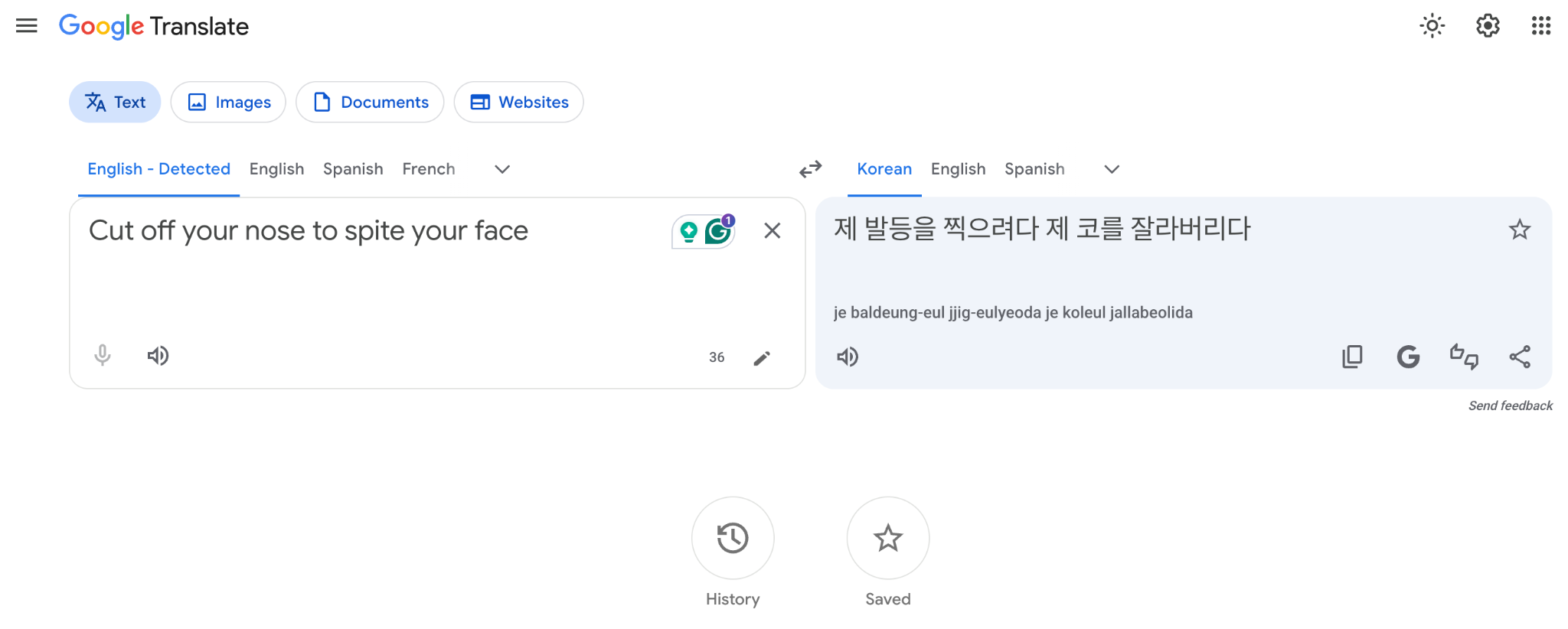
Both translations use imagery to convey the expression rather than simply replacing each English word with a Korean word. However, JotMe provides additional context about the intended meaning and explains why the translation was handled this way.
This is where the difference can be useful. When an idiom, expression, or culturally specific phrase does not have a direct equivalent, seeing the translation alone may not tell you exactly how the meaning was interpreted. JotMe's explanation gives you more information about the meaning behind the translation and the reasoning behind the wording.
For workplace messages, emails, technical terminology, and conversations where tone or context matters, this additional explanation can make the translated result easier to understand and review.
JotMe supports more than text translation. Its broader translation system includes live translation with support across 200+ languages, along with other features, such as transcription, document translation, image translation, and audio or video translation.
If you are comparing tools beyond Google Translate, our guide to Google Translate alternatives covers other options as well. But for the kind of context-heavy translation we focused on here, JotMe's combination of translation and explanation makes the result easier to understand and review.
Google Translate vs. JotMe: Which Tool Should You Use
After testing both tools across different types of translation examples, the choice largely depends on what you are trying to accomplish. Google Translate can be useful for straightforward text, while JotMe provides additional explanation notes alongside its text translations and supports ongoing translation workflows.
If you mainly need quick translations of simple text, Google Translate may be enough for many everyday situations. If you regularly translate workplace messages, multilingual conversations, or nuanced content where tone and context matter, JotMe gives you more information to evaluate the translation before you act on it. With either tool, consequential situations still call for review by a qualified speaker.
Download JotMe today and see how its text and live translation features can help you streamline communication!
FAQs About Google Translate Accuracy
Is Google Translate 100% right?
No, Google Translate may not be 100% right. Its performance varies significantly depending on the languages and text involved. For example, popular European language pairs like English to Spanish or French usually achieve higher accuracy in preserving overall meaning, whereas less common languages can have lower accuracy rates.
Is Google Translate accurate for Spanish?
Google Translate can be effective for many Spanish-to-English and English-to-Spanish tasks, especially when the source sentence is clear and contextualized. However, it may pick the wrong pronoun (like mixing up tú and usted) depending on the social context, which can lead to incorrect translations.
Is Google Translate reliable for business emails?
Yes, Google Translate can be useful for understanding business emails and creating a first draft, but important outbound communication should be reviewed for tone, commitments, numbers, dates, conditions, and negation. A message can be grammatically correct while sounding too informal, too direct, or subtly different from the intended meaning.
How can I check a translation without knowing the language?
Start by inspecting names, numbers, dates, and conditions, and add more context if something could mean more than one thing. Comparing alternative translations or back-translating can help you spot possible problems, but neither proves the translation is correct. If you do not speak the language, you cannot reliably judge every nuance yourself, so use a fluent speaker when the message matters. A tool that explains context and tone can make the result easier to evaluate, but an explanation is not independent proof.
Last updated on
September 30, 2026
Follow us on social media: