





What Language Do They Speak in Pakistan? Urdu, English, and Regional Languages Explained

Quick Answer
Pakistanis speak Urdu and English alongside dozens of regional languages, and Ethnologue counts 81 living languages in the country. Most people grow up with a regional mother tongue. The 2023 census puts Punjabi first at 36.98%, followed by Pashto (18.15%), Sindhi (14.31%), Saraiki (12.00%), and Urdu (9.25%).
Urdu is the national language and the common language between provinces, while English remains in official use for government and business. For a mixed Pakistani audience, Urdu or English works best.
Key Takeaways
- Punjabi leads: 36.98% of Pakistanis named Punjabi as their mother tongue in the 2023 census, the largest share of any language.
- Urdu ranks fifth at home: Urdu is the mother tongue of 9.25% of Pakistanis, about 22.2 million people, yet it serves as the national language.
- Six languages account for most mother-tongue responses: Punjabi, Pashto, Sindhi, Saraiki, Urdu, and Balochi together make up 94.07% of the census total with detailed language data.
- 81 living languages: Ethnologue lists 68 indigenous languages and 13 established non-indigenous languages in Pakistan.
- English keeps official use: Article 251 of the Constitution allows English for official purposes until Urdu replaces it.
- Jobs abroad push language learning: Pakistan registered 762,499 workers for overseas employment in 2025, and 530,256 of them went to Saudi Arabia.
Talk With Pakistani Teams in Urdu and English
JotMe provides accurate live caption translation without a meeting bot. Basic and Premium Quality offer 200+ translation language and regional options; supported speech inputs vary by model and include Urdu, Punjabi, Pashto, and Arabic. Start free on Mac or Windows, within your plan’s usage limits.
Download JotMe for FreeAnyone asking what language they speak in Pakistan usually expects a single answer, and the country hands back several. A supplier in Karachi can move between Urdu and English in the same sentence, while a warehouse supervisor in Peshawar grew up speaking Pashto and reads Urdu at work.
That mix matters the moment you plan a call with a Pakistani team or send them a document to sign. Choosing the wrong language leaves half the room nodding along without following, and the wrong script turns a translated document into something nobody on the other side can read.
The 2023 census is the best place to start, since it shows which languages Pakistanis grew up speaking at home.
Top Languages Spoken in Pakistan
Punjabi is the most common mother tongue in Pakistan, while Urdu is widely used between provinces. The Pakistan Bureau of Statistics 2023 census report records 241,499,431 people in the four provinces and Islamabad. Detailed mother-tongue data cover 240,458,089 people; the remaining restricted-area records contain headcounts only. Gilgit-Baltistan and Azad Jammu and Kashmir are outside this census scope. Shina and Balti speakers living inside the covered areas are still included.
Here are the languages Pakistanis named as their mother tongue, from the largest share to the smallest:
- Punjabi (36.98%): The most common mother tongue in the country, with 67.00% of Punjab's residents speaking it at home. Pakistani Punjabi uses Shahmukhi, a Perso-Arabic script.
- Pashto (18.15%): The main language of Khyber Pakhtunkhwa at 81.00%, and the second largest language in Balochistan.
- Sindhi (14.31%): 60.14% of people in Sindh speak it at home, and the province passed a law for Sindhi in 1972.
- Saraiki (12.00%): Its speakers live mostly in southern Punjab, and 20.64% of the province's residents use it as their first language.
- Urdu (9.25%): About 22.2 million Pakistanis grew up with Urdu, and Sindh holds the highest share at 22.30% of its residents.
- Balochi (3.38%): The leading language of Balochistan, where 39.91% of residents speak it at home.
- Hindko (2.32%): Most Hindko speakers live in Khyber Pakhtunkhwa, where it ranks second at 9.39%.
- Brahvi (1.16%): A Dravidian language that 17.22% of Balochistan's residents speak at home.
- English: Few Pakistanis call English their mother tongue, yet it runs through government offices, courts, universities, and corporate paperwork.
A language's share at home tells you little about its legal standing or where to use it. The table keeps mother tongue share apart from legal status and practical use, since guides about Pakistan often blur them.
| Language | Mother Tongue Share (2023 Census) | National, official or regional role | When to Use It |
|---|---|---|---|
| Urdu | 9.25% | National language under Article 251(1) of the Constitution | Default spoken language for mixed groups from different provinces; written Urdu uses the Nastaliq script, right-to-left |
| English | Absent from the census mother tongue options | Allowed for official purposes under Article 251(2) | Contracts, banking, court filings, corporate email, and senior-level meetings |
| Punjabi | 36.98% | Regional language widely spoken in Punjab | Informal talk with teams in Lahore and Faisalabad; formal work moves to Urdu or English |
| Pashto | 18.15% | Regional language widely spoken in Khyber Pakhtunkhwa and northern Balochistan | Building rapport in Khyber Pakhtunkhwa and northern Balochistan; Urdu for written work |
| Sindhi | 14.31% | Provincial language, with Sindh's 1972 law covering its teaching and use in government offices | Dealings with Sindh's provincial offices and rural Sindh; Urdu or English in Karachi's corporate offices |
| Saraiki | 12.00% | Regional language widely spoken in southern Punjab | Field teams and customers in southern Punjab |
| Balochi | 3.38% | Regional language widely spoken in Balochistan | Community and field work in Balochistan; pair it with Urdu for documents |
| Arabic | Absent from the census mother tongue options | Article 31 asks the state to encourage Arabic learning | Religious study, and jobs in Saudi Arabia and the Gulf |
How Many Languages Are Spoken in Pakistan?
Pakistan has 81 living languages in Ethnologue’s current Pakistan profile: 68 indigenous languages and 13 established non-indigenous languages. Counts depend on the edition and classification used. Most indigenous languages belong to the Indo-European family. Brahvi is Dravidian, while Burushaski in Gilgit-Baltistan is a language isolate with no established genealogical relationship to another language family.
The government census takes a narrower view. Its 2023 form offered 14 named mother tongues and an "other" box, and a handful of languages account for almost everyone:
- 81 living languages: Ethnologue’s current count includes 68 indigenous and 13 established non-indigenous languages.
- 14 named census options: Urdu, Punjabi, Sindhi, Pashto, Balochi, Kashmiri, Saraiki, Hindko, Brahvi, Shina, Balti, Mewati, Kalasha, and Kohistani.
- 94.07% across six languages: Punjabi, Pashto, Sindhi, Saraiki, Urdu, and Balochi account for most mother-tongue responses in the census.
- 9.25% Urdu speakers by birth: The national language reaches far beyond the 22.2 million people who grew up with it.
What Are the Provincial Languages of Pakistan?
Each province has a dominant home language, and Article 251(3) of the Constitution allows a provincial assembly to legislate for teaching, promoting, and using a provincial language alongside Urdu. Sindh’s 1972 law makes Sindhi and Urdu compulsory subjects in classes IV–XII and allows arrangements for the progressive use of Sindhi in government offices.
The provincial figures below are from the Pakistan Bureau of Statistics 2023 Key Findings Report, Table 2.16.
| Province or Territory | Most Common Mother Tongue | Next Largest | Urdu as Mother Tongue |
|---|---|---|---|
| Punjab | Punjabi, 67.00% | Saraiki, 20.64% | 7.18% |
| Sindh | Sindhi, 60.14% | Urdu, 22.30% | 22.30% |
| Khyber Pakhtunkhwa | Pashto, 81.00% | Hindko, 9.39% | 0.64% |
| Balochistan | Balochi, 39.91% | Pashto, 34.03% | 0.53% |
| Islamabad Capital Territory | Punjabi, 50.57% | Pashto, 18.21% | 15.72% |
Balochistan stands out as the most evenly split province, with Brahvi in third place at 17.22%. Islamabad draws people from every province, and its Urdu share runs more than double the Punjab average.
Gilgit-Baltistan and Azad Jammu and Kashmir run their own administrations and fell outside the 2023 count. Speakers of Shina, Balti, Burushaski, and Wakhi live mainly in Gilgit-Baltistan, and Pahari-Pothwari is the main language of Azad Jammu and Kashmir.
What Are the National and Official Languages of Pakistan?
Urdu is the national language of Pakistan, and English is the language the state still uses for most official work. Article 251 of the Constitution names Urdu as the national language and asked the state to arrange its official use within 15 years of 1973. The same article allows English for official purposes until Urdu replaces it.
Pakistan has yet to complete that switch. In September 2015, the Supreme Court of Pakistan ordered federal and provincial governments to adopt Urdu as the official language and to translate laws into it. Federal laws and corporate contracts still run largely in English, so the official language of Pakistan in daily practice is a working pair of Urdu and English.
Arabic holds no national or official status. Article 31 of the Constitution asks the state to encourage and facilitate the learning of Arabic for the country's Muslims, which keeps it in religious education.
Why More Pakistanis Are Speaking English and Foreign Languages?
Jobs abroad and work for foreign clients can make English and Arabic useful in daily work. The Pakistan Economic Survey 2025–26, citing the Bureau of Emigration and Overseas Employment, reports 762,499 workers registered for overseas employment in 2025. Saudi Arabia accounted for 530,256 registrations, followed by Qatar (68,376) and the UAE (52,664). Interviews, contracts, and workplace instructions may require a language other than a worker’s mother tongue.
Here is where that shift shows up in daily life:
- Job interviews: Recruiters in the Gulf and the UK interview Pakistani candidates over video calls in English, often before any visa paperwork begins.
- Visa and immigration documents: For documents such as Nikah Namas or degree certificates, check the receiving US or UK authority’s rules. A full translation and the translator’s certification may be required; AI output alone is not a substitute for those requirements.
- Work in Saudi Arabia and the Gulf: Workers pick up Arabic for daily instructions on site and English for contracts and supervisors from other countries.
- Learning English for careers: Students and job seekers practice English to qualify for universities abroad and for better-paying roles at home.
- Freelancing and remote work: Developers and designers working for overseas clients take briefs and calls in English.
- Travel and family calls: Families with relatives abroad switch between Urdu and English on calls, and travelers rely on English at airports and hotels.
Translate Urdu Calls and Documents in a Single App
JotMe captures your computer's audio, so no bot joins your Zoom, Google Meet, Microsoft Teams, or Webex call, and it translates Urdu speech into English as people talk. The same app translates PDFs and Word files into Urdu while preserving layout where the format allows.
Download JotMe for FreeHow to Understand Pakistani Language?
To follow a Pakistani conversation in a language you do not speak, live translation can help you read the meaning as people talk. JotMe supports Urdu, Punjabi, and Pashto speech through the appropriate Basic or Premium Quality language selection. Its Basic and Premium Quality caption translation offers 200+ language and regional output options.
Context matters more in Urdu than most first-time listeners expect. A polite request often arrives wrapped in the respectful aap and indirect phrasing, and JotMe reads each sentence against the rest of the conversation, so the intent comes through along with the words. Our live translation for meetings captures your computer's audio, which means the Pakistani side of the call never sees a bot join.
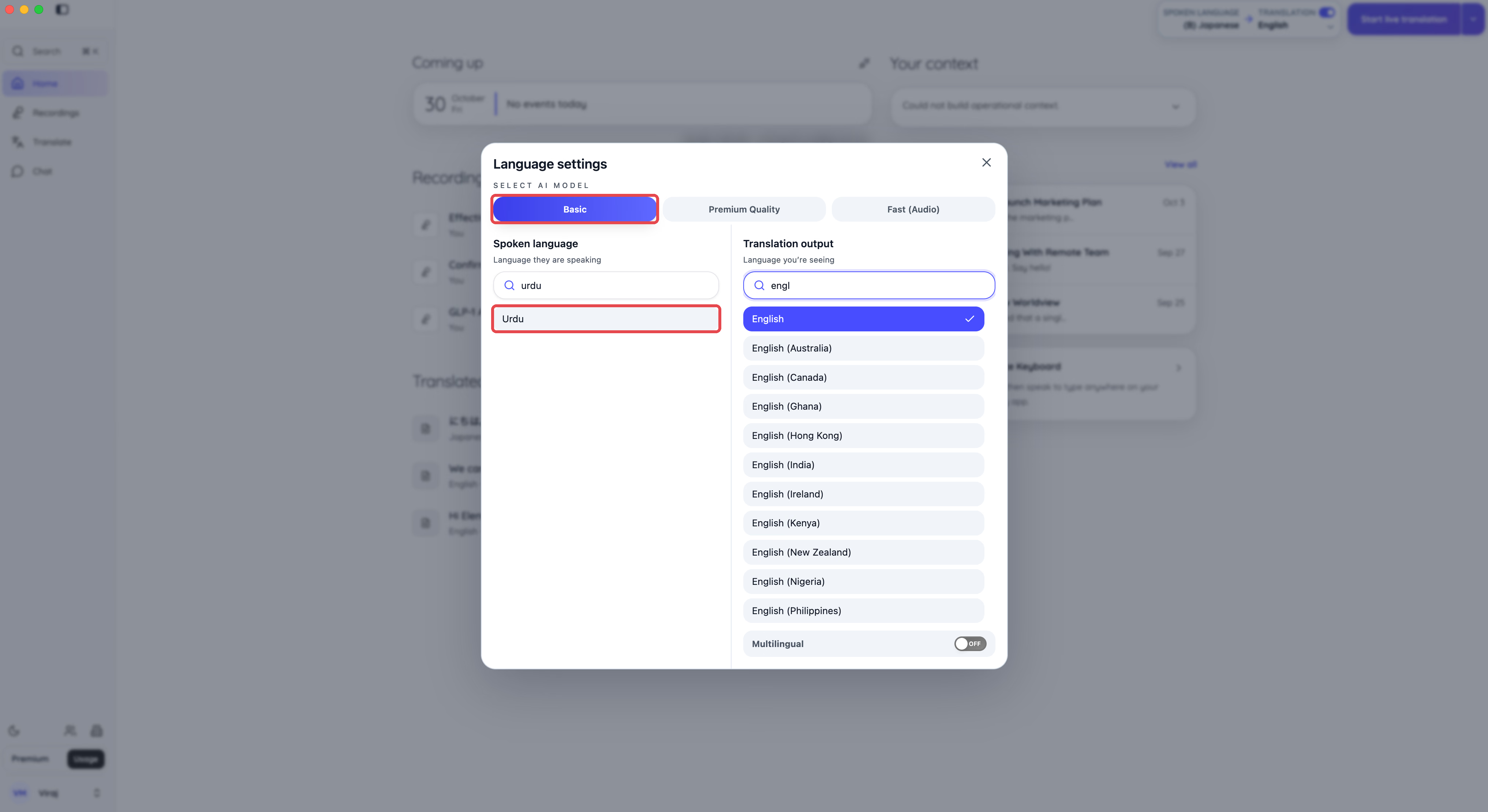
The desktop app gives you a choice of AI model. Basic suits everyday captions. Premium Quality provides higher-quality captions and translation for supported speech languages and uses twice as many translation minutes as Basic. For contracts or interviews, review important wording rather than treating any model as an accuracy guarantee.
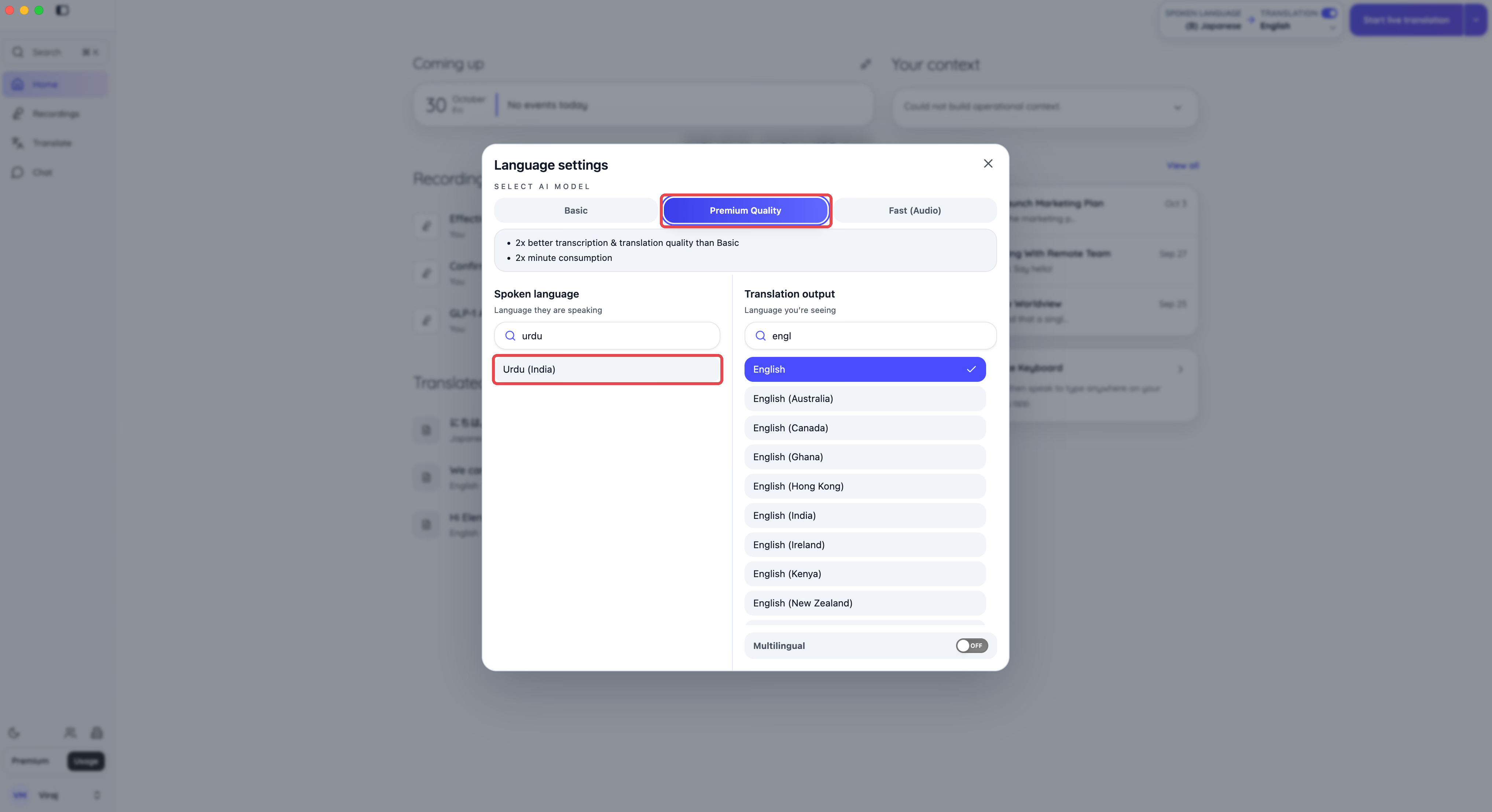
Our language lists include Urdu, Punjabi, Pashto, and Arabic among supported spoken inputs. Premium Quality uses regional entries such as Urdu (India), Punjabi (India), and Pashto (Afghanistan), so choose the option that fits your session. Sindhi, Saraiki, and Balochi do not appear in the inspected Basic or Premium Quality input lists. Urdu can be a bridge language when the speakers are comfortable using it.
You can try JotMe before installing anything. The free English-to-Urdu live translator runs in the browser without signup and displays translated text; the Urdu-to-English live translator handles the reverse direction. These pages translate microphone speech into captions, not spoken Urdu audio, and the displayed free allowance applies. For face-to-face conversations, such as a factory visit in Sialkot, the JotMe mobile app supports live speech translation on iPhone and Android. Our setup guides explain the desktop workflow.
Language Considerations for Business in Pakistan
What language is spoken in Pakistan depends on the setting: Pakistanis use a regional mother tongue at home and Urdu or English at work. Urdu connects the provinces, and English carries contracts and court work. For an English-speaking manager working with suppliers in Sialkot or a back office in Karachi, English covers most written work, while Urdu builds trust on calls with floor staff.
Which Language and Script Should You Use for a Meeting or Document?
Run through this checklist before you book the call or send the file:
- Mixed group from several provinces: Speak Urdu, or English when senior managers lead the meeting.
- Senior managers and legal teams: Use English for contracts and meeting minutes.
- Field or factory staff: Use Urdu, and add the local language when you know the team's region, such as Punjabi in Punjab or Pashto in Khyber Pakhtunkhwa.
- Government filings: Prepare English and Urdu versions, since the 2015 Supreme Court order pushed federal offices toward Urdu.
- Written Urdu: Use the Nastaliq script with a right-to-left layout, and check that numbers and names stay intact after translation.
- Informal chat and WhatsApp: Expect Roman Urdu, which is Urdu typed in English letters, and reply in plain English or Roman Urdu.
- Punjabi documents for Pakistani readers: Use Shahmukhi, the Perso-Arabic script, and avoid Gurmukhi, which Indian Punjabi uses.
- Visa and court documents: Use AI translation for drafts and checks, then follow the receiving authority’s requirements for a complete translation, translator certification, and any required credentials.
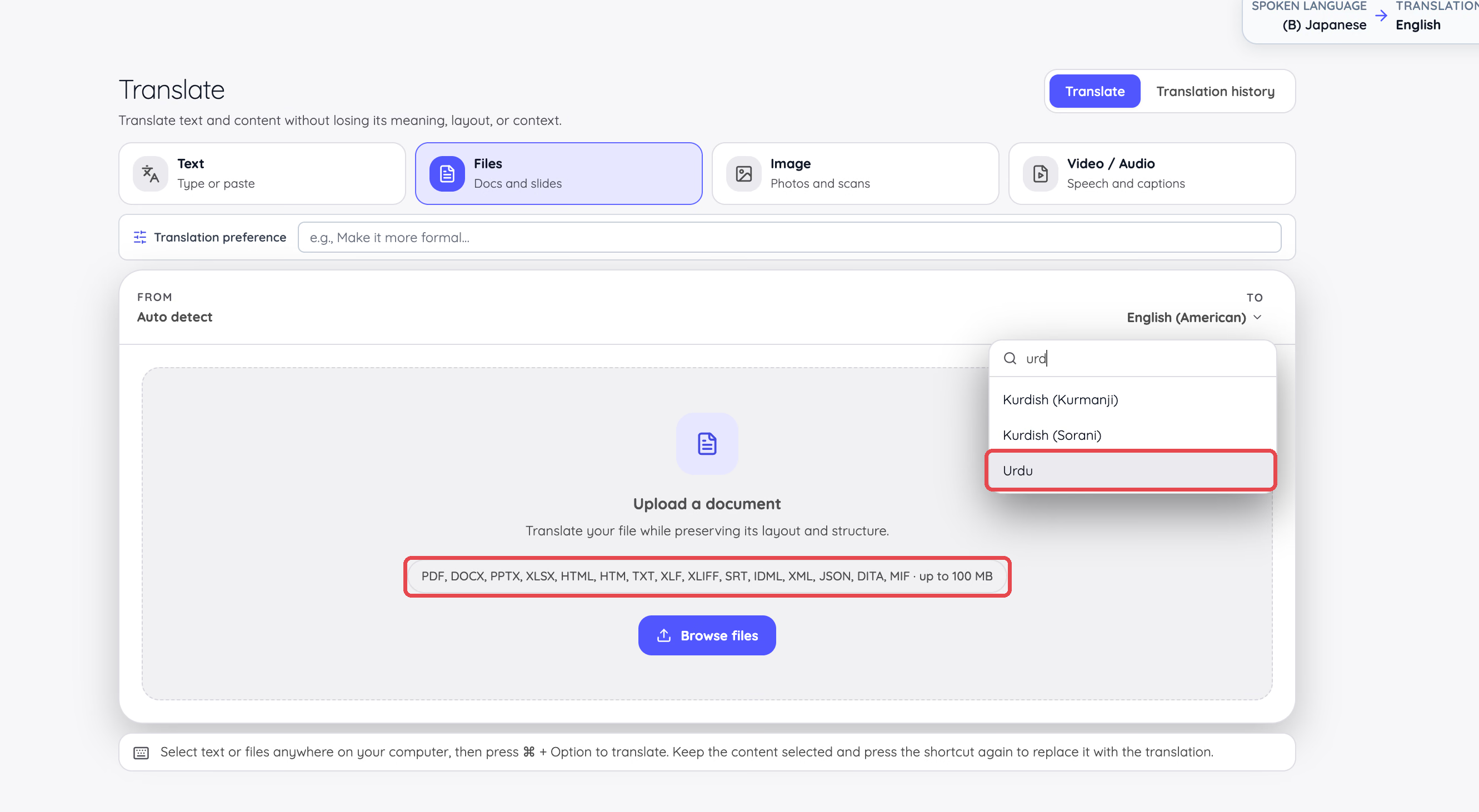
Short written messages need the same care. In JotMe's Translate tab, you can paste Urdu text and add a translation preference, such as a more formal tone, before you send the English reply to a supplier. Our free Urdu text translator does the same in a browser for quick checks.
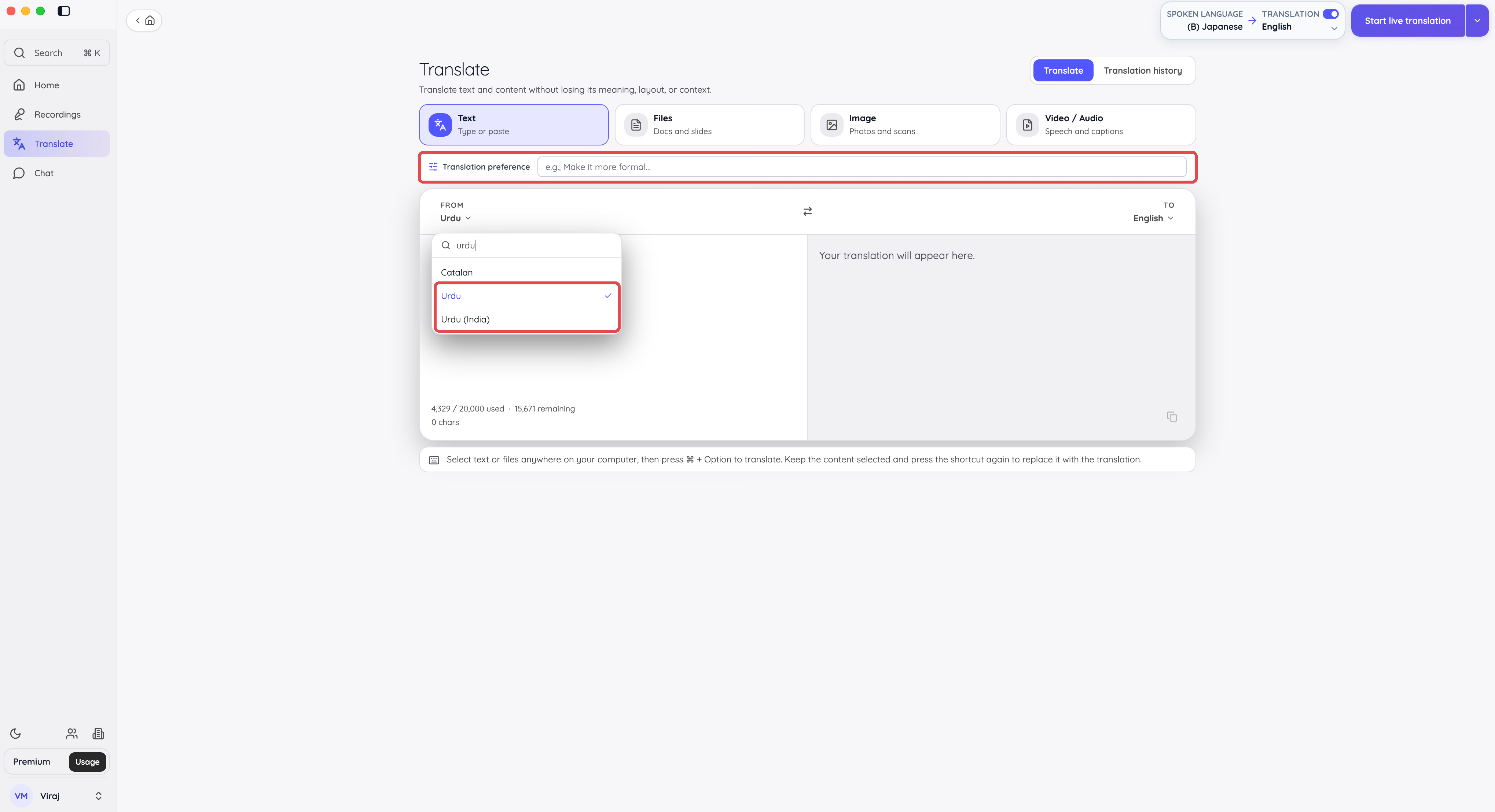
Longer documents go through the Files option, which preserves the layout of PDFs and Word files where the format allows while translating them into Urdu or out of it. That saves a round of reformatting when a contract or price list needs an Urdu version for the factory floor.
Pakistan rewards anyone who matches the language to the room and the script to the reader. JotMe handles both halves in a single app: live Urdu, Punjabi, and Pashto translation during the call, and Urdu document translation for the follow-up.
Run Your Next Pakistan Meeting With JotMe
Read Urdu and Pashto speech in your own language during the call, then translate the follow-up documents into Urdu while preserving layout where the format allows. Start free on Mac or Windows.
Download JotMe for FreeOn November 12, 2026, G2’s JotMe review page showed 4.4 out of 5 across 40 reviews. Reviewers highlighted multilingual meetings, ease of use, transcription accuracy and AI summaries. Other reviewers reported transcription errors and concerns about cost.
FAQs
What Are the Top Three Languages Spoken in Pakistan?
Punjabi, Pashto, and Sindhi are the top three mother tongues in Pakistan. The 2023 census found that 36.98% of Pakistanis speak Punjabi at home, 18.15% speak Pashto, and 14.31% speak Sindhi. Urdu ranks fifth as a mother tongue, yet it works as the main shared language between these groups.
How Many Languages Are Spoken in Pakistan?
Ethnologue’s current Pakistan profile lists 81 living languages: 68 indigenous and 13 established non-indigenous languages. The 2023 census instead offers 14 named mother-tongue categories plus an “other” category. These are different classifications, so the census categories are not a complete inventory of the country’s languages.
Do They Speak Arabic in Pakistan?
Arabic does not appear among the 14 mother tongue options on Pakistan's 2023 census, and many Pakistanis learn it mainly to read the Quran. Article 31 of the Constitution asks the state to encourage Arabic learning, and in 2021 the Senate approved a bill to make Arabic compulsory in Islamabad schools. Work gives it a practical side too, with 530,256 Pakistanis registered for jobs in Saudi Arabia in 2025.
How to Translate Urdu to English for Free?
Use JotMe’s browser features without signup. Paste text into the English–Urdu text translator and switch the direction to Urdu-to-English, or speak into the Urdu-to-English live translator to read translated captions. Each feature shows its free allowance on screen. Spoken Urdu audio output is not offered by the separate 13-language voice-output mode.
How to Translate Arabic to English Documents?
Open the Translate tab in the JotMe desktop app, choose Files, set the target language to English, and upload the document. The file workflow detects the source language. JotMe preserves layout and structure where the format allows, but review translated tables, headings, names, and numbers. For a short passage, our Arabic-to-English text translator works in the browser. For visa or court use, follow the receiving authority’s translation and certification requirements.
Can JotMe Support Document Translations?
Yes. JotMe translates PDF, DOCX, PPTX, XLSX, HTML, HTM, TXT, XLF, XLIFF, SRT, IDML, XML, JSON, DITA, and MIF files up to 100 MB, and Urdu appears among the target languages. You can add a translation preference, such as a more formal tone, before you upload, and JotMe preserves the file’s layout and structure where the format allows.
Try JotMe
Accurate translation for your meetings, events, and everyday work, with AI Memory that remembers your context.