
The problems of multilingual communication are fascinating to me.
AI already understands many of the linguistic rules remarkably well. But understanding the words is only part of understanding another person. The context behind those words matters just as much.
That is the problem I’m interested in solving: how do we transfer context from one person to another across languages?
Our new website is live, and it makes our direction clear. At JotMe, we’re building a platform for the future of global work.
The ambition behind JotMe is straightforward. We want people to be able to work together across languages, with the context they need to understand one another and get things done.
That means looking beyond the translation of an individual sentence. It means thinking about the whole journey of work: a conversation, a decision, a document, a meeting, a follow-up, and the people responsible for what happens next.
Why better translation alone hasn’t changed how everyone works
We have had translation technology for decades. It has become dramatically more capable. Yet for many teams, working across languages still means finding someone who speaks the language, asking a colleague to interpret, or limiting the conversation to whoever can participate comfortably.
A meeting can have translated captions and still leave people with different understandings of the work.
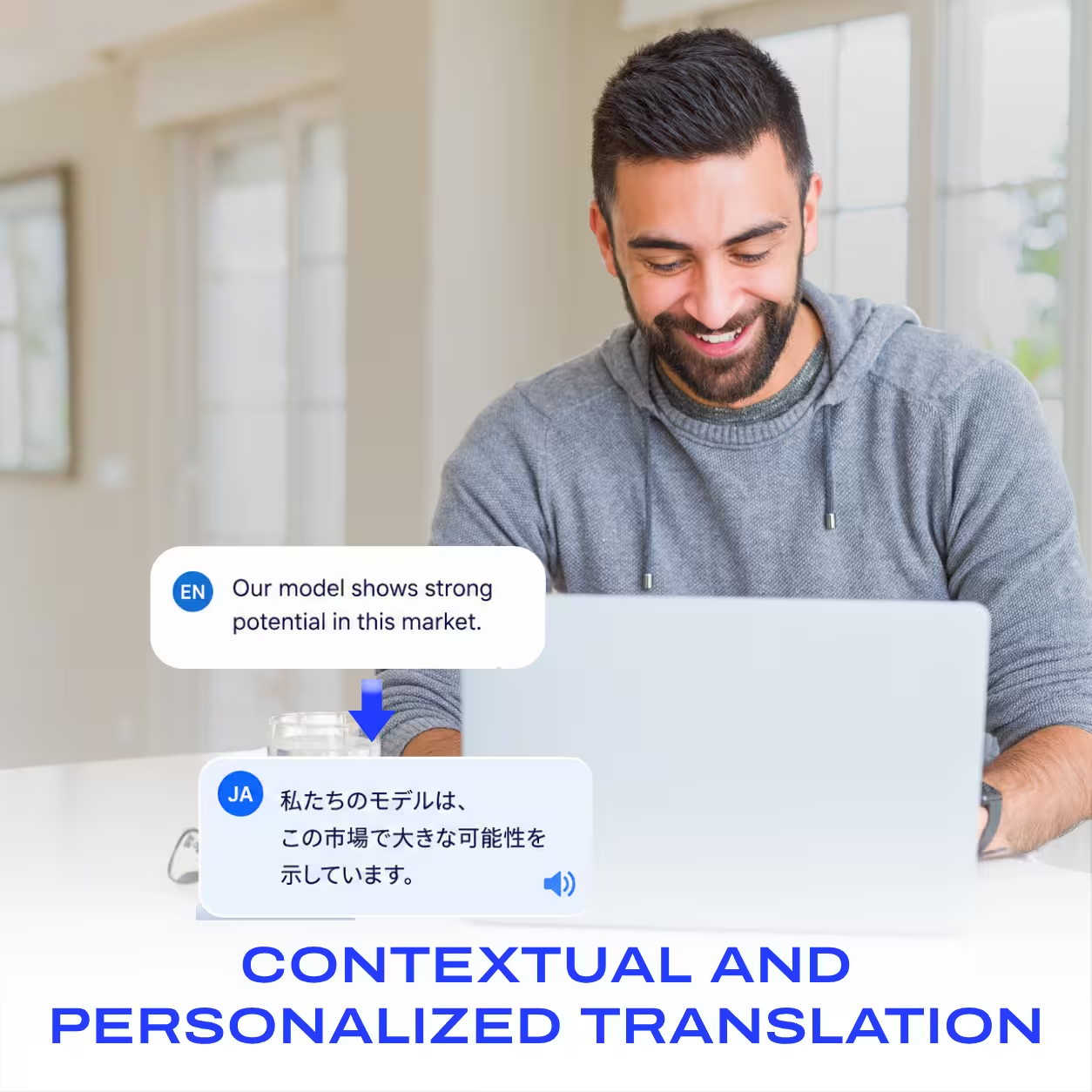
Consider a simple sentence: “Let’s move Atlas to Friday.” A translation can preserve every word and still leave important questions unanswered. What is Atlas? Which deadline are we changing? What did we agree earlier? Who needs to know?
Those answers come from context. And context is what people need to carry from one interaction to the next.
Context makes language useful for work
I see multilingual communication as a problem of transferring context on top of the linguistic rules AI already understands well today. That progress gives us the opportunity to help people understand what a conversation means in the work they are doing.
A product name should remain recognizable. An industry term should retain its meaning. A decision made in a meeting should still make sense when someone reads the notes or joins a follow-up conversation.
This is where accurate translation becomes part of a larger system of shared understanding.
We want to make it easier to pass context from one person to another, even when they work in different languages.
AI Memory is at the heart of that platform
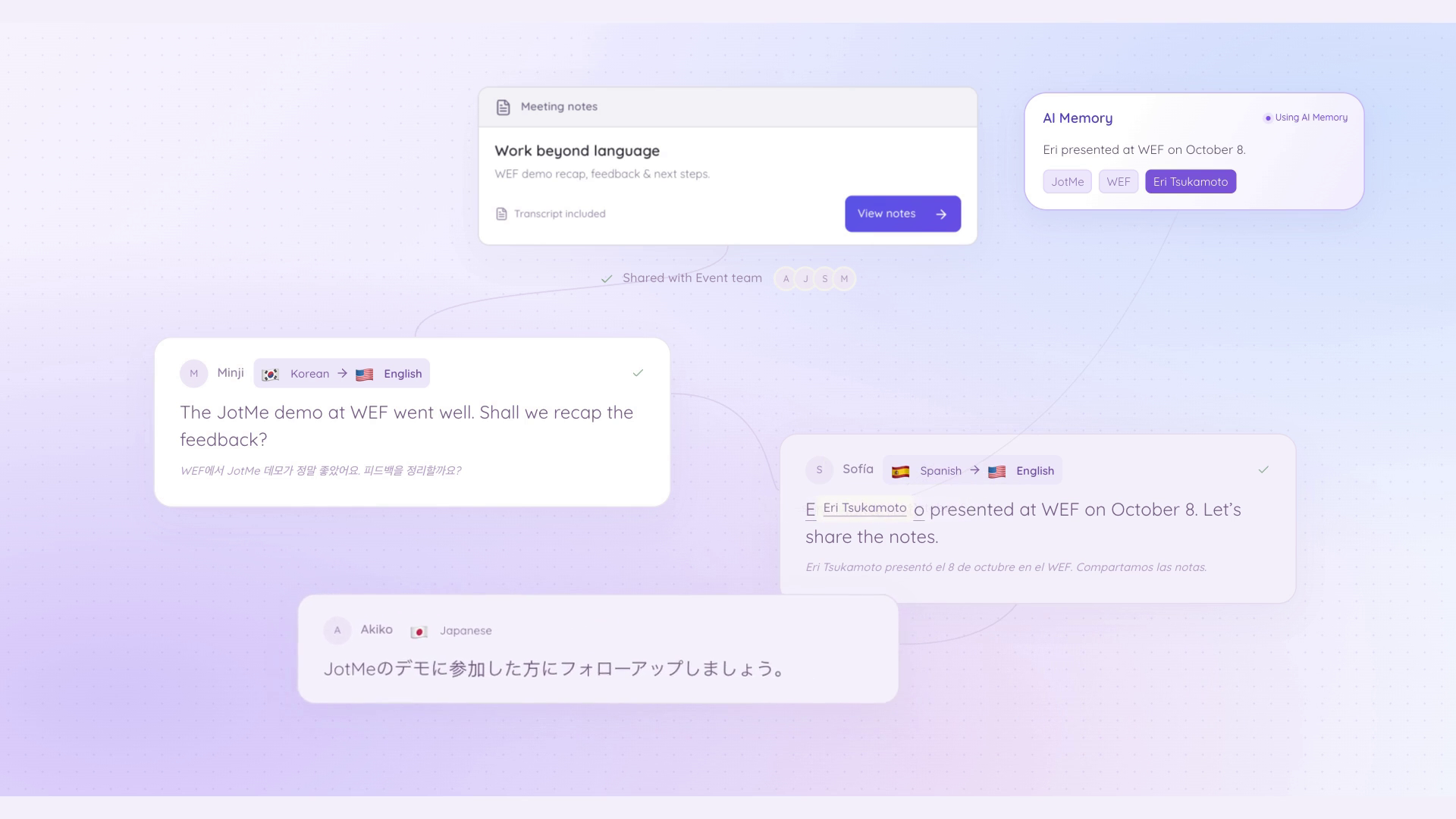
JotMe AI Memory brings together relevant context from your work across the platform to help shape more accurate, useful translation. Our new website shows that through three connected layers: your terminology, the current conversation, and your past work.
The names and terms you use matter. So does what was said earlier. So does the work that brought you into the conversation in the first place.
You can see a concrete example in JotMe’s multilingual chat: conversation memory helps translation stay grounded in what a thread is about, and people can edit that memory. Custom vocabulary gives important names and terms additional context across supported features.
Our broader direction is to make that understanding useful throughout the workday, from an individual’s ongoing work to the coordination required by teams and enterprises.
The work continues after the meeting
Imagine a team preparing a presentation across Japanese, English and Korean. The conversation establishes the project, the people involved and what needs to happen.
Then the presentation becomes an event. Attendees follow in their own languages. Afterwards, the team reviews the transcript and notes, shares the outcome, and continues the discussion.
The project should remain recognizable throughout that journey. People should be able to follow what happened, understand the decisions, and contribute to the next step.
That is why JotMe brings live translation, multilingual messaging, meeting notes, file translation and voice typing into one platform. Each supports a different part of the work. The value grows as the experience becomes more connected.
Language coverage varies by feature and mode; our language guide explains the current options.
What becomes possible when everyone can work in 200+ languages?
This is the question I keep coming back to.
Which people would work together if sharing a language stopped being the first condition? Which businesses could serve customers they struggle to reach today? Which ideas would travel further if the person with the answer could contribute in the language they know best?
Speaking another language will always be valuable. It should not have to be the prerequisite for contributing your knowledge.
Multilingual work and multilingual operations are still difficult for many organizations to put into practice. We believe a platform can make them accessible to more people, and give those people room to create ways of working we cannot predict today.
I believe this is a solvable, scalable problem. And that is what makes it so exciting: the applications extend far beyond what any of us can imagine today. We can build the capability, but the people using it will discover possibilities far beyond our own plans.
A clearer website, and the work ahead
The new JotMe website reflects this direction: a platform that helps people work across languages, with AI Memory at its core.
There is a lot left to build. We will keep making the experience more accurate, more connected, and more useful in the moments where work actually happens.
One conversation. One workflow. One organization at a time.
If you’re thinking this is just another translation tool, watch what we ship next.
Our ambition is bigger than a win for JotMe. We want this to be a win for everyone who has ever been held back by a language barrier.
Explore the new JotMe website, or join the conversation on X and LinkedIn.
Try JotMe
Accurate translation for your meetings, events, and everyday work, with AI Memory that remembers your context.