





Translation Rates: How Much Does Translation Cost in 2026?

Viraj Mahajan
October 24, 2026

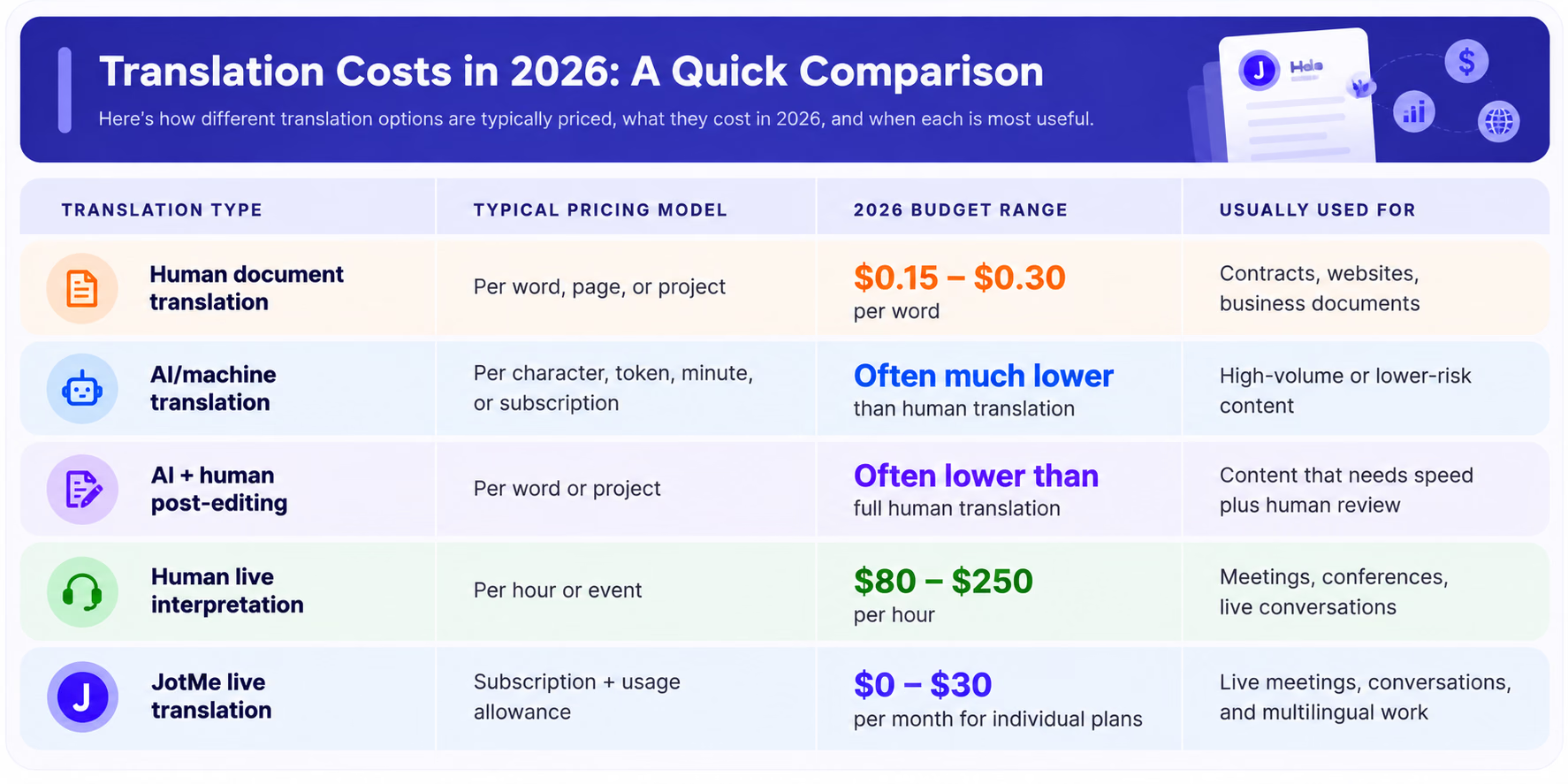
If you need a quick budget number, professional human translation in the US commonly costs around $0.15–0.30 per word, depending on the language pair, subject matter, turnaround, and service level. Live human interpretation is usually priced by time instead, with a rough translation cost coming to around $80–250 per hour.
AI translation can use a completely different pricing model. Some tools charge by characters, minutes, credits, or subscription usage. JotMe, for example, uses separate balances for live-translation minutes, transcription minutes, AI credits, and text-translation tokens, so the cost depends on what you are translating and how you use it.
If you are trying to estimate a translation budget, this table gives you a starting point:
| Translation type | Typical pricing model | Translation rate | Usually used for |
|---|---|---|---|
| Human document translation | Per word, page, or project | $0.15–0.30 per word | Contracts, websites, business documents |
| AI/machine translation | Per character, token, minute, or subscription | Often much lower than human translation | High-volume or lower-risk content |
| AI + human post-editing | Per word or project | Often below full human translation | Content that needs speed plus human review |
| Human live interpretation | Per hour or event | $80–250/hour | Meetings, conferences, live conversations |
| JotMe live translation | Subscription + usage allowance | $0–30/month for individual plans | Live meetings, conversations, and multilingual work |
The exact quote can vary significantly from these ranges. A two-page birth certificate, a 5,000-word technical manual, and a one-hour multilingual meeting are all “translation,” but they are not priced the same way.
Let’s take an example to understand better:
A 5,000-word employee handbook into Spanish and French at $0.14 per word is $1,400. When you add a 30% rush fee and two hours of layout work, the same job costs $1,970.
- Translation: 5,000 words × 2 languages × $0.14 = $1,400
- Illustrative rush charge: 30% = $420
- Layout: 2 hours × $75/hour = $150
- Illustrative total: $1,970
Note: The 30% rush charge and $75/hour layout rate are assumptions for this example.
How Much Does a Translation Cost?
Translation can cost anywhere from a few dollars for simple AI translation to hundreds or thousands of dollars for professional human work. The translation rate depends mainly on the type of translation, word count or duration, language pair, complexity, turnaround time, and whether certification or additional review is required.
For example, a 2,000-word general business document at $0.15 per word would cost about $300. The same word count at $0.30 per word would cost $600. A live meeting is different: a human interpreter may charge by the hour rather than by the number of words spoken.
The first question to ask is therefore not “What is the translation rate?” but “What exactly am I translating, and how will it be used?”
Translation Price by Word
Per-word pricing is one of the most common ways to quote professional translation, especially for documents. A simple calculation is source word count × rate per word = estimated translation cost.
| Content Type | Per-Word Rate |
|---|---|
| General (Blogs, Internal Emails) | $0.09–0.14 |
| Marketing and Advertising | $0.15–0.25 |
| Technical and Specialized | $0.18–0.30+ |
| Certified or Legal | $0.20–0.35+ |
Let’s take an example:
Say you have a 2,000-word employee handbook in English. When you translate English to Spanish, the general content would cost around $180 to $240.
However, there are many factors that change the per-word rate.
- Language pair: Common language combinations can have more available translators than less common combinations.
- Subject matter: Legal, medical, engineering, and other specialized content can require subject expertise.
- Turnaround: Rush work can carry an additional fee.
- Quality requirements: Translation, editing, proofreading, and post-editing are different levels of service.
- File format: A clean editable document is usually easier to process than a scanned or heavily designed file.
- Certification: Official documents may require certification or notarization, which adds cost.
A 1,000-word internal memo and a 1,000-word medical document have the same word count, but they do not necessarily require the same level of expertise and may cost differently.
Hourly Fee for Translation
Hourly pricing is more common when the work is difficult to measure by word count, such as interpreting, proofreading, desktop publishing, or creative adaptation. Generally, professional translator hourly rates are around $30–70 for some time-based work, while live interpretation can be considerably higher.
For live interpretation, a range of roughly $80–250 per hour is a useful planning benchmark. However, the final price can depend on the language pair, specialist knowledge, event format, minimum booking time, and whether more than one interpreter is needed.
For example, a two-hour meeting at $150 per hour would mean $300 for the interpreter's time before any additional event or travel costs. A full-day conference can cost much more because interpretation may require multiple people and supporting equipment.
Translation Cost vs. Translator Cost: Full Pricing Breakdown
The cost difference between human and AI-assisted translation depends on the workflow and level of human review. Raw machine translation can be inexpensive, while adding professional review brings the cost closer to traditional human translation.
Example 1: A 5,000-word document into Spanish
- Human translator (general content, $0.09 to $0.14 per word): $450 to $700.
- AI draft plus a human editor ($0.05 to $0.15 per word): $250 to $750.
- Raw machine translation ($10 to $20 per million characters): About $0.30 to $0.60, since 5,000 words is roughly 30,000 characters.
- JotMe document translation: 10 AI credits for a file of up to 50,000 characters. JotMe's 10-credit document allowance is part of a subscription rather than a separately priced translation service. For example, the Free plan includes 5 AI credits, so it does not cover the standard 10-credit document translation allowance by itself. Paid plans include larger credit allowances. If you already have a paid plan, the document uses 10 credits from that allowance and does not trigger a separate $3–$5 document charge.
Example 2: A small website with 10,000 words
- Human translator (marketing rate, $0.15 to $0.25 per word): $1,500 to $2,500. Published website prices run from $500 to $5,000+ depending on size.
- AI draft plus a human editor: $500 to $1,500.
- Raw machine translation: About $0.60 to $1.20, since 10,000 words is roughly 60,000 characters.
Example 3: A 10-minute training video
- Human subtitles ($5 to $25 per minute): $50 to $250.
- Human voiceover ($20 to $100+ per minute, including the voice actor): $200 to $1,000+.
- JotMe audio and video translation: It uses 20 minutes of live-translation allowance for every minute of video, so 10 minutes uses 200. That is the full monthly allowance on Pro, or 200 of the 500 minutes on Premium.
Example 4: A one-hour meeting with two languages
- Human interpreter ($80 to $250 per hour, conferences $150 to $400): Many interpreters have a half-day minimum. A one-hour session may be billed at a provider's minimum, such as four hours, if that provider requires a four-hour minimum booking.
- JotMe: JotMe does not charge a separate fixed price for each meeting. Its plans include a set number of live-translation minutes, and the minutes consumed depend on the selected mode, target outputs, and delivery method.
Here is an example:
Assume a 60-minute meeting with one target translation output, no shared recipients, and Basic Caption mode. This uses about 60 translation minutes. JotMe’s Premium Caption would use about 120 minutes, while Voice-to-voice would use about 300 minutes. A 200-minute Pro allowance therefore covers about three 60-minute Basic meetings, while one 60-minute Voice-to-voice meeting would require 300 minutes—100 minutes more than the Pro allowance.
If you want to compare the cost with a human interpreter, keep the scope consistent. A one-hour human interpretation session may be quoted by the hour, while JotMe uses plan-based translation minutes. A human quote can also include minimum booking times or other event requirements, so the two prices should not be treated as identical services.
| Translation Need | Human Option | JotMe/AI Option | What The Comparison Means |
|---|---|---|---|
| 5,000-word document | 450–700 at the stated human rate | 10 JotMe AI credits for up to 50,000 characters | JotMe uses subscription credits. It is not a separately priced 3–5 document |
| 10,000-word website | Human translation priced by word, plus any review/localization | AI text processing priced by measured characters | API/AI processing does not include human editing, SEO, or implementation |
| 10-minute video | Human subtitles or voiceover priced separately | JotMe dubbing uses 20× source duration in translation minutes | Compare equivalent outputs rather than subtitles with voice translation |
| 60-minute live meeting | Human interpreter usually quoted by time/event | 60 Basic / 120 Premium / 300 Voice-to-voice translation minutes | JotMe usage depends on mode and delivery method |
AI Translation vs. Human Translation: Which is Better?
Neither human interpreter nor AI interpreter is automatically right for every translation. Human translation makes more sense when nuance, legal requirements, specialist knowledge, or publication quality are critical, whereas an AI translation app is often more practical when speed, volume, or live access matters.
Think about the consequence of an error.
- If you are translating a quick internal message so a colleague can understand the basic meaning, paying for a human translator may add unnecessary cost and delay.
- If you are translating a court document, medical material, contract, or public-facing campaign, the cost of review can be justified because a wrong word can have a much bigger consequence.
Live meetings are a completely different case. A human interpreter provides real-time language support but normally needs to be scheduled and paid for the session. An AI live translation tool can be useful when you need translation immediately or need it repeatedly across ordinary work meetings.
| Situation | Better Choice | Why |
|---|---|---|
| Contract, court filing, patent | Human | Errors can void or dispute the document |
| Birth certificate for an immigration filing | Certified human | Needs a signed accuracy statement, which software cannot give |
| Medical consent or dosage instructions | Human | Patient safety |
| Brand campaign or slogan | Human (transcreation) | Literal translation falls flat |
| Internal wiki, knowledge base, support tickets | AI, or AI plus human edit | High volume, low risk |
| Daily standups, client calls, webinars | AI live translation | Fast, no scheduling lead time |
| Recorded interview you need to read | AI transcript plus translation | Minutes, not days |
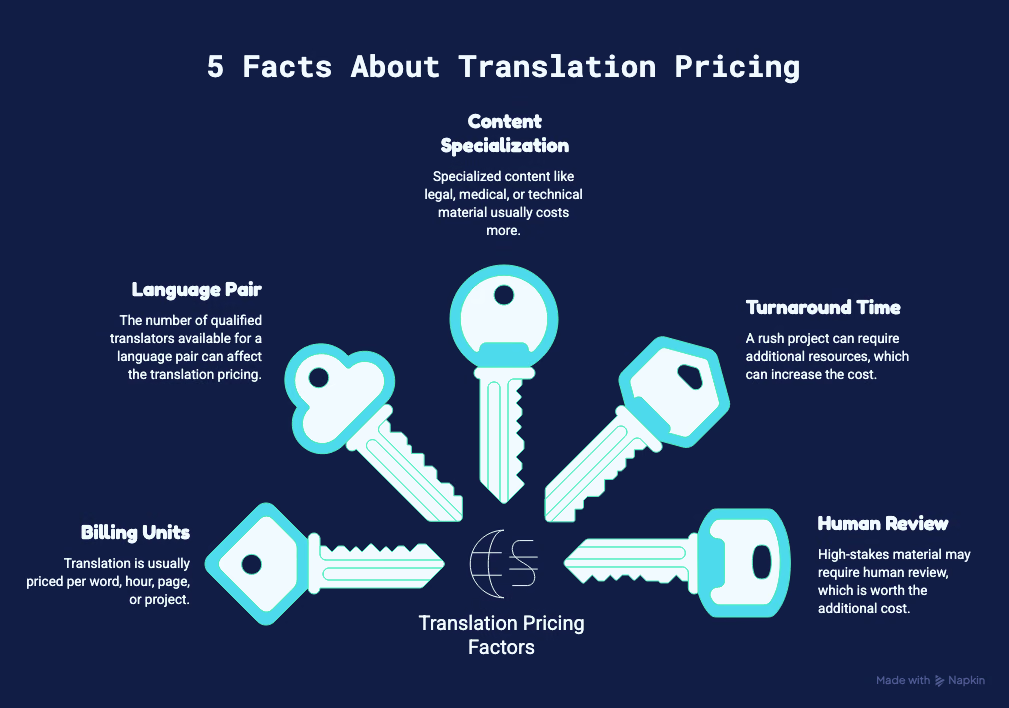
5 Facts About Translation Pricing
Translation pricing is not based on one universal rate. The final price usually depends on how the translation is billed, the language pair, the type of content, the turnaround time, and the level of human review required.
1. Translation is Usually Priced Per Word, Hour, Page, or Project
For written content, per-word pricing is the most common model. The translation rates in 2026 range broadly from about $0.15–0.30 per word, although the actual quote depends on the language and project requirements.
Other projects use different units:
- Per word: Common for documents, websites, reports, and other written content.
- Per hour: More common for interpreting, proofreading, desktop publishing, and other time-based work.
- Per page: Sometimes used for short official or certified documents, although page counts can be misleading because two pages can contain very different amounts of text.
- Per project: Common when the scope is large or predictable enough for a provider to give a fixed quote.
For example, a 5,000-word business document at $0.15 per word would cost $750 before any additional services or discounts.
What to do: Before comparing quotes, make sure every provider is using the same billing unit and scope.
2. Language Pair Can Change the Rate
The number of qualified translators available for a language pair can affect the translation pricing. Common language pairs tend to have more translators available, while less frequently requested combinations can require a smaller pool of specialists and may cost more.
That means two documents with exactly the same word count can receive different quotes.
For example, translating a 2,000-word general business document from English into a widely requested language may have a different rate from translating the same document into a less commonly requested language.
What to do: Ask for a quote for your exact language pair rather than using a generic per-word rate.
3. Specialized Content Usually Costs More
A translator needs more than language skills when working on legal, medical, technical, financial, or highly specialized content. The translator also needs to understand the terminology and conventions of that field. The specialized work can cost substantially more than general translation.
Consider two 5,000-word documents:
- A general internal company announcement may require straightforward language work.
- An aircraft maintenance manual requires terminology that cannot be translated casually.
The word count is identical, but the second project carries a much higher requirement for subject-matter accuracy.
What to do: Tell the provider what the content is about so you are quoted for the right level of expertise.
4. Faster Turnaround Can Increase the Price
A normal translation schedule gives the translator time to work through the content and complete the required review. A rush project can require additional people, project management, or work outside normal hours, which can increase the cost.
For example, translating a 10,000-word report over several business days is a different scheduling problem from translating the same report overnight.
If you know a document will need translation, sending it early can help you avoid paying specifically for a rushed turnaround.
What to do: If you have flexibility, ask for both standard and rush turnaround pricing before choosing a deadline.
5. Cheapest Translation is Not Always the Right One
The right translation option depends on what happens if the translation contains an error.
For a low-stakes task, such as understanding the general meaning of an email in another language, an AI or machine translation may be enough. For a legal filing, medical document, published marketing campaign, or other high-stakes material, human review may be worth the additional cost.
So instead of asking only “What is the cheapest translation rate?”, ask “What level of translation do I actually need for this particular job?” That question usually gives you a much more useful budget.
What to do: Match the translation method to the consequence of an error. A casual internal conversation and a legal filing should not be treated as the same job.
Translation Rates Calculator
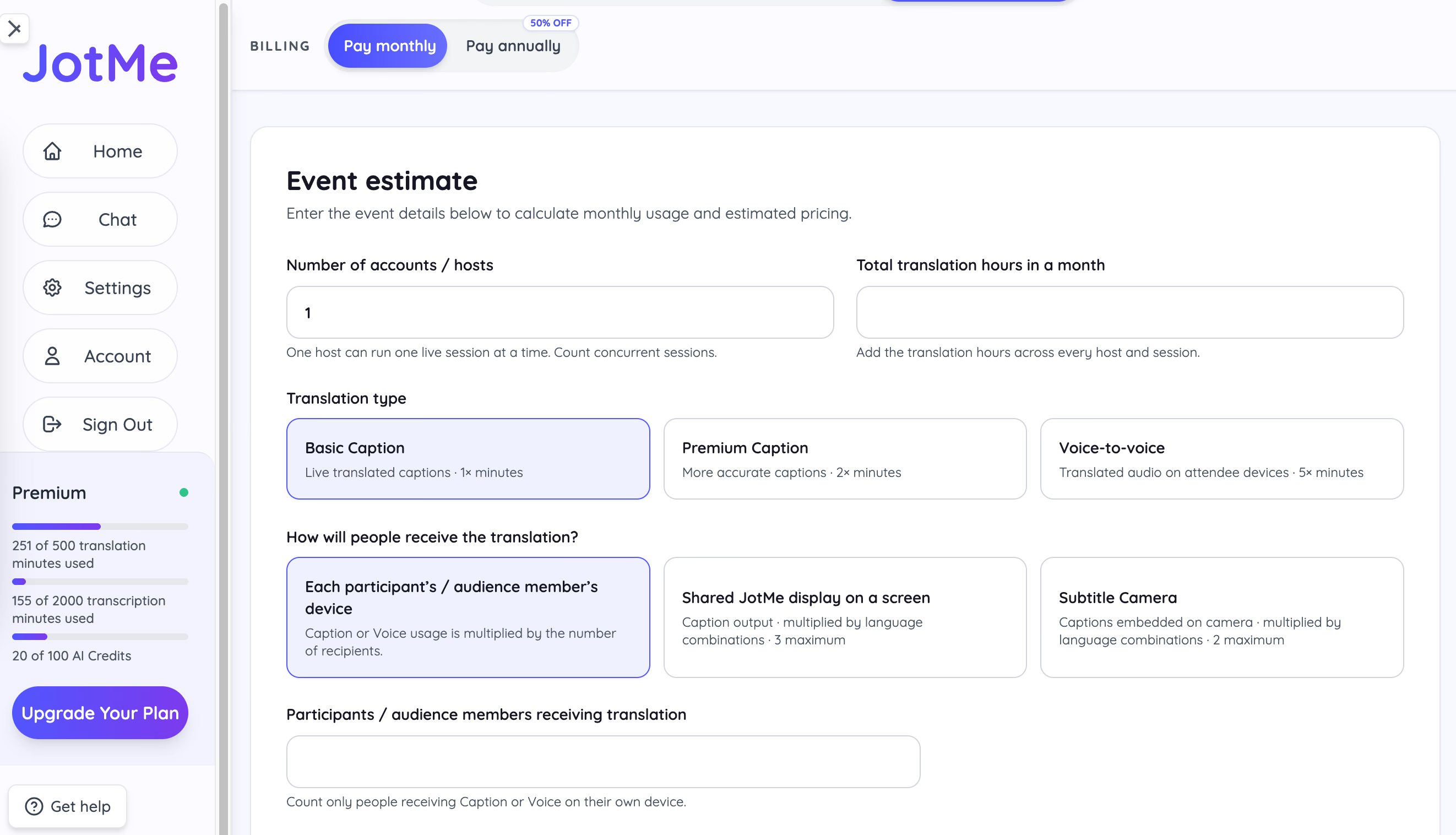
JotMe's Event Pricing Estimator helps you estimate translation usage for meetings, workshops, and other live events. Instead of entering a word count, you enter the number of hosts, total translation hours, translation type, delivery method, and audience size. The estimator then calculates the translation minutes your event may use.
How to Use JotMe's Event Pricing Calculator
Enter the details of the event rather than trying to convert the entire project into a per-word translation rate:
- Enter the number of accounts or hosts. One host can run one live session at a time, so count concurrent sessions.
- Enter the total translation hours. Add the hours across the hosts and sessions you expect to run.
- Choose the translation type. Basic Caption uses a 1× multiplier, Premium Caption uses 2×, and Voice-to-voice uses 5×.
- Choose how people receive the translation. If attendees use their own devices, recipient count affects usage. A shared display is calculated differently.
- Enter the number of recipients when people are receiving translation on their own devices.
- Review the estimate before deciding how much translation capacity you need.
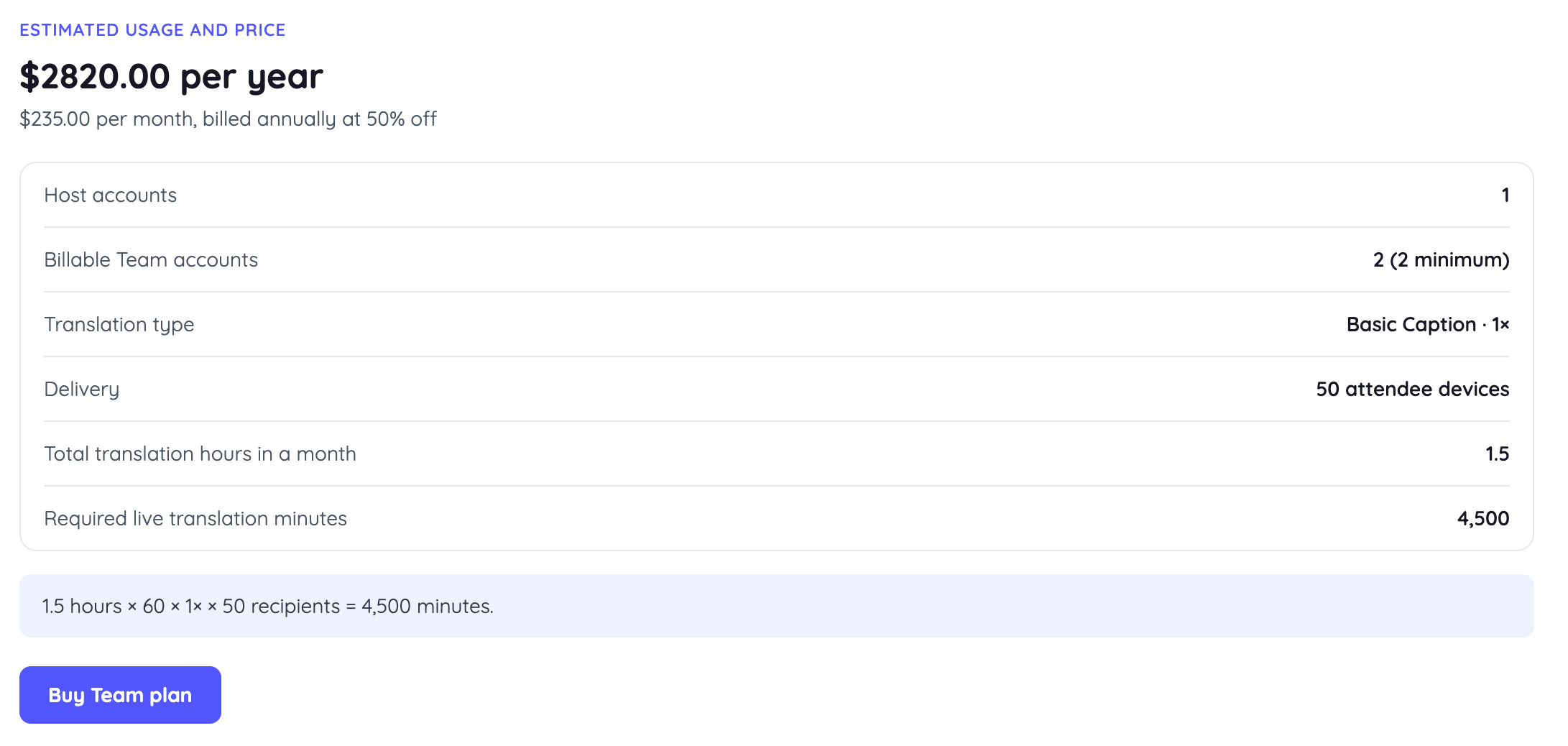
For example, a 90-minute workshop with 50 attendees using Basic captions on their own devices would require about 4,500 translation minutes:
90 minutes × 1× × 50 recipients = 4,500 minutes
If those same 50 people watch one translated language on a shared screen, the audience size does not multiply the usage in the same way. The estimate is about 90 minutes for that displayed output.
How Much Does a Translation Cost with JotMe?
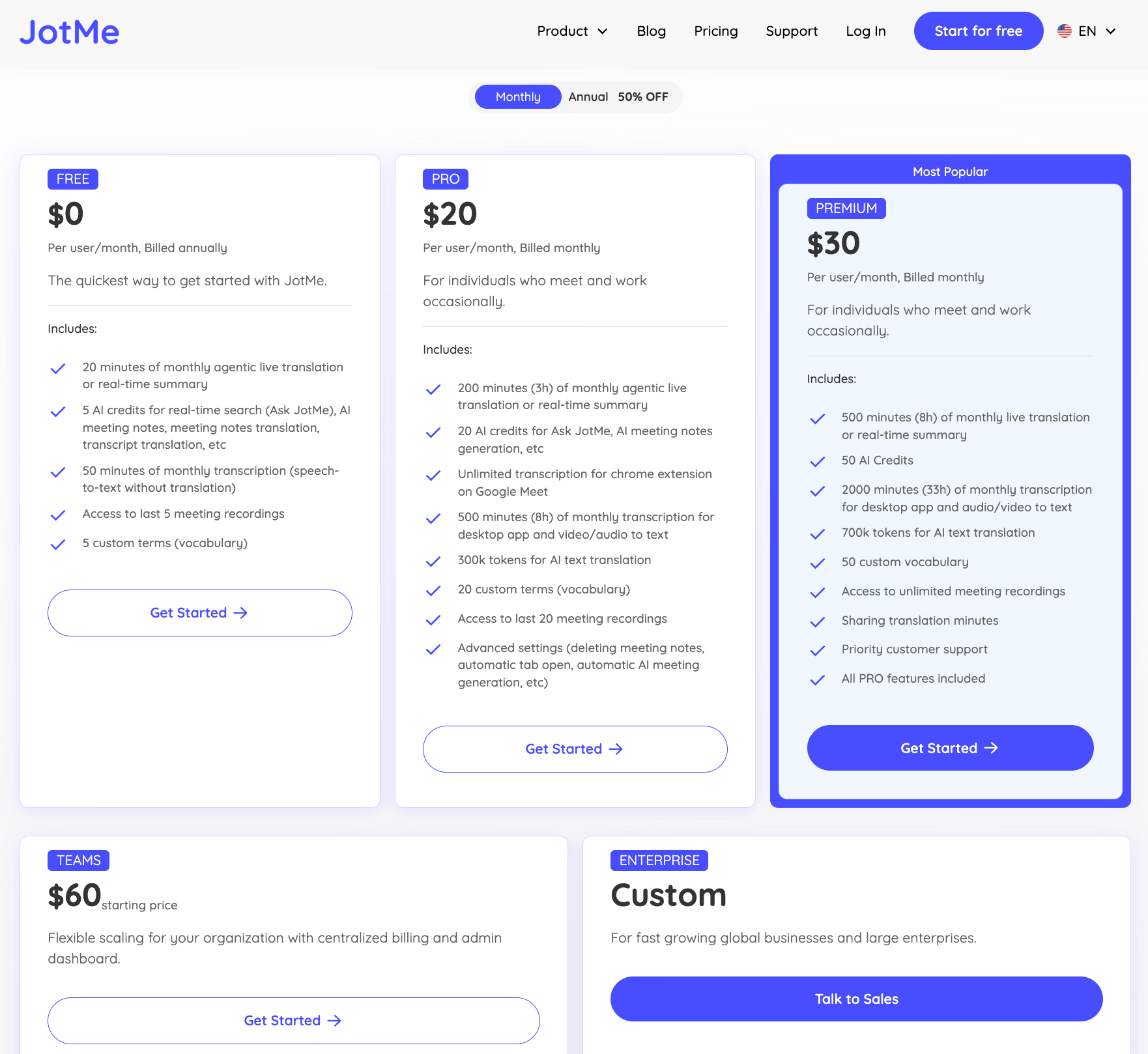
JotMe's pricing plans currently start at $0, with Pro at $20/month and Premium at $30/month when billed monthly. Annual billing is $120 for Pro and $180 for Premium, equivalent to $10 and $15 per month when paid upfront for the year.
| Plan | Monthly price | Effective monthly price when billed annually | Live translation | Transcription | AI credits | Chat tokens |
|---|---|---|---|---|---|---|
| Free | $0 | $0 | 20 min/month | 50 min/month | 5 | 20,000 |
| Pro | $20/month | $10/month | 200 min/month (about 3 hours) | 500 min/month | 20 | 300,000 |
| Premium | $30/month | $15/month | 500 min/month (about 8 hours) | 2,000 min/month | 50 | 700,000 |
JotMe makes more sense when you need translation repeatedly or in real time, such as:
- Recurring Multilingual Meetings: A team with several 30- or 60-minute meetings each month can use its plan's live-translation allowance instead of arranging an interpreter for every meeting.
- Events and Workshops: JotMe can estimate usage based on event duration, translation mode, and how attendees receive the translation.
- Quick Conversations: If you need to understand or communicate across languages without arranging a human interpreter in advance, an AI translator can be more practical.
- Internal or Lower-Risk Communication: For routine discussions where the goal is understanding rather than producing an official translated document, paying for a human translation may be unnecessary.
JotMe can be a practical option when you need real-time translation repeatedly, such as recurring multilingual meetings, workshops, events, or routine cross-language conversations.
Human translation or interpretation may be more appropriate when the output requires formal certification, specialist judgment, or a high level of human review.
How Many JotMe Credits Does Translation Use?
JotMe AI credits are used for specific AI actions rather than being a replacement for live-translation minutes. A question in Ask JotMe costs 1 credit, image translation costs 5 credits, and document translation starts at 10 credits for up to 50,000 characters.
| JotMe | AI credits used |
|---|---|
| Ask JotMe question | 1 |
| AI meeting notes | 1 per generated language |
| Speech generation | 1 |
| Image translation | 5 |
| Document translation up to 50,000 characters | 10 |
| Each additional 5,000 document characters | +1 |
For example, a document containing 42,000 characters starts at 10 AI credits. A 57,000-character document would require 12 credits: 10 credits for the first 50,000 characters plus 2 credits for the additional 10,000 characters.
This is separate from live translation. If you spend 60 translation minutes in a meeting, that does not mean you have also spent 60 AI credits. If you want to understand the JotMe pricing and plans in detail, you can refer to our detailed guide: JotMe Pricing 2026: Plans, Costs & Modes Explained.
Per Word vs. Per Page Pricing: Why Translation Costs Vary
Per-word pricing charges for the text you send, and per-page pricing charges a fixed amount for a standard document. The translation costs vary because the two units measure different things: effort in one case, predictability in the other.
Per word suits anything with variable length, like contracts, reports, and websites. Per page suits documents with a fixed structure, such as birth certificates, diplomas, and marriage licenses, where the provider already knows the effort.
For example, two two-page documents can contain very different amounts of text if one has large headings, tables, or spacing. Always check how the provider defines a billable page before comparing a page rate with a per-word quote.
The takeaway: There is no single translation rate. Use per-word quotes for text, per-page quotes for certificates, hourly quotes for editing and interpreting, and per-minute plans for live conversations. Get the tier, word basis, minimums, and rush terms in writing before you compare numbers.
If you need translation for meetings, calls, and recordings, start with JotMe's free plan and measure your real minutes before you commit to anything.
Note: Translation rates mentioned in this article are general market ranges intended for budgeting and comparison. Actual prices can vary by language pair, content type, word count, turnaround time, provider, level of human review, and pricing model. Always check the provider’s current pricing before making a purchase or finalizing a translation budget.
FAQs
How Much Does a Certified Translation Cost in 2026?
A certified translation of a short official document usually costs $30 to $55 per page, including the signed statement that it is accurate. Notarization, if required, is an extra fee. Confirm the accepting authority's requirements before ordering. An AI tool cannot sign the certification.
How Much Should I Charge for the Translation of a Book?
You should charge per word, with a project minimum, to translate a book. The general US professional range of $0.15 to $0.30 per word is a starting point, which puts a 60,000-word book at $9,000 to $18,000. Adjust for genre, deadline, and whether you include editing.
How Much to Charge for Translation Per Page?
You can charge anywhere from $30 to $55 per page for standard certified documents and up to $100 for dense or specialized pages. For text pages, convert to words first: 250 to 500 words per page at your per-word rate.
How Much Does It Cost to Translate a Website?
Smaller sites commonly start around $500, and larger ones run $5,000 or more. The words are priced per word. The extra cost comes from extracting text, fitting longer translated text into layouts, and multilingual SEO. Sites that change often are cheaper per update under an ongoing arrangement.
How Much Do Professional Translation Services Usually Cost?
You can expect $0.09 to $0.40 per word for human translation in the US, with common language pairs near $0.10 to $0.22. Machine translation with human editing runs $0.05 to $0.15 per word, and per-page pricing for certificates is $30 to $55.
How Much Does It Cost to Translate Documents?
The cost to translate the document can be calculated by multiplying your word count by the per-word rate. A 1,000-word business document typically costs $150 to $300 per language.
How Much Do You Charge as a Translator?
You can charge anywhere around $0.15 to $0.30 per word for general work, 50 to 100% more for legal, medical, or technical subjects, and $30 to $70 an hour for editing and proofreading. Add a minimum fee of $30 to $75 and a rush surcharge of 20 to 50%.
How Many Hours of Meetings Can JotMe Translate per Month?
With JotMe’s free plan, you can translate 20 minutes per month. Pro covers 200 minutes, about 3 hours, and Premium covers 500 minutes, about 8 hours. Enterprise plans are custom.
How Are Translation Minutes Consumed in JotMe?
Live translation minutes are used while translation or real-time summary is on during a meeting. Transcription without translation uses transcription minutes. Translating notes or transcripts afterward uses AI credits, 1 credit each.
Last updated on
October 24, 2026
Follow us on social media: