





Translation Quality Assurance: Complete Guide to Improving Translation Quality

Lovely Mangla
October 24, 2026

Translation quality assurance (QA) is the process of checking whether a translation preserves the source meaning, facts, terminology, tone, and intended use. It is more than proofreading: a translation can read smoothly and still change an instruction, omit an important detail, or use the wrong business term.
We tested JotMe across three different workflows: live translation, document translation, and text translation. We compared English source material with JotMe’s Japanese output and evaluated each result for meaning, completeness, terminology, factual details, grammar, naturalness, tone, and context.
We then gave those inputs and outputs to ChatGPT and asked it to evaluate the translation. The tests scored 96/100 for live translation of English/Japanese business conversation, 97/100 for English business document to Japanese translation, and 97/100 for English business text to Japanese text translation.
| JotMe Translation Test | ChatGPT-Assigned Sample Rating | What We Tested | Key Observation |
|---|---|---|---|
| Live Translation | 96/100 | English ↔ Japanese business conversation, meaning, context, terminology, conversational language, and transcription completeness | Strong semantic preservation in our sample; most deductions came from transcription and segmentation issues |
| Document Translation | 97/100 | English → Japanese business document containing dates, times, procedures, requirements, terminology, and a security warning | No substantive meaning-changing errors in our sample; remaining issues were mainly naturalness-related |
| Text Translation | 97/100 | English → Japanese business text, sentence-level meaning, completeness, grammar, terminology, dates, and instructions | Strong factual preservation and completeness in our sample; a few phrases could be more natural in Japanese |
Note: These are the results of our own JotMe translation tests, based on the specific samples and conditions we evaluated. They should not be interpreted as a guaranteed or universal JotMe accuracy score. Translation quality can vary depending on the language pair, content, input quality, terminology, settings, and use case.
What is Translation Quality Assurance?
Translation quality assurance is a systematic process for checking whether translated content meets the requirements of the source and the purpose for which it will be used.
Translation QA also includes preventive steps such as defining quality requirements, preparing terminology, setting review criteria, checking the output, recording recurring errors, and improving the workflow.
A useful translation QA review checks at least these areas:
- Meaning: Does the target text communicate the same idea and intent?
- Completeness: Were important words, phrases, sentences, or instructions omitted?
- Factual accuracy: Are dates, times, numbers, names, units, and other details unchanged?
- Terminology: Are business, technical, product, and industry terms correct and consistent?
- Grammar: Is the target language grammatically sound?
- Naturalness: Would a fluent speaker naturally phrase it this way?
- Tone: Does the translation retain the source’s level of formality and intent?
- Context: Does the translation reflect the surrounding conversation or document?
The Multidimensional Quality Metrics (MQM) framework takes a similar analytical approach. MQM is designed for translation quality evaluation across human and automatic translation, using defined error types, severity levels, and scoring models to turn observations into measurable quality data.
This matters for AI translation because “it sounds good” is not enough. A fluent sentence can still contain the wrong date or omit a critical instruction.
MQM is also useful to separate translation errors from source-processing errors. If a speech-recognition system hears “Asian markets” incorrectly before the translation is generated, the final problem is not necessarily a failure to translate a correct source sentence.
Translation Quality Assurance: Testing Framework & Best Practices
A useful translation QA framework starts before the output is generated. The reviewer should know what is being tested, what counts as an error, and which errors matter most for the intended use.
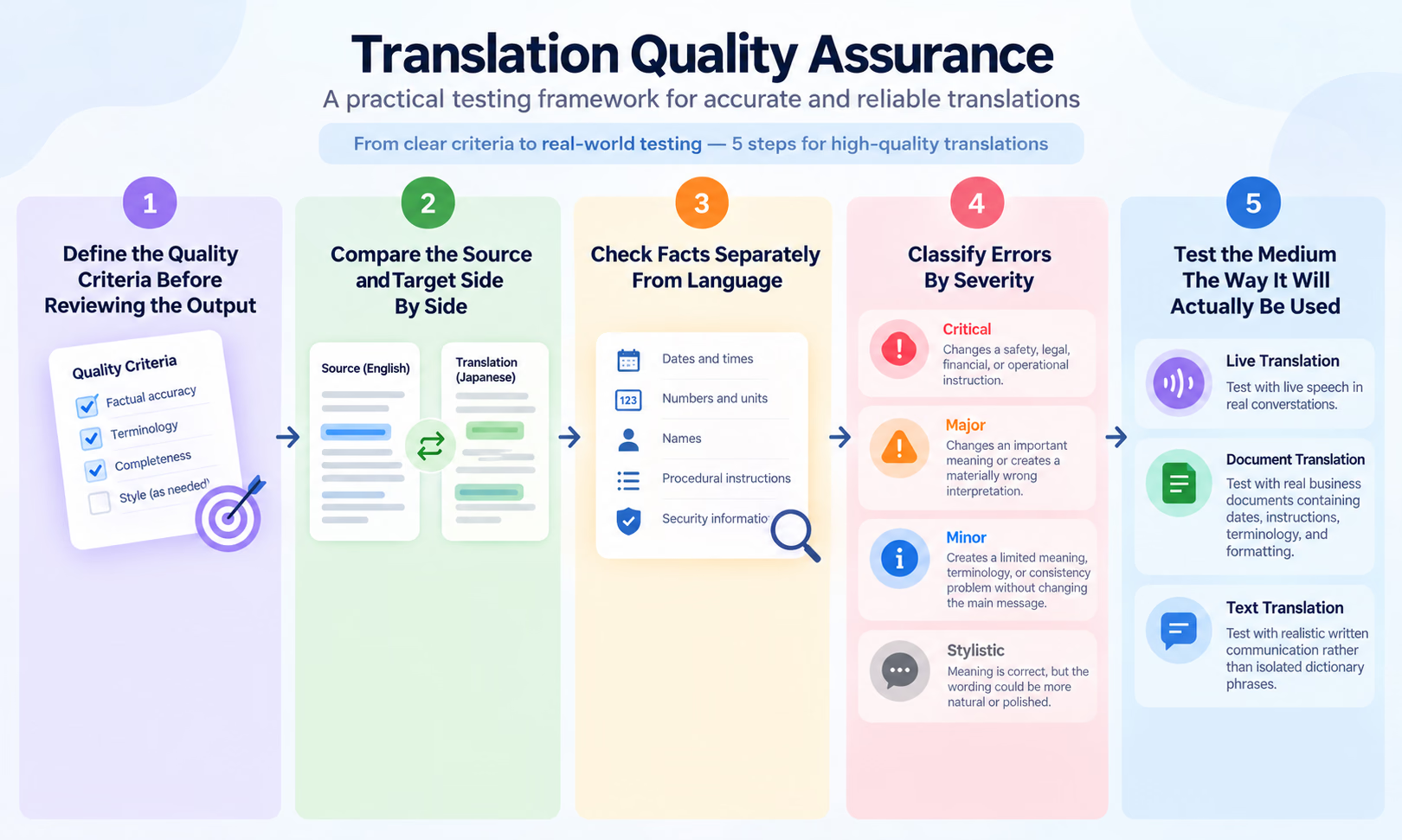
1. Define the Quality Criteria Before Reviewing the Output
Decide what “good” means for the content.
For a business document, factual accuracy, terminology, and completeness may matter more than conversational style. For live translation, transcription completeness, context, and conversational meaning become more important.
Before reviewing the output, define the intended audience, content risk, required terminology, and acceptance rule. For example, a safety instruction or binding deadline may require zero unresolved critical errors, while a low-risk internal message may allow minor stylistic issues.
2. Compare the Source and Target Side By Side
Reading only the translated text creates a blind spot. A target sentence can sound polished while quietly dropping a qualification or changing an instruction.
For each discrepancy, record the source wording, target wording, error type, severity, and required correction. This creates an evidence trail instead of relying on a general impression of whether the translation "looks right."
For the JotMe document and text tests, we compared the English source with the Japanese output sentence by sentence. We checked whether the same information survived the translation rather than judging the Japanese in isolation.
3. Check Facts Separately From Language
Check negation, dates, times, quantities, units, deadlines, names, responsibilities, and procedural instructions separately. An output can be grammatically correct while changing who must do something or when it must be done.
A translation can be linguistically fluent but operationally wrong. In our document translation test, preserving the schedule, requirements, sequence of actions, and security warning was more important than making every Japanese sentence maximally elegant.
4. Classify Errors By Severity
Every imperfection does not reduce a translation score in the same way.
A practical review can classify issues by type and severity. For example, accuracy, terminology, completeness, and fluency describe the type of problem, while critical, major, and minor describe its impact.
A stylistic issue may be minor when it is simply a preference, but it can become more consequential if the wording affects comprehension, tone, or the intended audience.
Each severity level should trigger an action. A critical error affecting a legal, safety, financial, or binding operational instruction should block release until corrected. Major errors should be corrected before approval, while minor issues can be prioritized based on the intended use.
5. Test the Medium The Way It Will Actually Be Used
A live translator should be tested with live speech. A document translator should be tested with a document containing the dates, instructions, terminology, and formatting that matter in real work. A text translator should be tested with realistic written communication rather than isolated dictionary phrases.
That is why we tested JotMe across all three workflows.
The final translation quality assurance review should also check the delivered format. For documents, verify headings, tables, page breaks, missing text, links, placeholders, and visible text overflow. For live translation, check speech recognition, segmentation, timing, and context. For pasted text, check whether the surrounding context is sufficient for the intended meaning.
Translation Quality Assurance Tools
Translation quality assurance tools help identify, measure, and reduce errors in translated content by checking areas such as terminology, consistency, completeness, factual details, grammar, and fluency. They can include automated QA checks, translation quality frameworks such as MQM, terminology management tools, bilingual review workflows, and AI translation platforms with quality controls.
| Category | Useful For | Main Limitation |
|---|---|---|
| Automated Bilingual Checks | Missing numbers, terminology mismatches, empty segments, tags, and consistency issues | A clean report does not prove meaning is correct |
| Evaluation Frameworks | Consistent error classification and scoring | Require reviewers and an agreed scoring method |
| Bilingual Review | Meaning, context, tone, and specialist terminology | Depends on reviewer competence and source access |
| AI Translation Tools With Quality Controls | Supporting recognition, context, and recurring terminology | Do not replace a documented QA review |
Automated Quality Checks
Common automated checks include missing numbers, inconsistent terminology, empty segments, formatting or tag mismatches, and other repeatable differences between source and target content. These checks identify patterns, but they cannot by themselves determine whether the translation preserves the intended meaning.
Translation Quality Frameworks
A framework such as MQM gives reviewers a shared vocabulary for describing errors. Instead of saying that a sentence “feels wrong,” a reviewer can identify whether the problem is accuracy, terminology, fluency, style, or another defined category.
MQM also supports severity-based scoring and root-cause analysis, which makes it useful for comparing results over time rather than treating every review as a one-off opinion.
Bilingual Review
Human bilingual review is useful for problems that depend on context, cultural conventions, intent, or specialist knowledge. It is particularly important for high-consequence content where a small translation error can create a large downstream problem.
AI Translation Tools With Quality Controls
Modern AI translation tools increasingly provide controls for terminology, context, and output preferences.
JotMe currently provides translation for text, documents, images, audio, and video, while its live translation workflow handles speech during meetings and events. It also provides a Custom Vocabulary feature to translate names, products, acronyms, and specialist terms with high accuracy.
However, AI translation tools should not be treated as substitutes for every other QA method. Automated checks can find patterns, bilingual reviewers can evaluate context, and product-level controls can reduce recurring errors before they reach the final output.
What is Quality Assurance vs. Quality Control?
Quality assurance is process-oriented, whereas quality control is output-oriented.
- Quality assurance asks whether the workflow has the right requirements, terminology rules, review criteria, and checks in place.
- Quality control asks whether a particular translated output contains errors.
For example, creating an approved terminology list is a QA activity. Checking a completed Japanese document for an incorrect product term is a QC activity.
The two should work together. If QC repeatedly finds the same terminology error, the answer should not always be another manual correction. The workflow should change so the same error becomes less likely to happen again.
For AI translation, that feedback loop can be especially useful: translate, evaluate, identify recurring errors, improve the input or terminology controls, and test again.
| Quality Assurance | Quality Control | |
|---|---|---|
| Purpose | Prevent recurring problems | Find problems in a specific output |
| Timing | Before and throughout the workflow | During or after output review |
| Main Task | Define requirements, terminology, criteria, and process | Inspect translated content for errors |
| Output | Improved process and review rules | Error findings and corrections |
How to Evaluate Translation Quality: 8 Point Checklist
To evaluate translation quality, compare the source and target text for meaning, completeness, additions, terminology, factual details, grammar, naturalness, and tone, then determine whether the translation is fit for its intended purpose. A useful QA process should also classify errors by severity rather than treating every awkward phrase as a major translation failure.
1. Is the meaning preserved?
Compare the source and target sentence by sentence. Ask whether the same idea, intention, and relationship between statements survive.
2. Is anything missing?
Look for omitted qualifiers, instructions, examples, names, numbers, or complete sentences.
3. Has anything been added?
Check that the free language translator has not introduced facts, requirements, explanations, or implications that are absent from the source.
4. Are names and terminology consistent?
Check product names, technical vocabulary, acronyms, people, organizations, and industry-specific terms.
5. Are dates, numbers, units, and instructions correct?
Run a dedicated factual check. Do not assume that fluent language means every factual detail was preserved.
6. Does the target language sound natural?
A translation can be accurate while still sounding translated. Check grammar, sentence structure, formality, idioms, and conventions used by native speakers.
7. Does the tone match the source?
A casual message should not automatically become stiff corporate language. A customer-support or business document may require a more formal register.
8. Is the translation fit for its real use?
Ask the practical question: Can the intended reader safely and correctly use this translation for the job it was created to do?
How to Improve Translation Quality
Improving AI translation quality starts with better input, better terminology control, and a review process that focuses on the errors that matter.
Give the Translator Useful Context
Context reduces ambiguity. The same sentence can have different valid translations depending on the subject, audience, industry, and surrounding conversation.
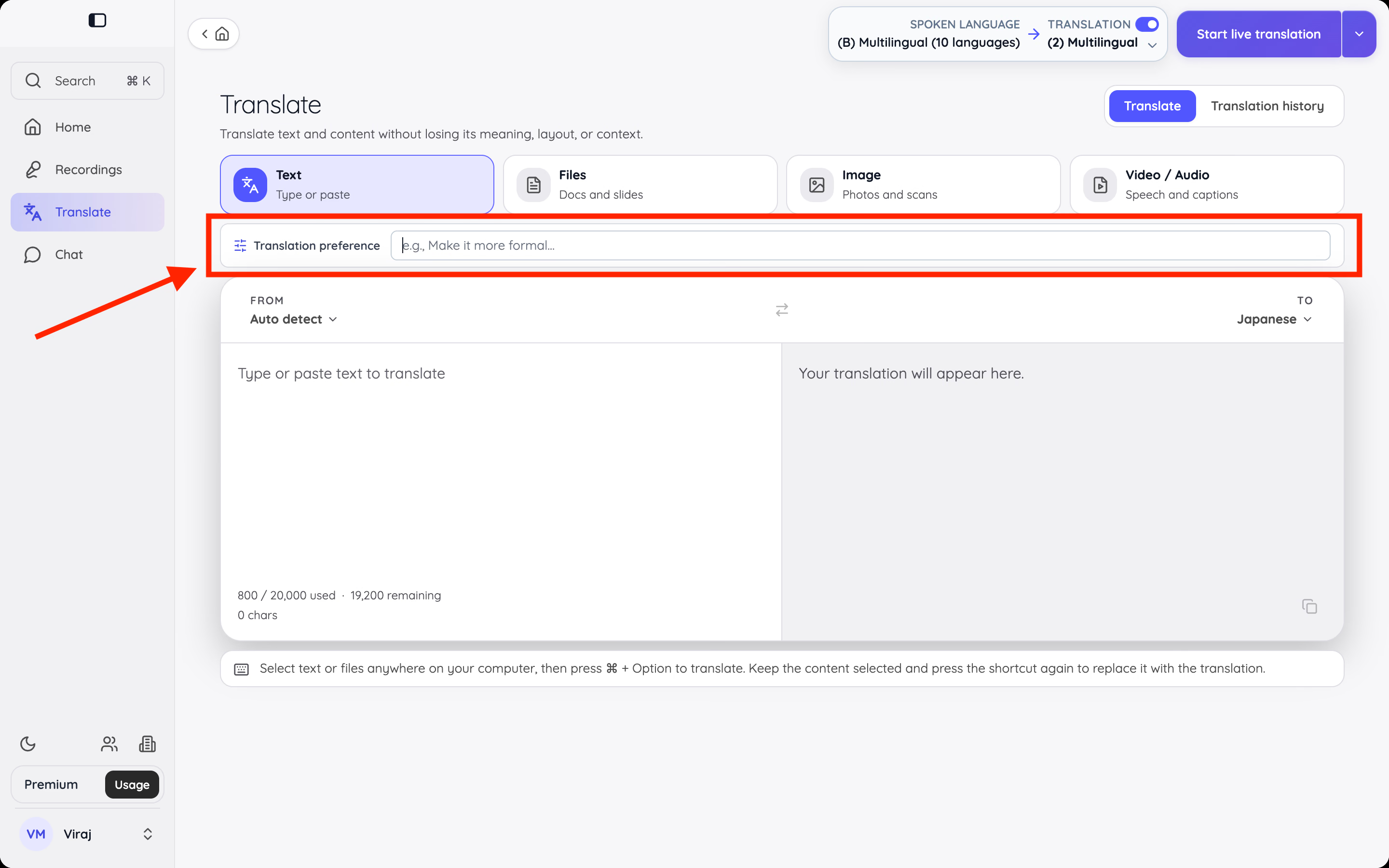
For written translation, you should give the tool a clear preference when the workflow supports it. JotMe’s text translation workflow lets users add a plain-language preference for tone and style, such as asking for a more formal translation.
Use Terminology Controls
If a company repeatedly uses the same product names, acronyms, names, or specialist terms, relying on the model to infer them every time creates unnecessary risk.
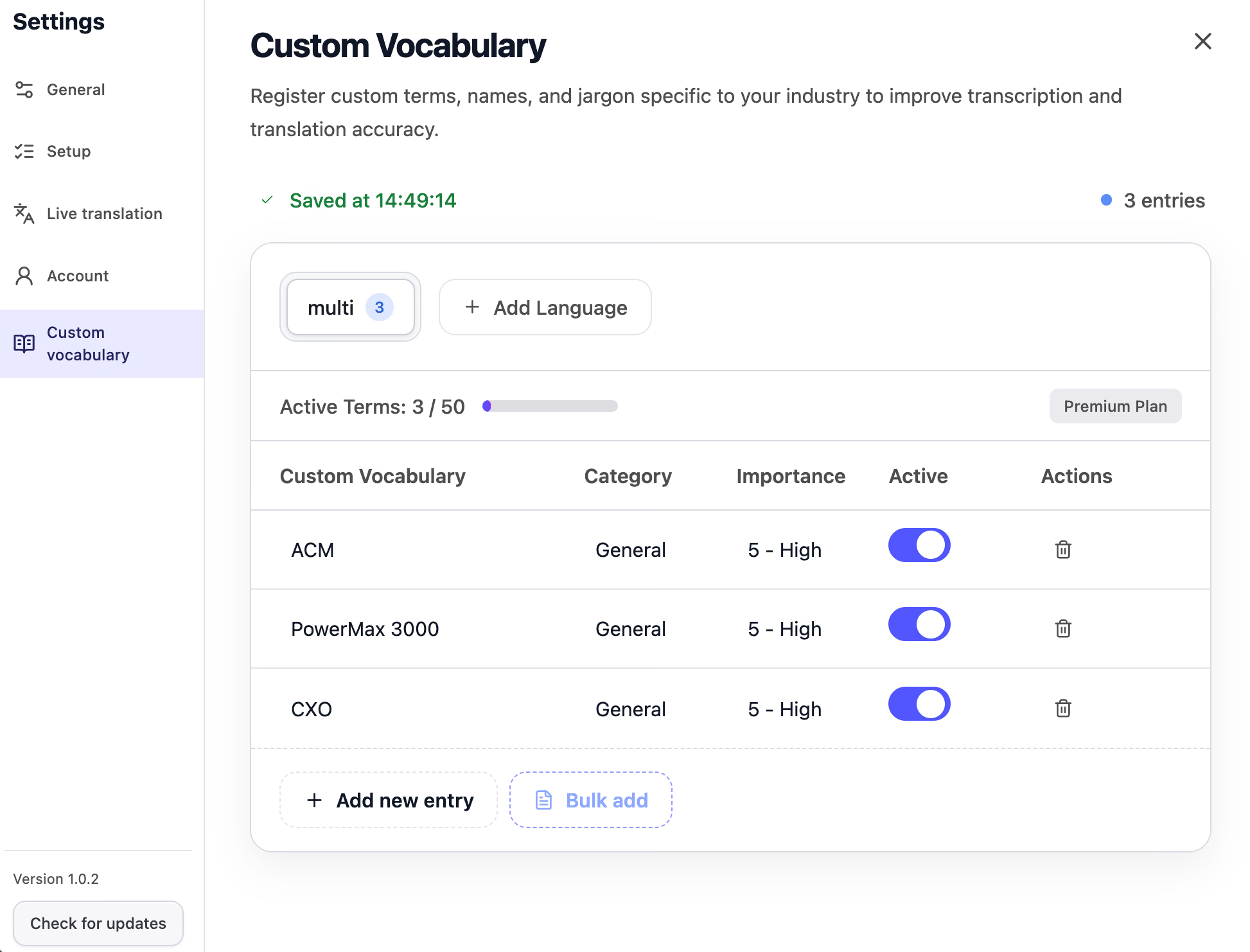
JotMe’s Custom Vocabulary lets users register names, products, acronyms, and specialist terms. Vocabulary can improve the translation quality across its different features, such as live transcription and translation, uploaded-file transcription, voice typing, meeting transcripts and AI notes, and text, document, image, audio, and video translation.
Match Quality Settings to the Use Case
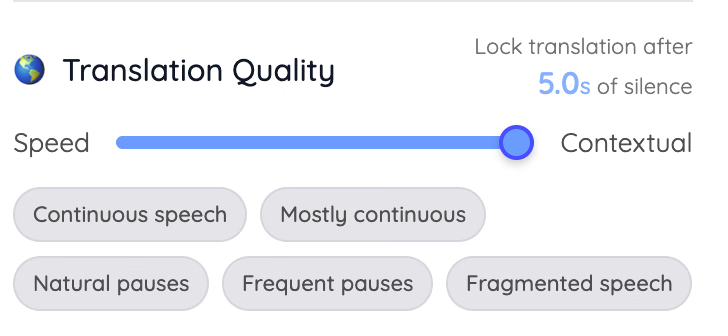
Live translation has a different speed-versus-context trade-off from written translation. JotMe’s live translation settings include a Translation Quality control that balances speed and context, along with transcription-quality controls.
Choose the setting based on the communication context, then review representative outputs for recognition, completeness, timing, and contextual accuracy. If the setting is changed, compare equivalent samples rather than assuming that a higher contextual setting will always produce better results.
Review High-Consequence Translations
AI translation can reduce manual work, but fluent output should not automatically be treated as approved output.
For contracts, safety information, regulated material, legal documents, or other high-consequence content, establish an appropriate human-review step.
How Can JotMe Support a Translation QA Workflow?
We tested three JotMe translation workflows: live translation, document translation, and text translation. The language direction was English ↔ Japanese for the live test and English → Japanese for the document and text tests. We compared the available source and translated material for meaning, completeness, factual details, terminology, grammar, naturalness, and context. The ratings shown below were assigned by ChatGPT based on the material provided for each evaluation. These tests represent specific business samples rather than a broad language benchmark.
Our Live Translation Test: 96/100
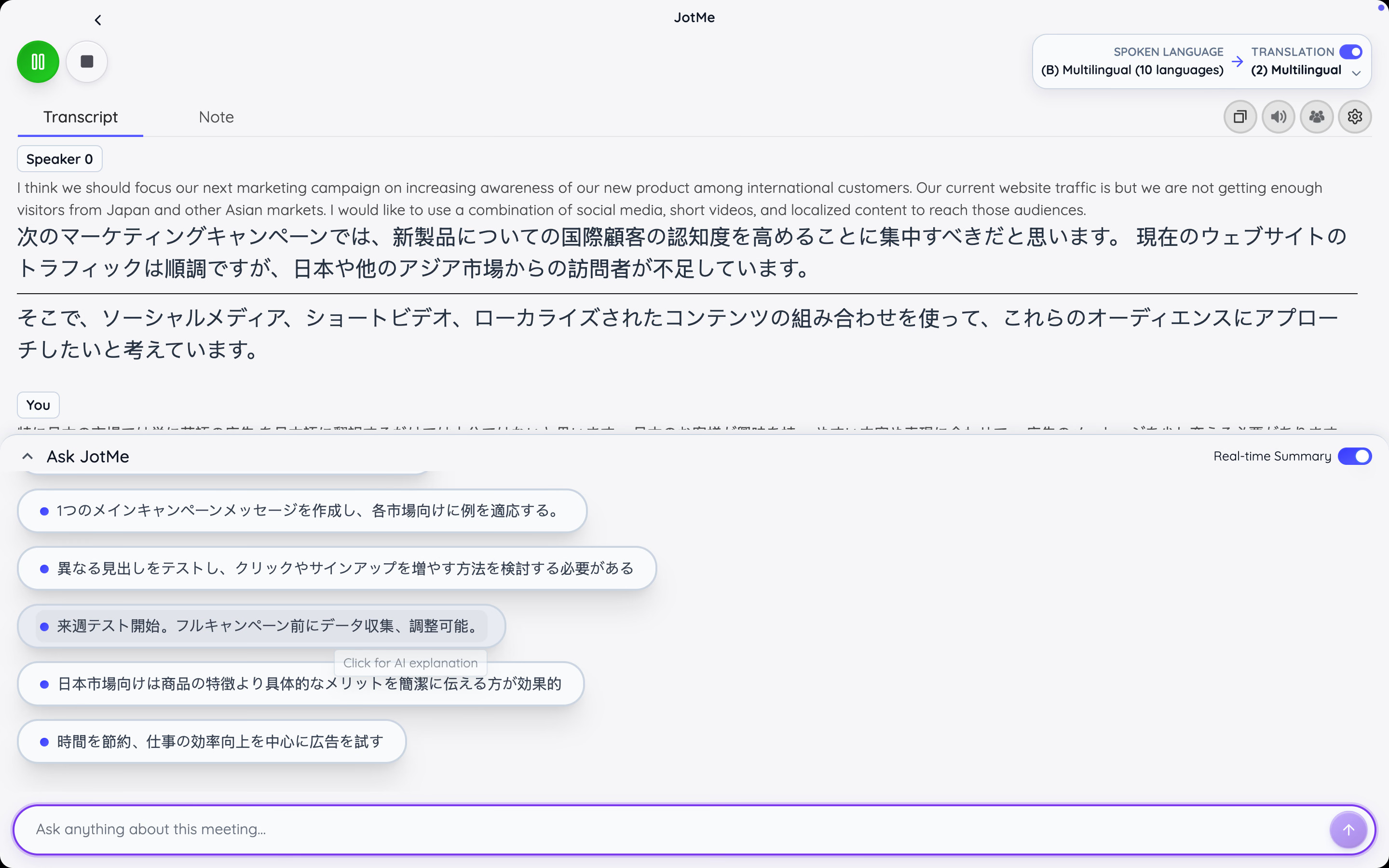
For the live test, we evaluated an English/Japanese business conversation covering global campaigns, regional adaptation, target audiences, leads, key messages, click-through rates, conversions, engagement, tracking information, and localized content.
We evaluated:
- Overall meaning
- Sentence-level translation
- Business terminology
- Context preservation
- Japanese → English translation
- English → Japanese translation
- Conversational language
- Transcription completeness
We provided the source conversation and JotMe's final transcript/translation to ChatGPT for evaluation, and ChatGPT assigned the sample a quality rating of 96/100.
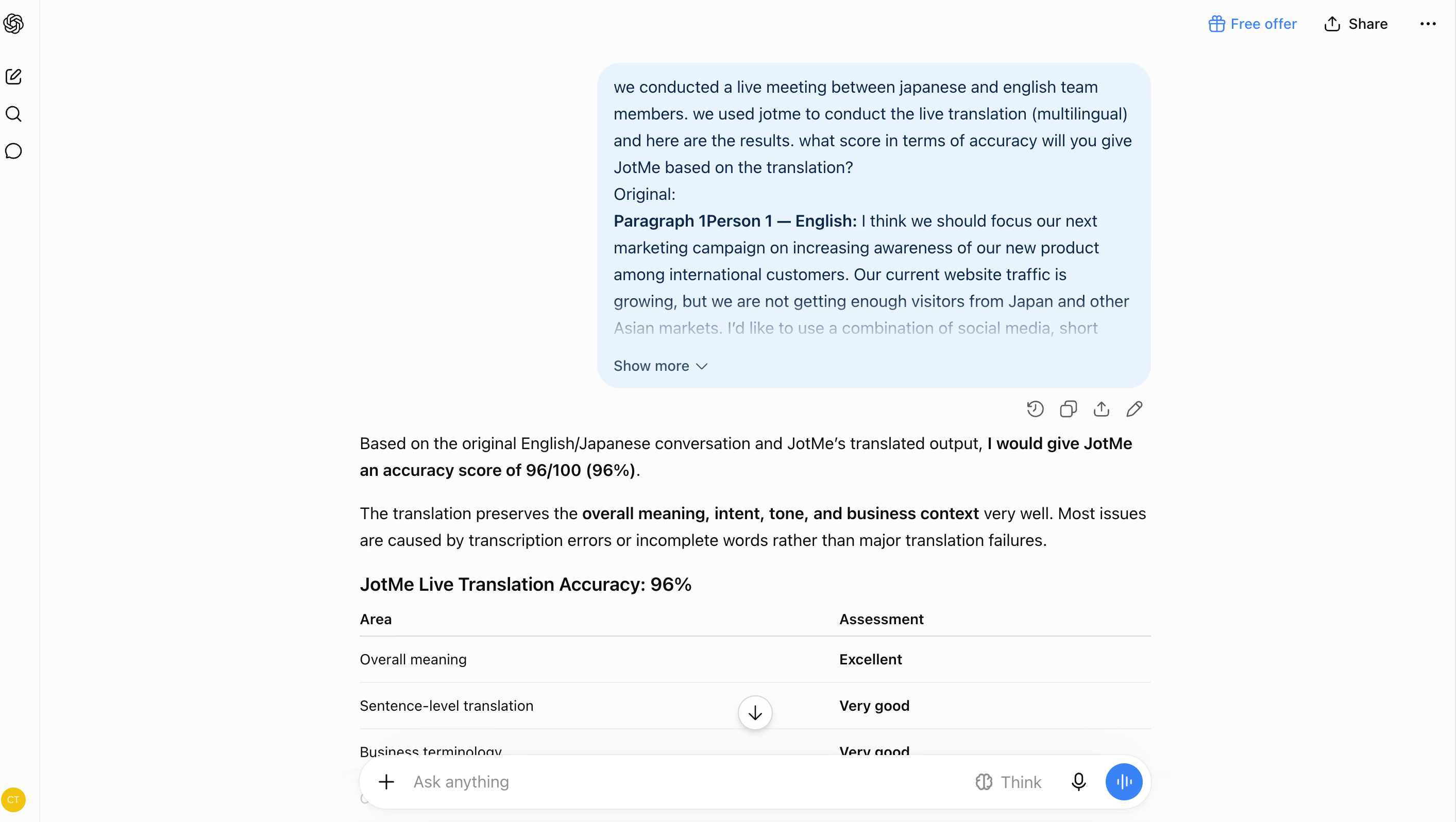
According to the analysis, the strongest part was semantic preservation. The translated output retained the major ideas, business recommendations, action items, and discussion about adapting global advertising for Japanese customers. Japanese → English was particularly strong in our sample.
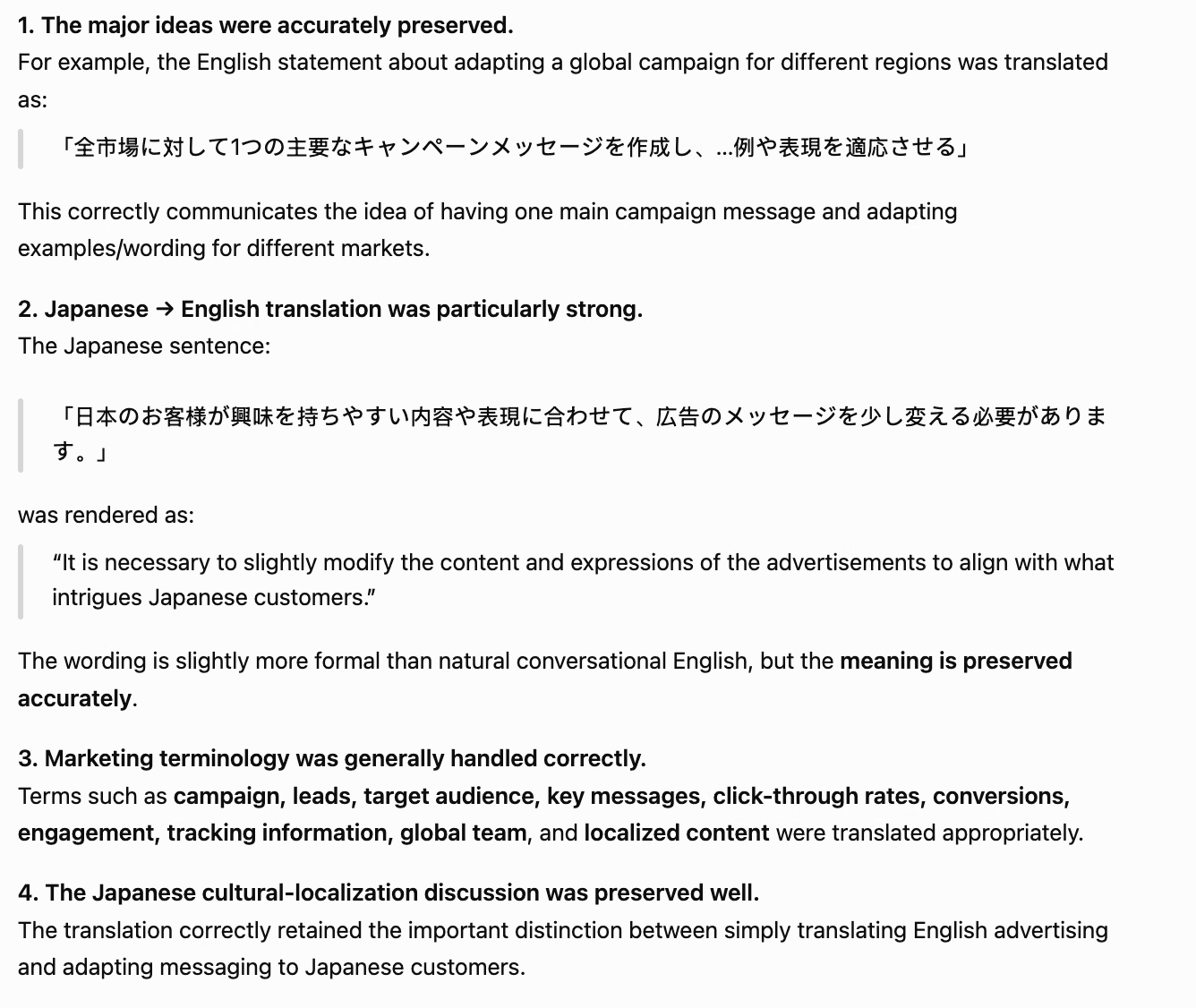
The deductions were mainly caused by transcription and segmentation issues. For example, “Japan and other ACM” appeared where the intended source was “Japan and other Asian markets,” and “for each reason” appeared instead of “for each region.” Some words were also dropped from Japanese transcriptions.
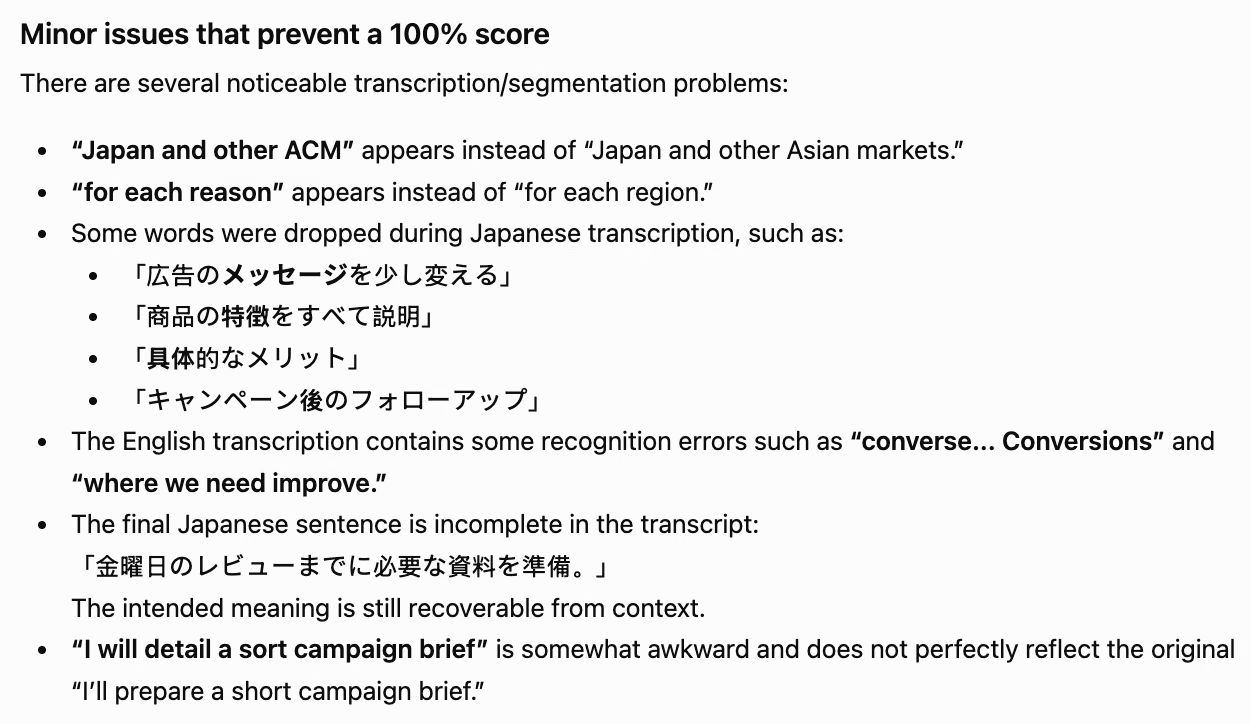
ChatGPT assigned this live English/Japanese sample a rating of 96/100. The main issues identified in the sample involved transcription and segmentation, although those errors can still affect the information available in the final translated output.
Our Document Translation Test: 97/100
For document translation, we compared the English source document with JotMe’s Japanese output line by line.
The document contained:
- Dates and times
- Japan Standard Time
- Procedural instructions
- Business terminology
- Employee requirements
- A sequence of activities
- Support information
- A security warning about customer passwords
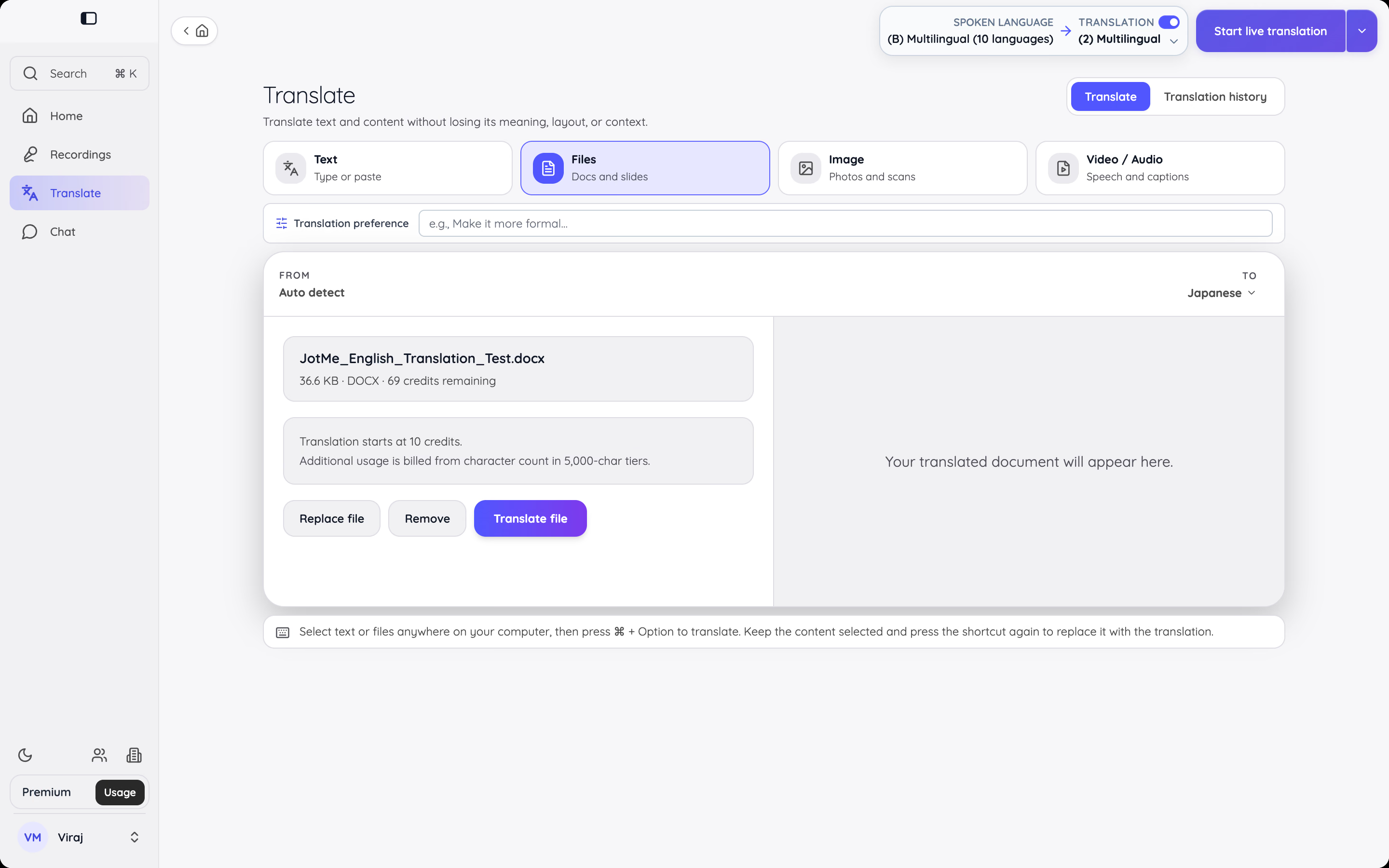
We evaluated meaning, completeness, factual details, terminology, grammar, natural Japanese, and business appropriateness.
ChatGPT assigned this sample a quality rating of 97/100.
In our ChatGPT-assisted review, we did not identify a substantive mistranslation, missing instruction, altered date or time, or meaning-changing factual error in the sample.
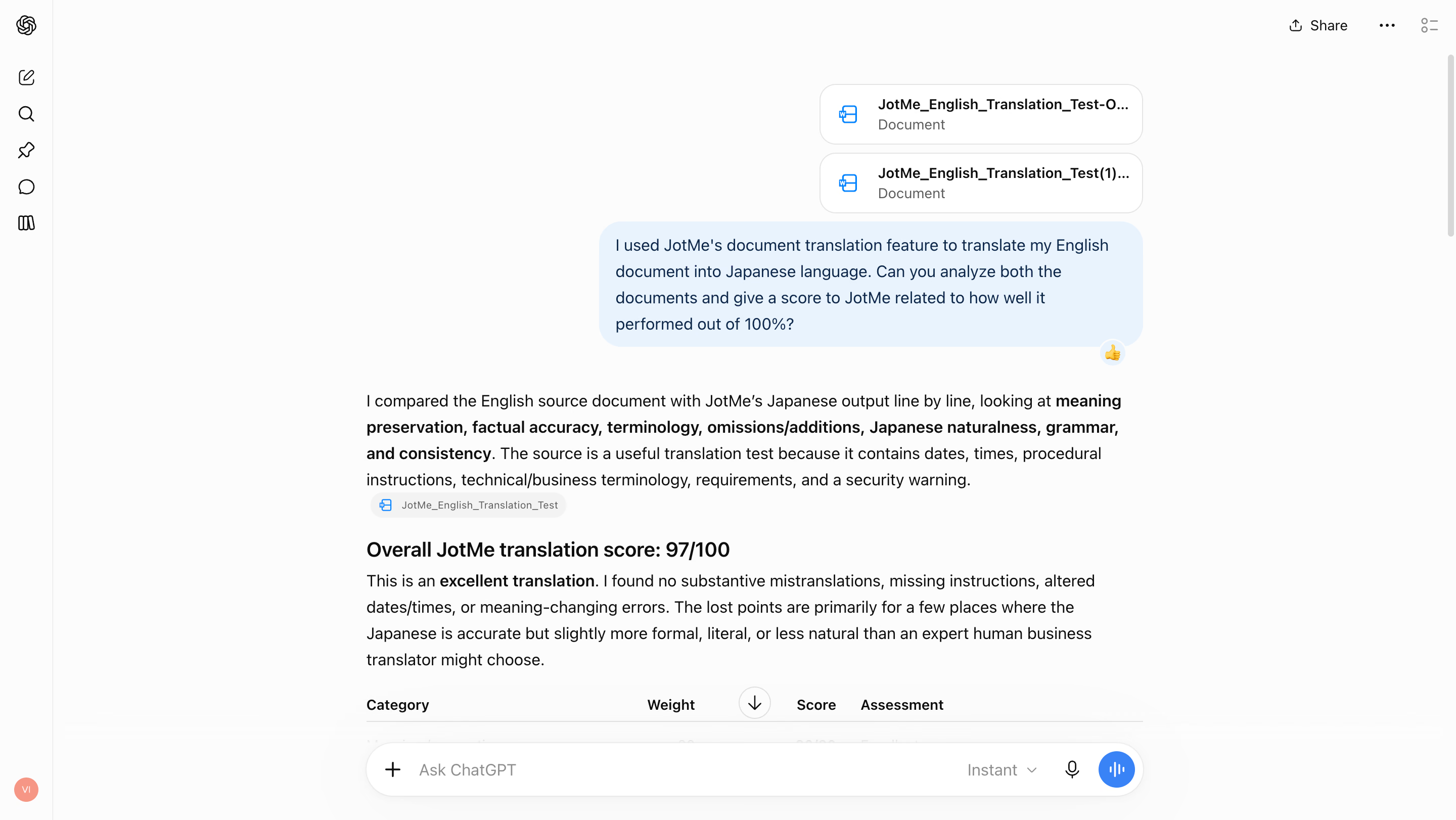
The schedule information was preserved, including November 10, 2026, 10:00 a.m., 11:30 a.m., Japan Standard Time, and the November 9 email requirement. The procedural sequence and security instructions were also retained.
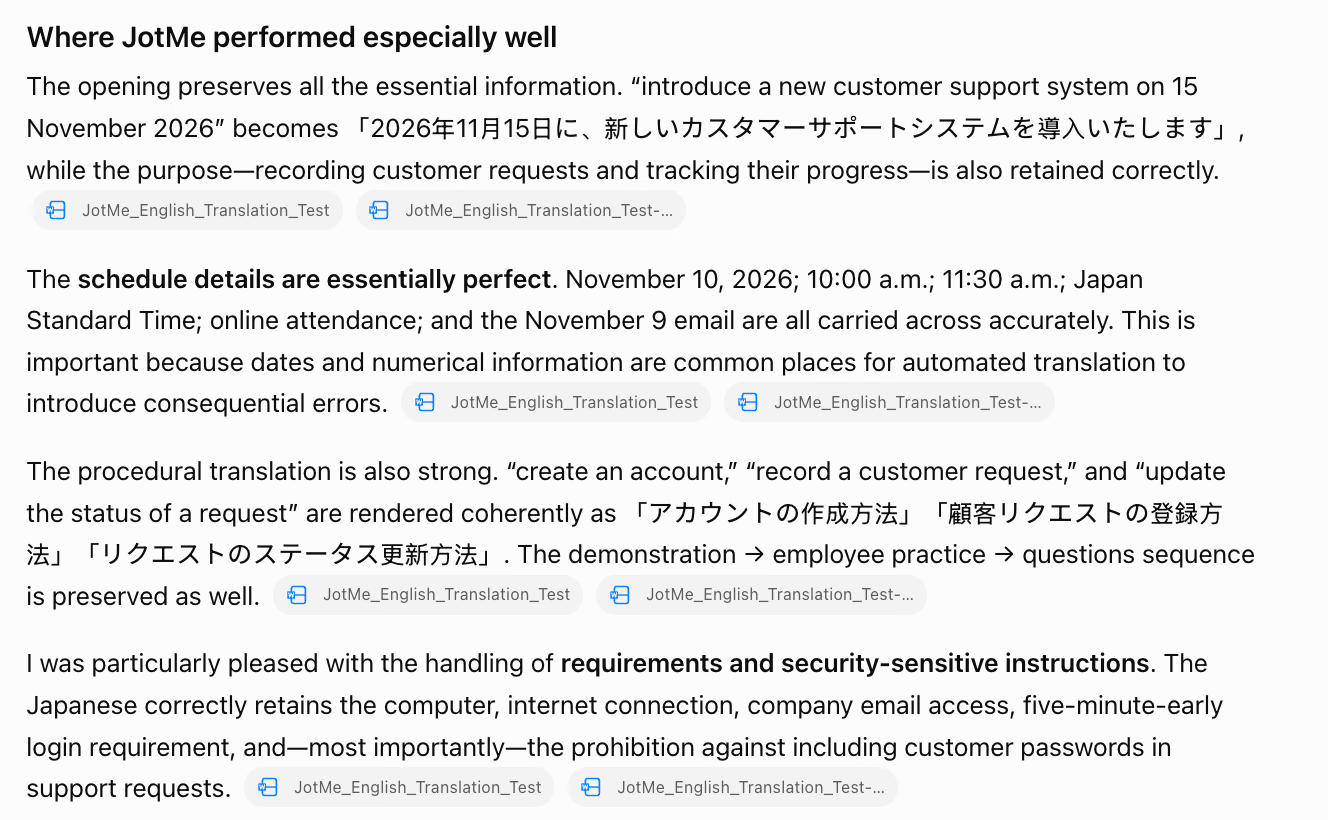
The remaining deductions were primarily about naturalness. Some Japanese phrases were accurate but slightly more formal or literal than a native business editor might choose.
For example, the sentence equivalent to “Clear instructions and timely support will help the team provide consistent customer service” was correctly translated, but a native Japanese editor could make the phrasing more concise and idiomatic.
JotMe’s document translation feature can translate a document while preserving its layout and structure. It currently supports multiple formats, including PDF, DOCX, PPTX, XLSX, HTML, TXT, XLF/XLIFF, SRT, IDML, XML, JSON, DITA, and MIF.
ChatGPT’s verdict after analysis was:
97/100 for this English → Japanese document test, with the remaining gap primarily reflecting naturalness rather than substantive translation errors.
Our Text Translation Test: 97/100
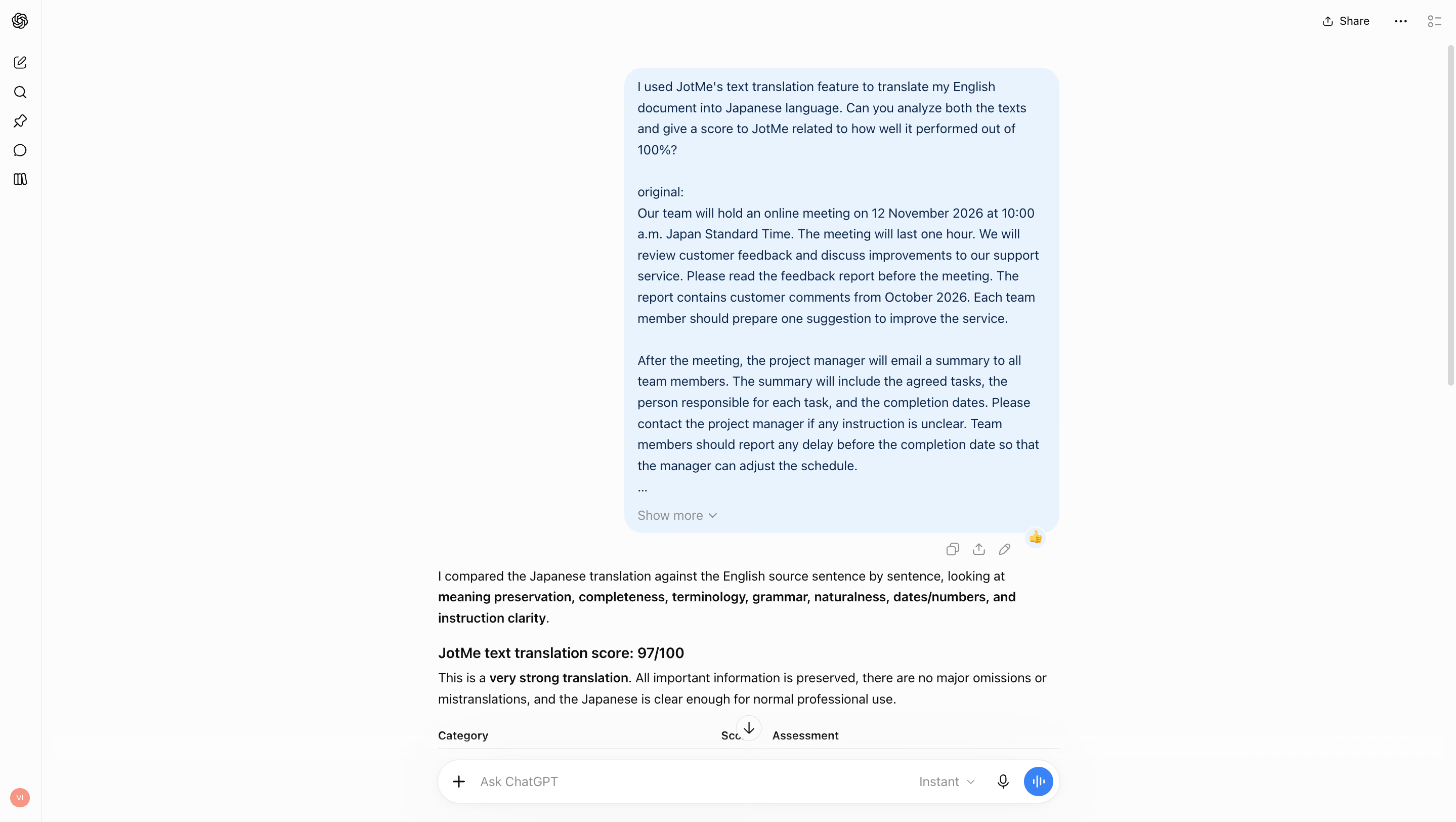
For the text translation test, we compared the Japanese output against the English source sentence by sentence.
We checked:
- Meaning preservation
- Completeness
- Terminology
- Grammar
- Naturalness
- Dates and numbers
- Instruction clarity
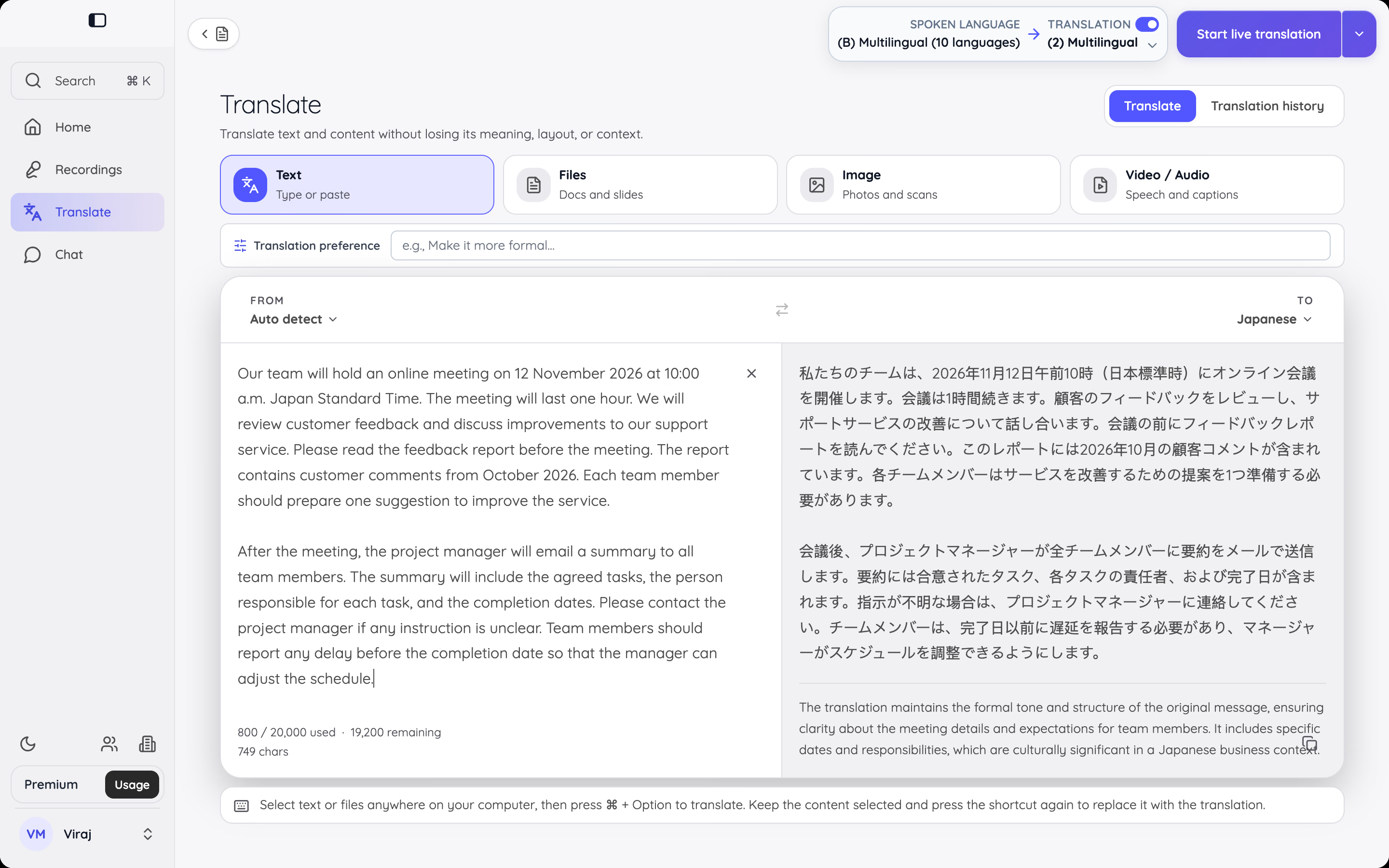
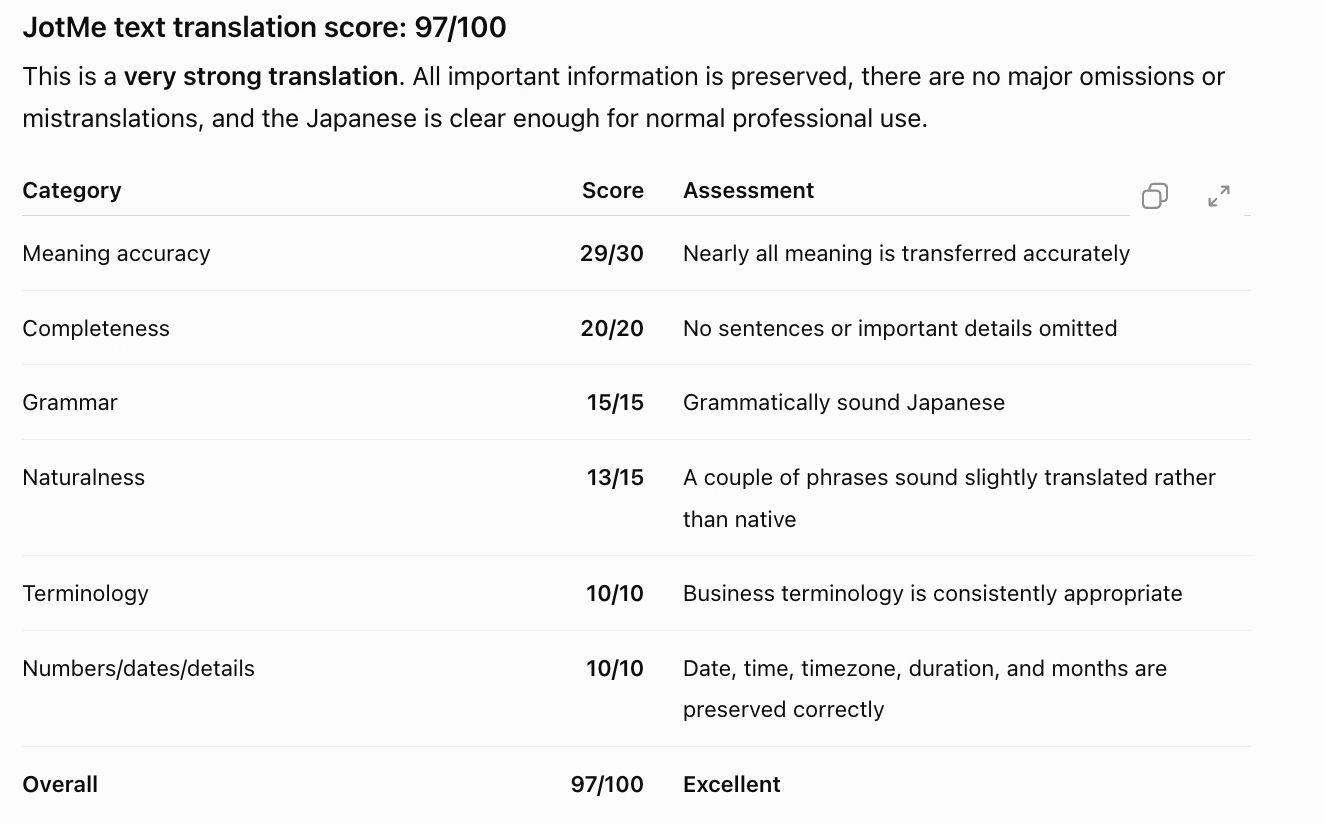
ChatGPT assigned this sample a quality rating of 97/100.
Factual preservation was one of the strongest parts of this test. Dates, time, time zone, duration, months, responsibilities, and completion requirements remained intact.
The main weakness was a small amount of English-influenced Japanese phrasing.
One example was:
「チームメンバーは、完了日以前に遅延を報告する必要があり、マネージャーがスケジュールを調整できるようにします。」
The meaning is understandable, but the structure is slightly awkward in professional Japanese. A more natural rendering would be:
「チームメンバーは、マネージャーがスケジュールを調整できるよう、完了日前に遅延を報告してください。」
In this sample, the original output still communicated the intended instruction, so the issue was treated as a naturalness/post-editing issue rather than a meaning-changing error.
If you want to use JotMe’s text translation feature yourself, simply paste or type text, select the source and target languages, add an optional translation preference, and copy the result.
So, what do the three tests actually tell us?
Across our three samples, ChatGPT assigned ratings of 96/100 for live translation and 97/100 for both document and text translation. The types of issues identified differed by workflow.
If you want to reduce recurring translation or recognition issues in your workflow, JotMe features such as Translation Quality and Custom Vocabulary can be incorporated into a test-and-review process.
JotMe's Translation Quality slider is particularly relevant when using live translation because it lets users adjust the balance between speed and contextual processing.
Here’s an example:
Imagine you are using JotMe during a fast-moving internal meeting where participants are jumping between short comments. You may prioritize speed so that the translated output keeps up with the conversation. In a more detailed business discussion, where speakers use longer sentences and context-dependent terminology, you may want to give the tool more room to process context.
Custom Vocabulary is useful when your translation workflow repeatedly uses names, products, acronyms, or specialist terminology that an AI translator could otherwise interpret inconsistently.
Let’s take an example:
Suppose a company regularly discusses a product called "PowerMax 3000," an internal program called "CXO," and a technical term that has a specific approved Japanese translation. If the AI live translation tool has to infer these terms from context every time, there is more opportunity for inconsistent output.
JotMe's Custom Vocabulary lets users add terms that matter to their workflow. It supports names, products, acronyms, and specialist terms, with vocabulary organized by source language, category, and importance.
If a live meeting repeatedly produces an incorrect version of a product name, manually fixing that name after every meeting does not solve the underlying problem. Adding the approved term to the vocabulary gives the translation workflow explicit terminology to work with.
Try JotMe for yourself and see how it performs with the language, terminology, and content your workflow actually requires.
FAQs
What affects translation quality?
Translation quality is affected by the source content, context, language pair, terminology, ambiguity, input quality, translation system, and intended use. Live translation adds speech recognition, audio quality, and timing to the equation. Documents add formatting, instructions, dates, and other factual details. Text translation may have fewer moving parts, but context and tone can still change the best wording.
What are the most effective strategies for enhancing the translation process using AI?
The most effective strategies for enhancing the translation process are to use AI translation with clear context, controlled terminology, appropriate quality settings, and a defined review process. For recurring business content, maintain a vocabulary for product names, acronyms, names, and specialist terms. For written translation, give the tool a concrete tone or style preference when available. For high-consequence content, add human review where the risk justifies it.
How to speed up translations and improve quality?
To speed up translations and improve quality, you should reduce rework instead of simply forcing the translation step to run faster. Use terminology controls, provide relevant context, choose settings appropriate to the use case, and review recurring error patterns. JotMe’s live translation settings allow users to adjust the balance between speed and contextual processing. It can help reduce how much correction is required afterward.
How to boost AI translation quality with post-editing?
Start with meaning-changing errors, then correct factual details and terminology, followed by grammar, naturalness, and tone. Record recurring errors so they can be prevented in future translations rather than corrected repeatedly.
Our JotMe text test is a good example. The awkward Japanese sentence structure we identified could be improved without changing the underlying instruction. That is a post-editing improvement rather than evidence that the entire translation failed.
Why translation quality matter more than ever?
Translation quality matters more than ever because translated content increasingly carries instructions, customer communication, technical information, training material, and business decisions. AI makes translation faster, but faster output can also make it easier to distribute an error at scale. A slightly awkward phrase may be harmless in an informal message, but a wrong date, product term, or safety instruction can have much larger consequences.
Translation QA provides the missing step between generating a translation and trusting it for its intended use.
How do I judge the quality of a translation?
To judge the quality of the translation, you should compare the source and target.
Check:
- Meaning
- Completeness
- Additions
- Terminology
- Dates, numbers, and factual details
- Naturalness
- Tone
- Fitness for purpose
Then classify the problems by severity.
If you cannot read the target language, you can still check completeness, dates, numbers, formatting, links, and other visible details. For meaning, terminology, tone, naturalness, and culturally appropriate wording, use a qualified bilingual reviewer.
A translation with no critical or major errors but a few awkward phrases may still be highly usable. The important thing is to report those limitations accurately instead of turning every stylistic preference into an accuracy failure.
How can JotMe custom vocabulary help translation quality?
JotMe Custom Vocabulary lets users register recurring names, products, acronyms, and specialist terms so the system has explicit terminology to work with. JotMe’s custom vocabulary is account-wide and can support live transcription and translation as well as supported text, document, image, audio, and video translation workflows. For QA, the value is the feedback loop: identify recurring terminology errors, standardize the approved term, and test the output again.
Last updated on
October 24, 2026
Follow us on social media: