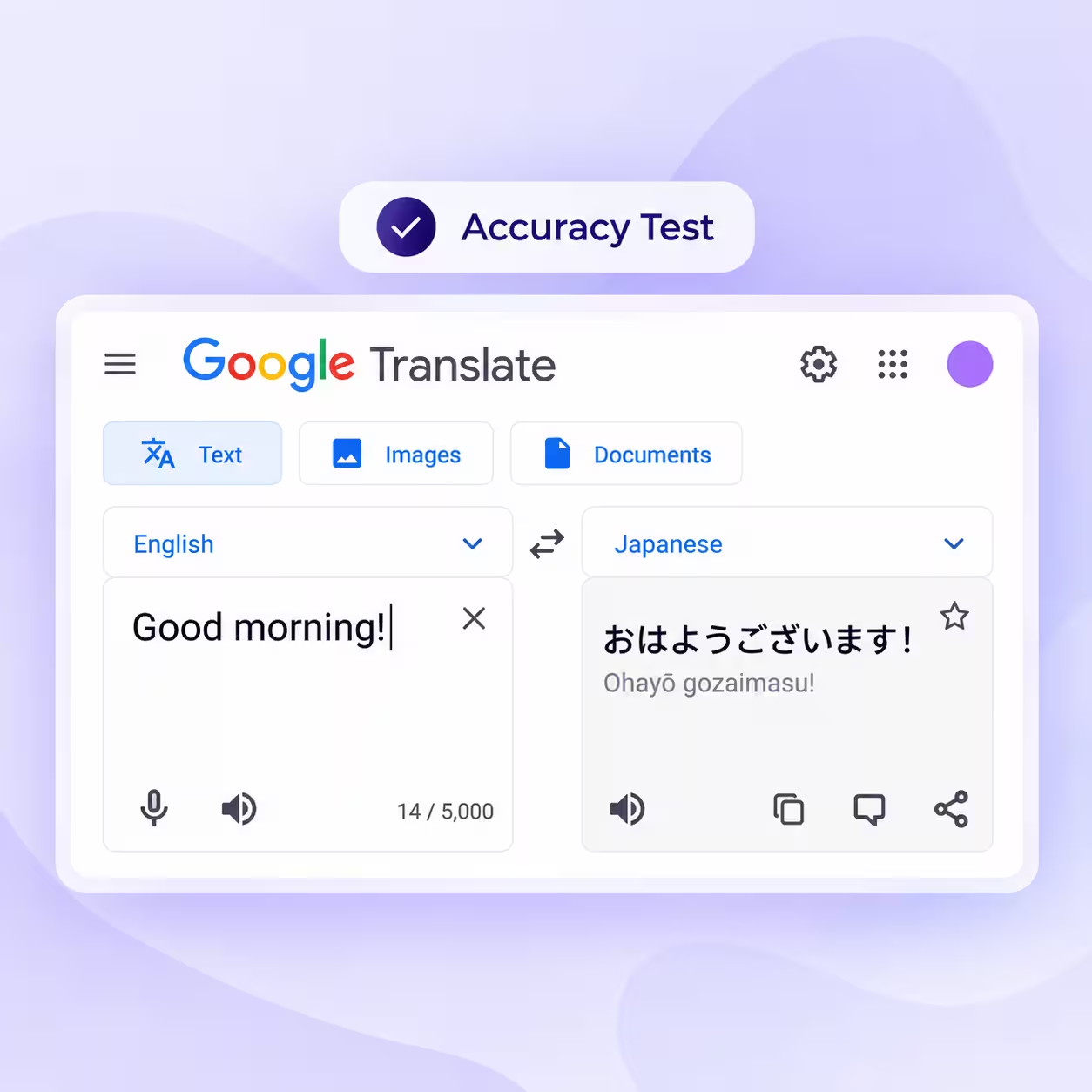







What is Transliteration? Definition & Examples

Viraj Mahajan
October 21, 2026
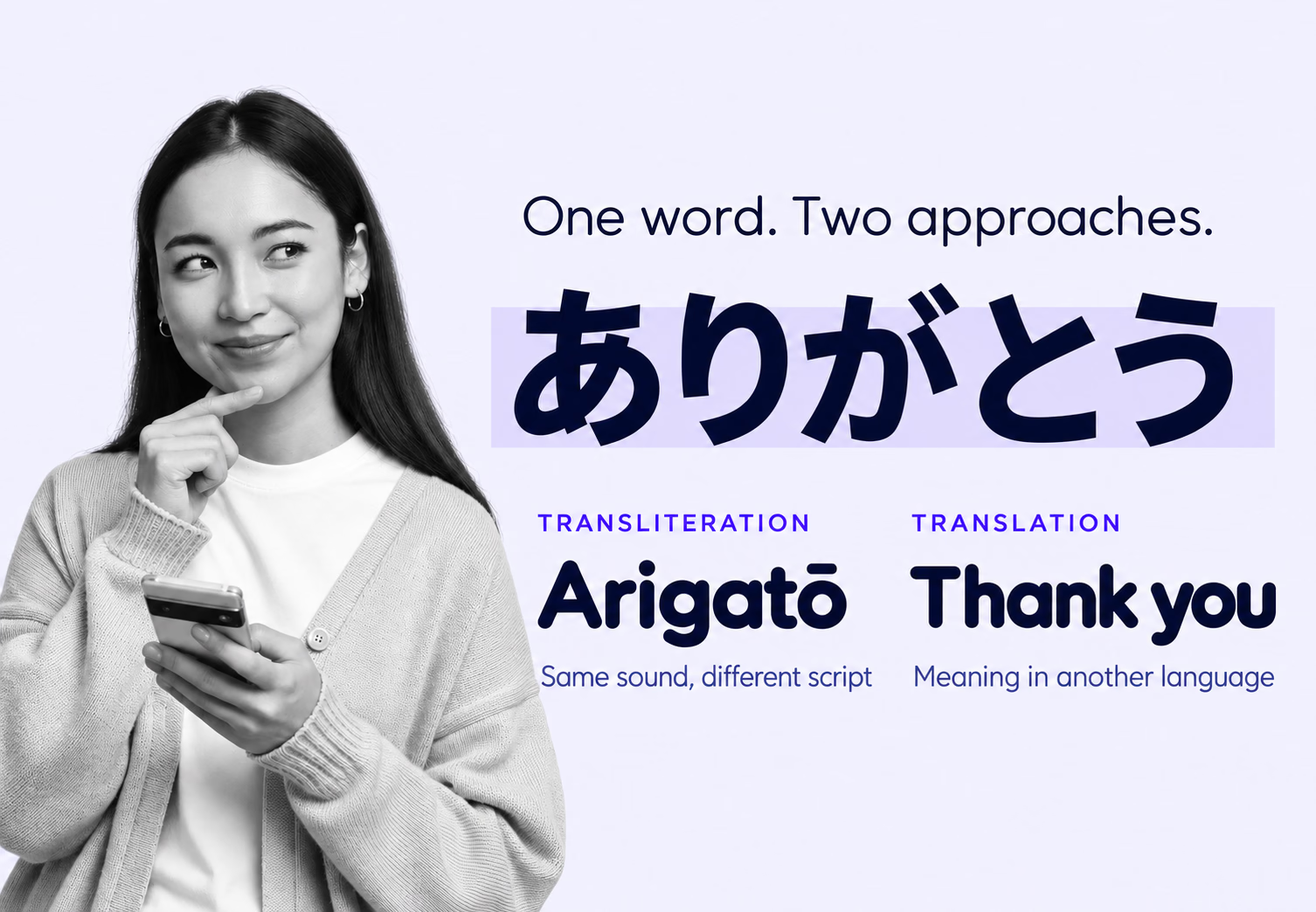
Transliteration is the process of representing text written in one script using another script, usually while keeping the original word recognizable by its pronunciation or spelling.
For example, “Spasibo” represents the Russian word in Latin script, while “thank you” conveys its meaning in English.
In other words, transliteration changes the script used to write a word, whereas translation expresses its meaning in another language. You can transliterate a name without translating it, and you can translate a sentence without transliterating it.
What is Transliteration
Transliteration converts written text from one writing system into another according to a defined set of rules. The source language does not necessarily change. What changes is the script used to represent it.
For example:
- Arabic: محمد → Muhammad
- Russian: Москва → Moskva
- Hindi: नमस्ते → namaste
- Japanese: こんにちは → konnichiwa
- Greek: Αθήνα → Athína or Athina, depending on the system used
The important point is that these are not translations of the source words. They are representations of the same written forms in another script.
A useful way to remember it is:
- Transliteration answers: “How can I write this in another script?”
- Translation answers: “What does this mean in another language?”
Transliteration is especially useful when readers need to recognize, search for, enter, pronounce, or preserve a name or term but cannot read the original script.
Transliteration is also more technical than simply “writing a foreign word in English letters.” Different languages and script pairs have different conventions. Some systems aim for a reversible, character-by-character mapping. Others prioritize a spelling that gives target-script readers a closer approximation of the source pronunciation.
That is why one source word can sometimes have more than one accepted transliteration.
For example, محمد may appear as Muhammad, Mohammad, Mohamed, or Muhammed in Latin script. The variation does not automatically mean one version is wrong. It can reflect different transliteration systems, language conventions, or established personal-name spellings.
Romanization is specifically the representation of text from a non-Latin script using the Latin alphabet. It is often treated as a form of transliteration, although terminology can vary depending on the linguistic or technical context.
How Does Transliteration Work
Transliteration works by applying rules that map characters, character combinations, or other written units in a source script to characters in a target script.
A simple workflow looks like this:
Source script → transliteration system → target script
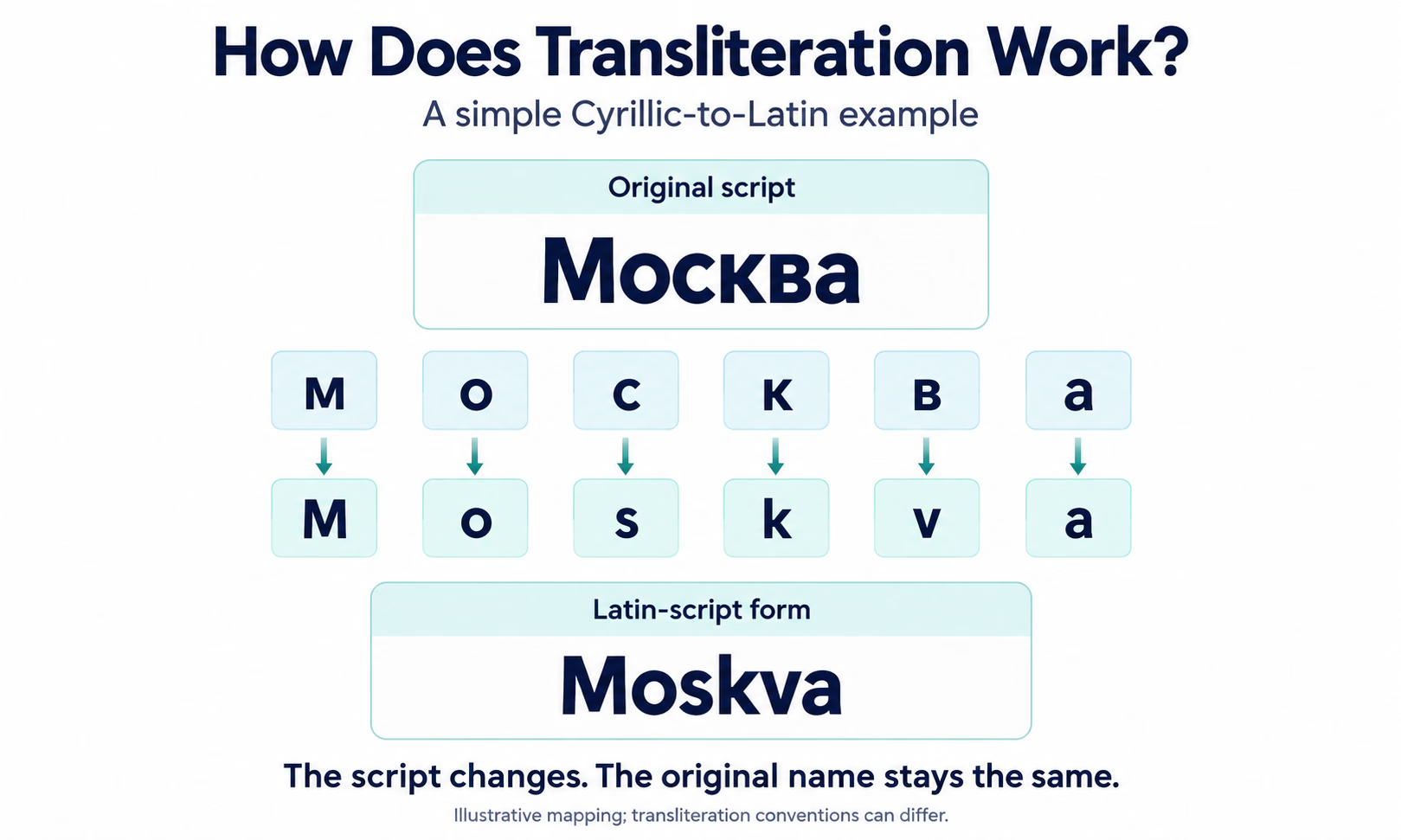
Consider the Russian word Москва.
- Start with the original Cyrillic spelling: Москва
- Apply the chosen Cyrillic-to-Latin rules.
- Produce Moskva using the chosen Cyrillic-to-Latin transliteration system.
- If the goal is English meaning rather than script conversion, use the English name Moscow instead.
| Source Character | Latin Representation |
|---|---|
| М | M |
| о | o |
| с | s |
| к | k |
| в | v |
| а | a |
Note: This is a simplified character-by-character illustration. The actual transliteration systems can use character combinations, diacritics, or contextual rules rather than a strict one-character-to-one-letter mapping.
The same source word can have different Latin-script spellings because transliteration depends on the system being used. Some systems aim for a consistent character-to-character mapping, while others prioritize readability or approximate pronunciation. Diacritics can also be used to represent distinctions that are difficult to show with basic Latin letters.
For example, Japanese 東京 can appear as Tōkyō in a formal romanization system, while Tokyo is the established English form. Both relate to the same Japanese name, but they serve different purposes. This is why a transliteration should be evaluated against the convention and context in which it is being used rather than treated as a single universally correct spelling.
What are Some Examples of Transliteration in Language Translation
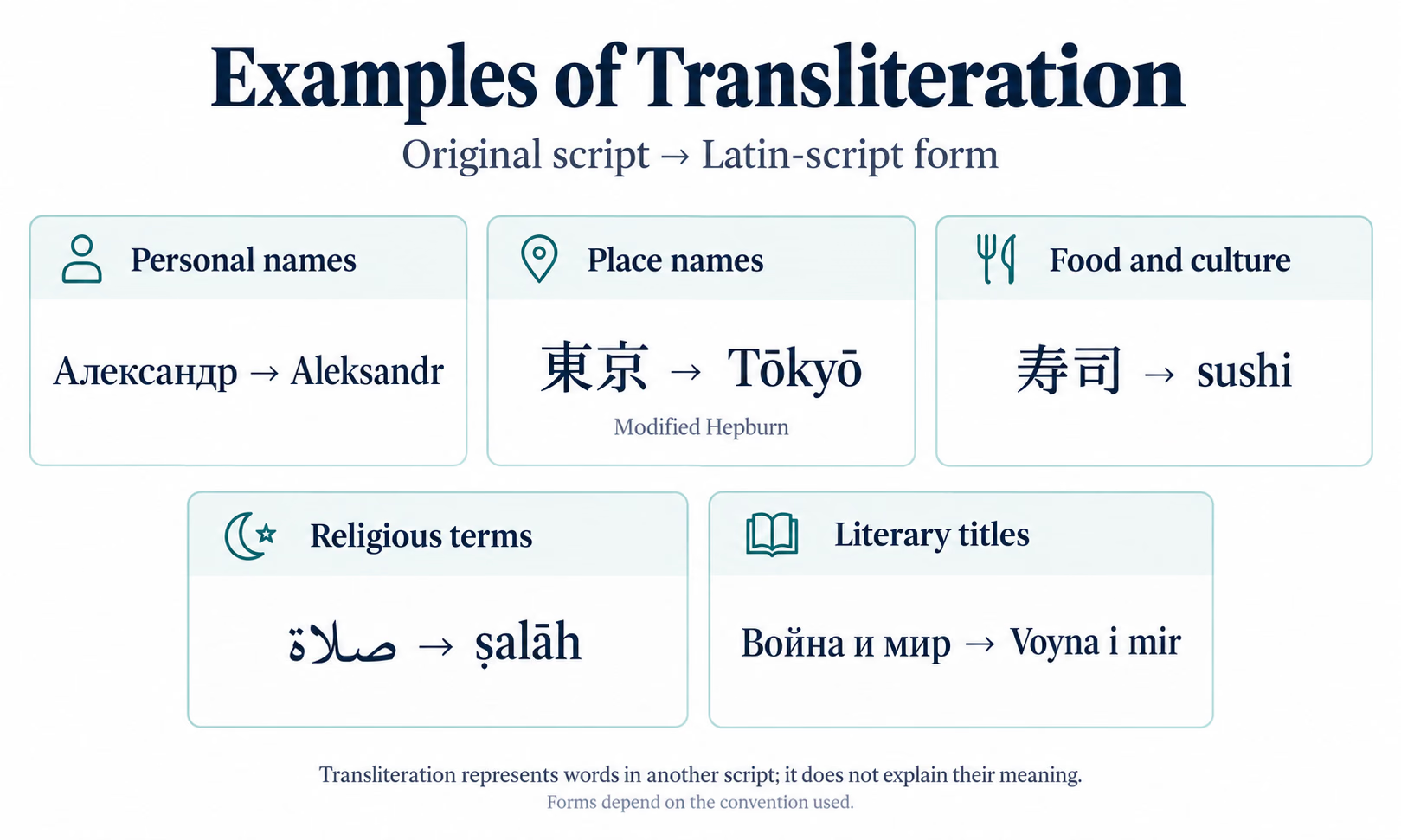
Transliteration is commonly used for names, places, cultural terms, food, and other words that need to be represented in a different script without translating their meaning. For example, Japanese こんにちは can be transliterated as konnichiwa, Russian Москва as Moskva, Greek Αθήνα as Athina, and Arabic محمد as Muhammad.
In each case, the original word or name remains in the same language and only the writing system changes. This can make foreign-language terms easier to read, type, search for, or reference when the original script is unfamiliar or unavailable. However, transliteration does not always give the reader enough information to understand the term. A person who sees konnichiwa may be able to read or pronounce it, but still may not know that it means “hello.”
This is why transliteration is useful for preserving the identity of a word or name, while translation is needed when the reader's goal is to understand its meaning.
1. Personal Names
Names are one of the clearest examples of transliteration because a person's identity does not change just because the script does.
- Arabic: محمد → Muhammad
- Russian: Александр → Aleksandr under a transliteration convention
- Greek: Γεώργιος → Georgios
- Hebrew: דוד → David
- Hindi: राहुल → Rahul
- Japanese: 田中 → Tanaka
A practical complication is that official names may already have an established Latin spelling. In that case, generating a new transliteration from the original script may create a mismatch.
For example, two people with the same Arabic name محمد might officially spell it as “Mohamed” and “Muhammad” in their documents. Both can be valid personal-name spellings. A system handling identity data should not assume there is one universally correct Latin form.
2. Place Names
Geographic names are another common use.
- Russian: Москва → Moskva
- Ukrainian: Київ → Kyiv
- Arabic: دبي → Dubayy in some formal systems; Dubai is the widely established English form
- Japanese: 東京 → Tōkyō in formal romanization; Tokyo is standard English usage
- Hindi: मुंबई → Mumbai
Place names show why transliteration and translation can overlap with another concept: conventional or exonymic names.
For example:
Москва → Moskva = transliteration
Москва → Moscow = established English name/conventional English form
The second is not simply a Latin-script spelling of the Russian word. It is the English name used for the city.
3. Food and Cultural Terms
Transliteration is useful when a food or cultural term does not need to be replaced by an English equivalent.
Examples include:
- Hindi: समोसा → samosa
- Japanese: 寿司 → sushi
- Arabic: حمص → hummus
- Korean: 김치 → gimchi/kimchi, depending on the romanization or established English usage
- Hindi: योग → yoga
But these examples need context. “Samosa” is recognizable in English, but an English reader may still need a translation or explanation such as “a filled savory pastry.” Transliteration makes the term readable, but it does not guarantee that the reader understands what it means.
4. Religious and Culturally Specific Terms
Religious texts contain many terms that are transliterated rather than replaced with a supposedly equivalent English word.
Examples include:
- Arabic: القرآن → al-Qur'an
- Arabic: الصلاة → al-ṣalāh in a scholarly transliteration
- Sanskrit: धर्म → dharma
- Sanskrit: कर्म → karma
The reason is not simply pronunciation. A culturally specific term may carry meanings, associations, and traditions that do not map neatly onto one target-language word.
In these cases, a publication may use the transliterated term and then explain it in the surrounding text.
5. Literature, Titles, and Historical Names
Libraries, academic publications, museums, and publishers often need a consistent way to represent titles and names written in another script.
For example:
- Russian: Война и мир → Voyna i mir → War and Peace (English meaning)
- Japanese: 源氏物語 → Genji Monogatari → The Tale of Genji (English meaning)
The exact form depends on the transliteration or romanization system required by the publication.
The best transliteration depends on what the reader needs to do with the text. A scholarly publication, library catalog, or database may require a standardized system with specific rules and diacritics. A travel website may instead use a familiar spelling that is easier for general readers to recognize. Personal names can be different again because the person may already use a particular Latin-script spelling in passports, publications, or professional profiles.
This means that two spellings can both be valid without being interchangeable in every situation. When accuracy matters, identify the transliteration or romanization system first. When dealing with names, also check whether an established spelling already exists. For common words and place names, distinguish a formal transliteration from the form normally used in English.
Translation vs. Transliteration: Understanding the Differences
The easiest way to separate translation and transliteration is to ask what you want to preserve.
Translation preserves meaning. Transliteration preserves the written identity or pronunciation of a source term across scripts.
| Transliteration | Translation | |
|---|---|---|
| Main Goal | Convert scripts | Convey meaning in another language |
| Changes Language? | Not necessarily | Yes |
| Changes Script? | Yes | Not necessarily |
| Focus | Representation, spelling, pronunciation | Meaning, context, intent |
| Example | こんにちは → konnichiwa | こんにちは → hello |
| Typical Use | Names, places, terms, identifiers | Sentences, instructions, articles, documents |
Here is another example:
Arabic: مرحبا
- Transliteration: marhaba
- Translation: hello
The first gives a Latin-script representation of the Arabic word. The second tells an English reader what the word means.
However, one important thing to remember is that translation can happen after transliteration when a reader needs both the original term and its meaning, but translation does not require transliteration first.
Suppose a restaurant menu contains:
寿司
A Latin-script reader may first need the transliteration:
sushi
But if they do not know Japanese food vocabulary, they may still need an English explanation or glossary, such as:
sushi — Japanese dish made with vinegared rice, often served with seafood or vegetables
That is the practical difference: transliteration can make a term readable in a more familiar script, whereas translation makes its meaning understandable.
This distinction becomes important in multilingual websites, product interfaces, travel content, subtitles, academic writing, legal documents, and customer support.
Types of Transliteration and/or Translation
There is no single universal “type” of transliteration because different systems are designed for different purposes. It is more useful to classify transliteration by what the system tries to preserve. One thing to note is that these categories are not mutually exclusive. They describe different dimensions of transliteration, such as the level of standardization, the intended pronunciation, the target script, or whether translation is provided alongside the transliteration.
1. Strict or Standardized Transliteration
A strict system aims for a consistent mapping between source-script characters and target-script characters. This can make the result less intuitive to an ordinary reader, but it can be valuable for catalogs, archives, databases, and scholarly work.
ISO 9 for Cyrillic is an example of a formal transliteration standard designed to support consistent conversion.
2. Phonetic or Pronunciation-Oriented Representation
Some transliteration systems prioritize how the source is pronounced rather than preserving a strict character relationship.
This is helpful when the reader's main goal is to say the word aloud.
In narrower linguistic terminology, a sound-focused representation may be described as transcription rather than transliteration, depending on the system and purpose.
However, pronunciation-oriented transliteration systems can vary more by language, dialect, and audience. They should not automatically be treated as interchangeable with formal transliteration.
3. Romanization
Romanization means representing text from a non-Latin script using the Latin alphabet. It is often treated as a form of transliteration, although the terminology can vary across linguistic and technical contexts.
For example:
- 北京 → Běijīng — Hanyu Pinyin
- 東京 → Tōkyō — Hepburn romanization
- Москва → Moskva — Cyrillic-to-Latin transliteration
- नमस्ते → namaste — Latin-script romanization
Romanization is especially common when text needs to work with Latin-based keyboards, databases, search systems, URLs, or software.
Unlike the other categories in this section, romanization describes the target script rather than the specific purpose or level of standardization. A romanized form can therefore also follow a standardized or pronunciation-oriented system.
4. Transliteration with Translation
Sometimes the best output contains both transliteration and translation.
A useful presentation approach is to provide transliteration alongside translation. For example:
धर्म (dharma): a concept with meanings that can include duty, conduct, or a moral order depending on context.
Here, transliteration preserves the original term, while the explanation supplies meaning.
This approach is common for cultural, religious, historical, and technical vocabulary where a single translated word would be incomplete or misleading.
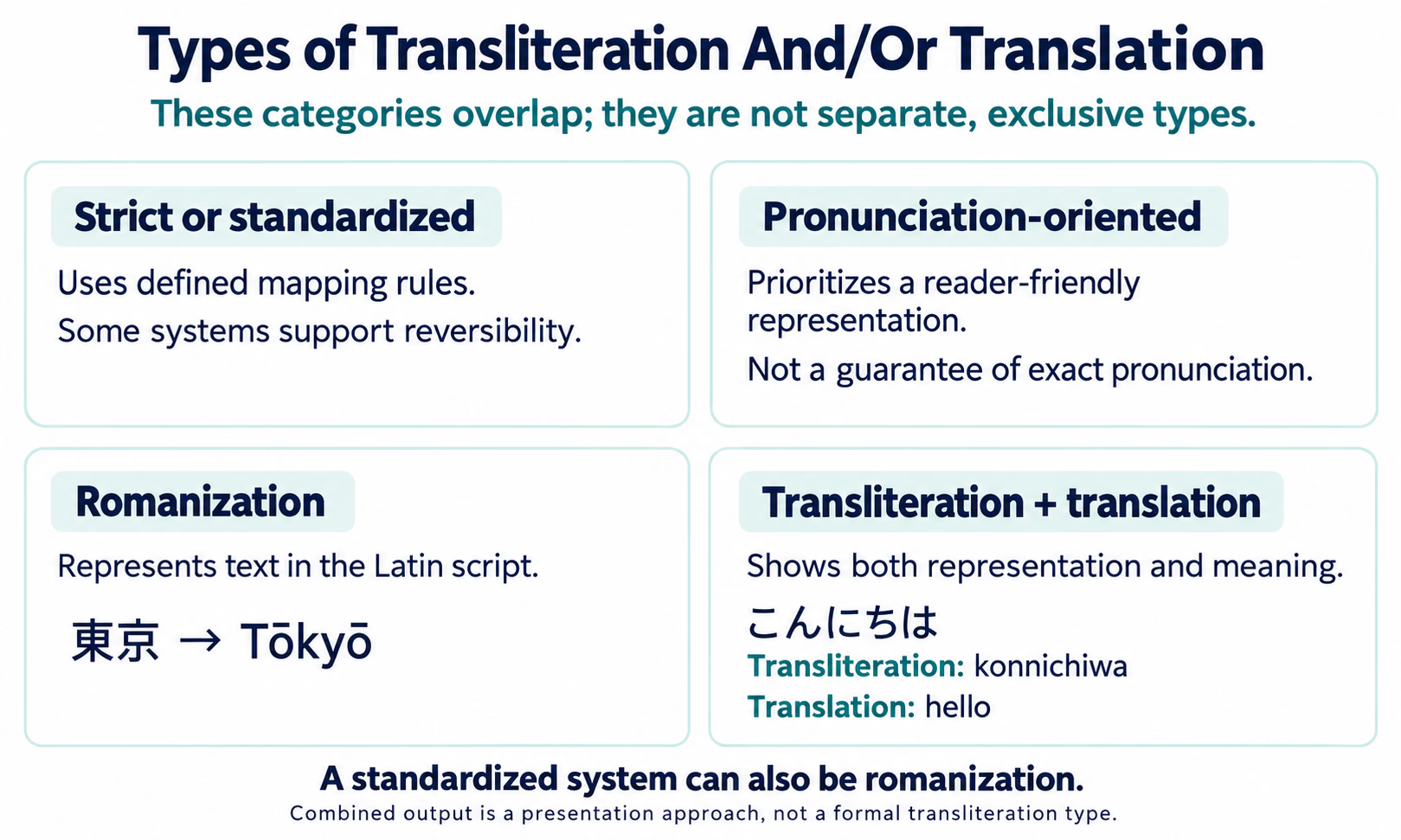
Note: These categories can overlap. A single transliteration can fit more than one category.
When Do You Need Translation Instead of Transliteration
You can use translation instead of transliteration when your goal is to understand the meaning of the original text or speech and not simply read it in another script.
Transliteration can turn Japanese こんにちは into konnichiwa, for example. But if you don't know Japanese, you still may not know that it means “hello.”
The same problem occurs with spoken language. Hearing a Spanish sentence written phonetically in English letters does not tell an English speaker what the sentence means. They need a translation.
A simple rule is to:
- Use transliteration when you need to read or pronounce the original term.
- Use translation when you need to understand it.
Here are some situations where translation is the better choice.
Use Case 1: When You're Having a Conversation in Another Language
Imagine you are an English speaker visiting Japan. A hotel employee says:
チェックインは3時からです。
For comparison, the sentence can be romanized as:
Chekku-in wa san-ji kara desu.
That is easier to read, but it does not tell you what the person actually said.
A translation gives you:
“Check-in starts at 3 o’clock.”
If the conversation is happening live, you don't want to stop after every sentence to type or copy the words into a transliteration tool. You need the speech translated as the conversation happens.
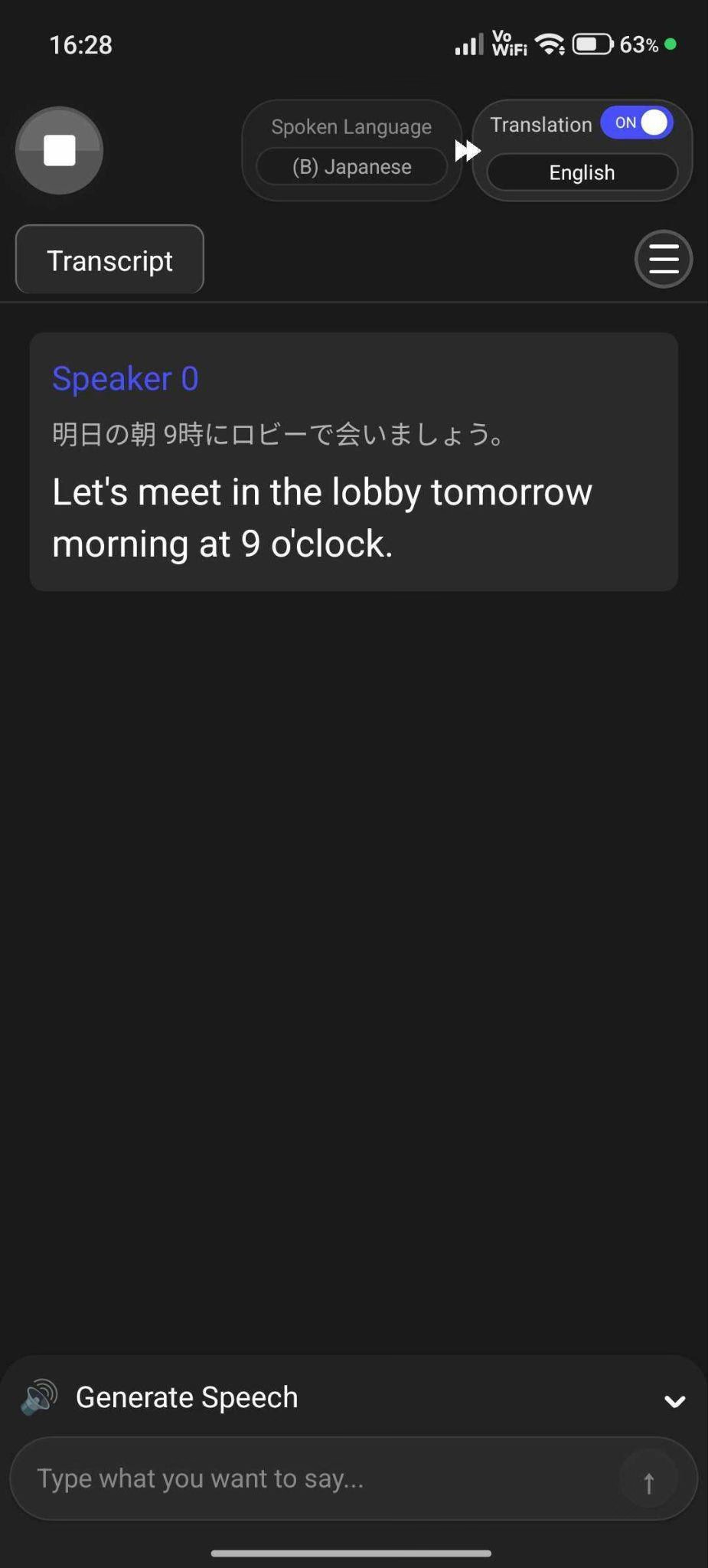
This is where JotMe's live translation on its mobile app can be useful. You select the language being spoken and the language you want to understand, and JotMe can provide real-time translated captions and optional translated speech. It can maintain context as the conversation continues.
Example:
Japanese speaker:
「明日の朝、9時にロビーで会いましょう。」
For comparison, the sentence can be romanized as:
Ashita no asa, ku-ji ni robī de aimashō.
Translation:
“Let's meet in the lobby tomorrow morning at 9 o’clock.”
The transliteration helps you read the Japanese sentence. The translation helps you know what you need to do.
Use Case 2: When You're Speaking With an International Client
Suppose you are an English-speaking sales representative speaking with a client in Spain.
Your client says:
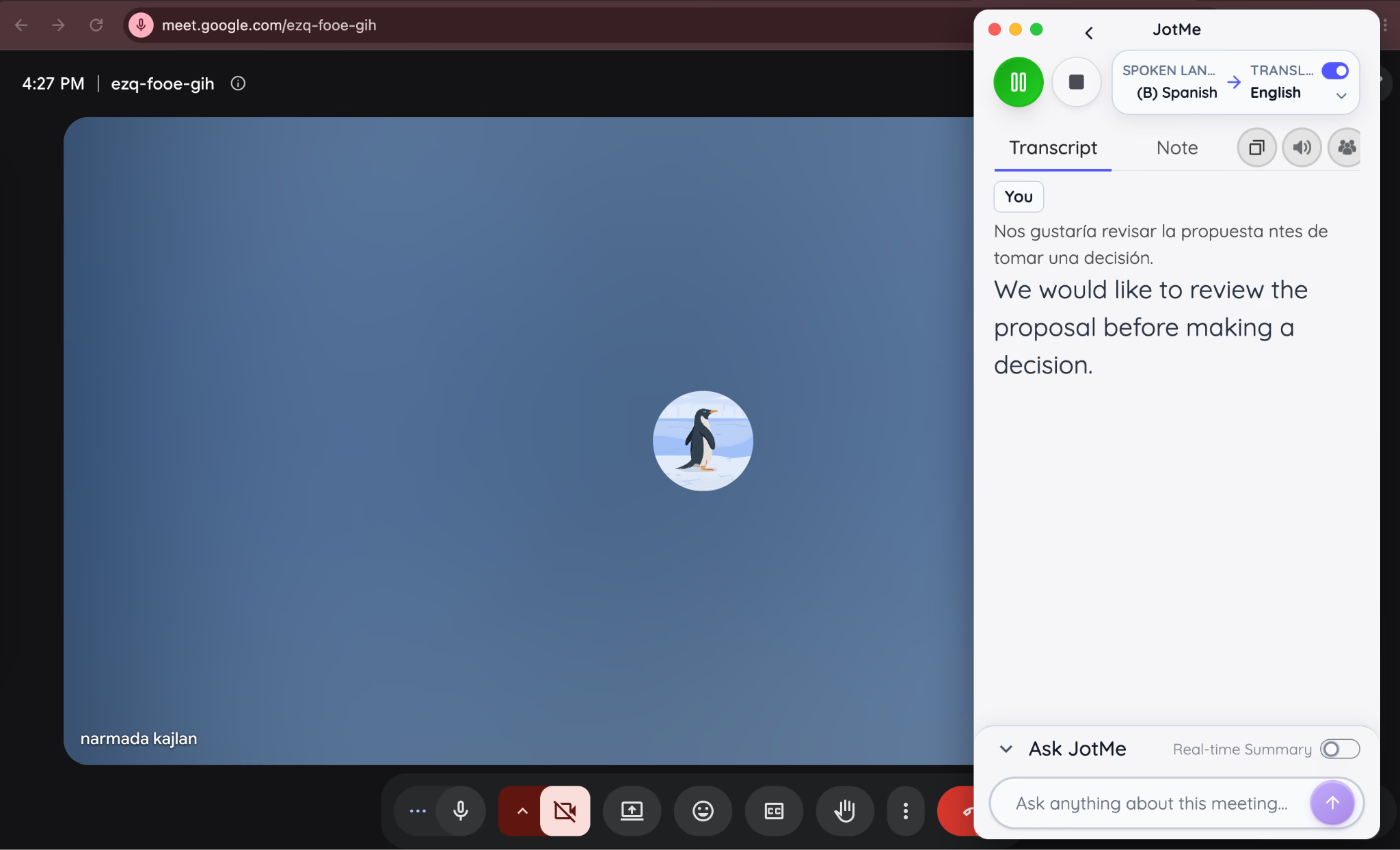
“Nos gustaría revisar la propuesta antes de tomar una decisión.”
A transliteration is not useful here because Spanish already uses the Latin alphabet. The problem is the language.
You need (just like JotMe translates Spanish to English in the screenshot):
“We would like to review the proposal before making a decision.”
This is an important distinction: translation is not limited to situations where different writing systems are involved.
Spanish and English both use the Latin alphabet, but they are different languages. Transliteration does not solve that problem, but translation does.
For live client calls, JotMe can translate conversations in real time, including English-to-Spanish and Spanish-to-English conversations. Its live translation can provide captions and voice output, so participants can follow the discussion without manually translating each sentence.
Use Case 3: When You're Translating an Email, Message, or Piece of Text
Sometimes the input is not a conversation at all.
You might receive a Japanese email from a supplier:
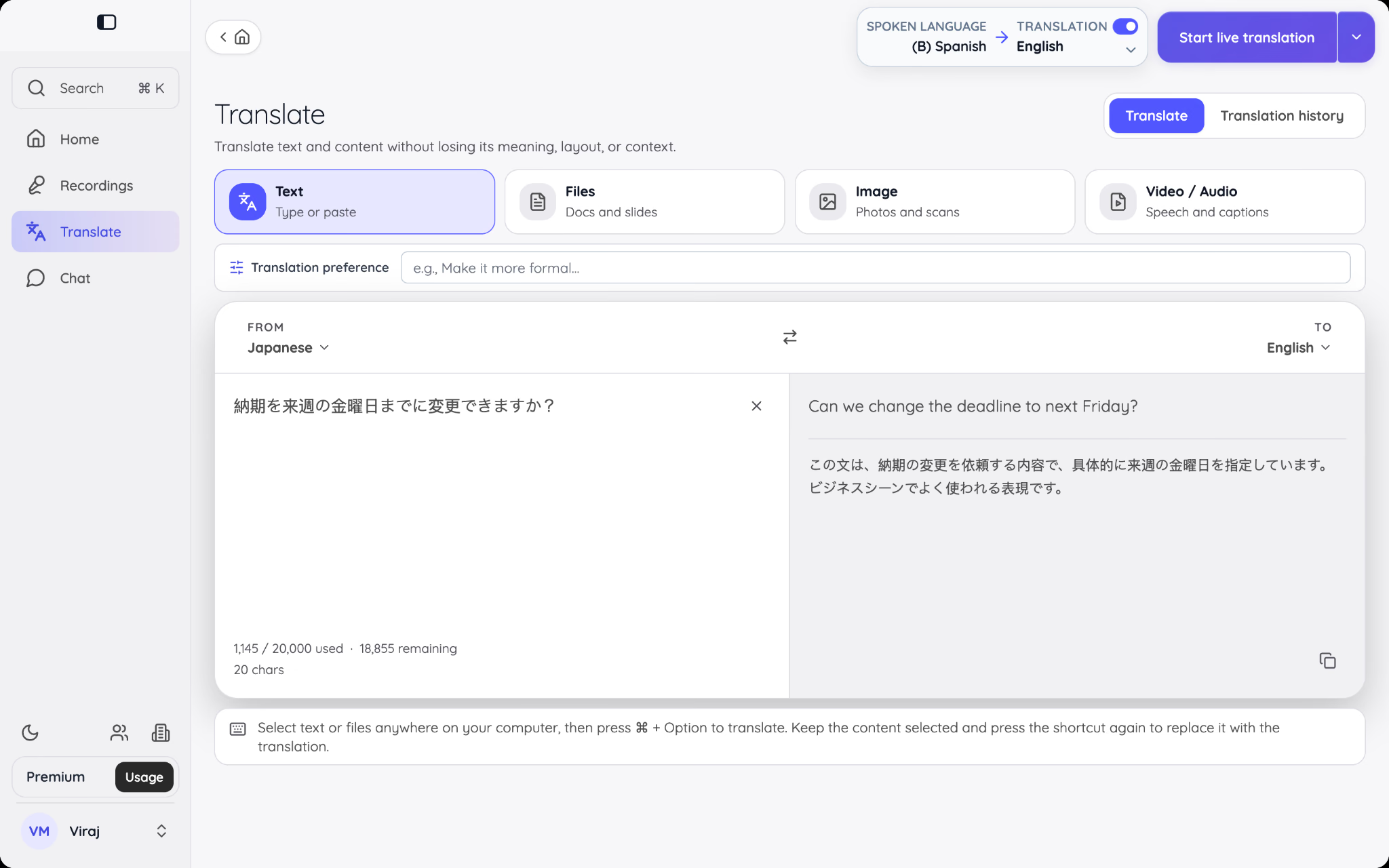
納期を来週の金曜日までに変更できますか?
You don't need the Japanese text represented in Latin letters. You need to know what it says:
“Can we change the deadline to next Friday?”
JotMe's Text translation lets you paste or type text, select the source and target languages, and translate it. You can also add a preference for the tone or style of the translation, for example, asking for a more formal version.
Use Case 4: When You Need to Translate a Document
A transliteration can make individual words readable, but it won't turn a foreign-language contract, presentation, report, or PDF into something your team can actually work with.
For example, imagine receiving a Japanese product specification from a supplier.
You could transliterate:
製品仕様書 → Seihin shiyōsho
Now you can read the Japanese term using Latin characters, but you still don't know what the document says.
You need the document translated.
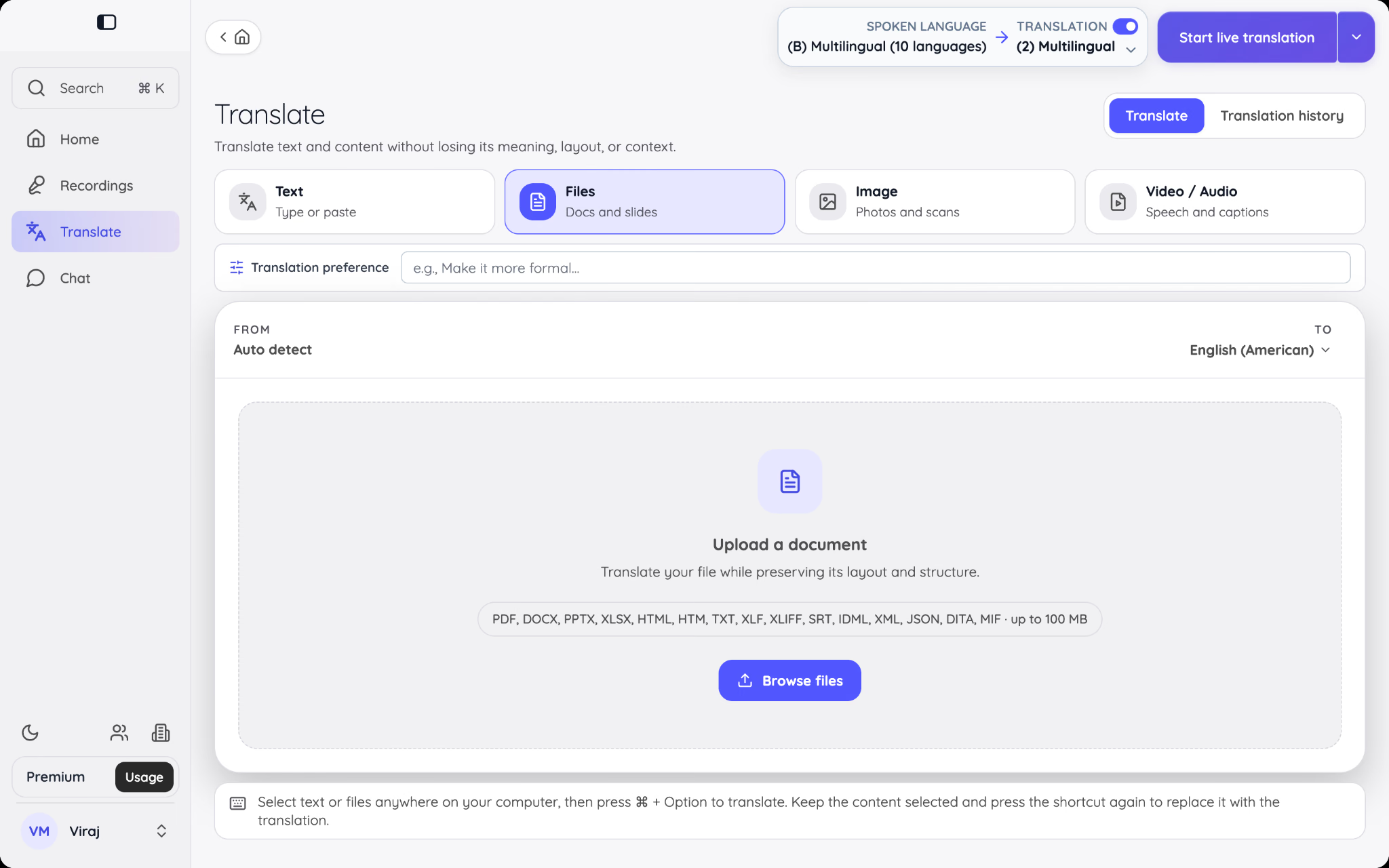
JotMe’s document translation feature can translate documents while preserving their structure and layout, rather than requiring you to copy and paste every section manually. Its translation workspace supports documents and slides in addition to plain text.
Use Case 5: When The Text is Inside an Image
The same problem appears with menus, signs, screenshots, scanned documents, product labels, and photographs.
Suppose you are in Tokyo and take a photo of a restaurant menu.
Transliteration could turn:
寿司盛り合わせ
into:
Sushi moriawase
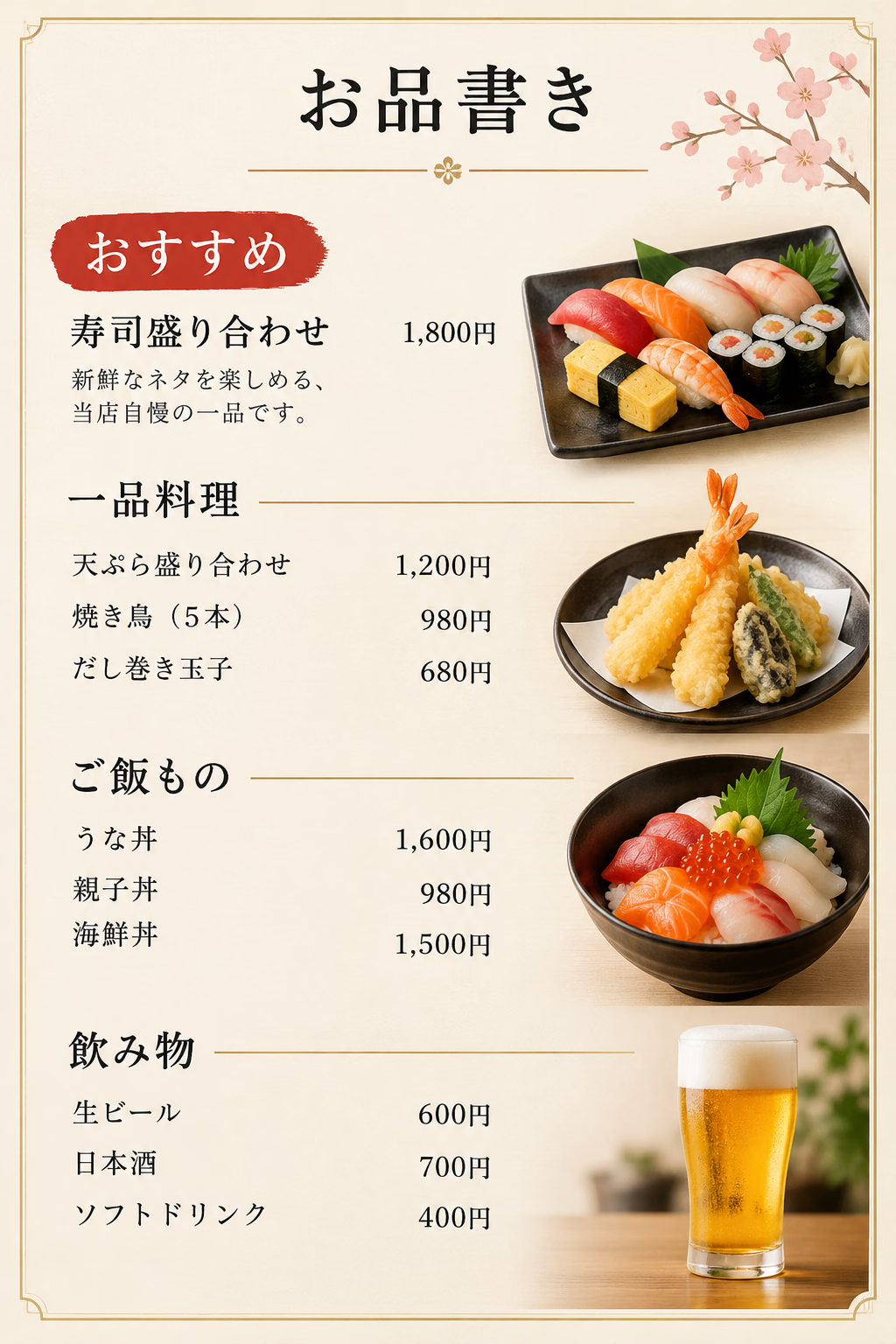
But that still does not tell you what you are ordering.
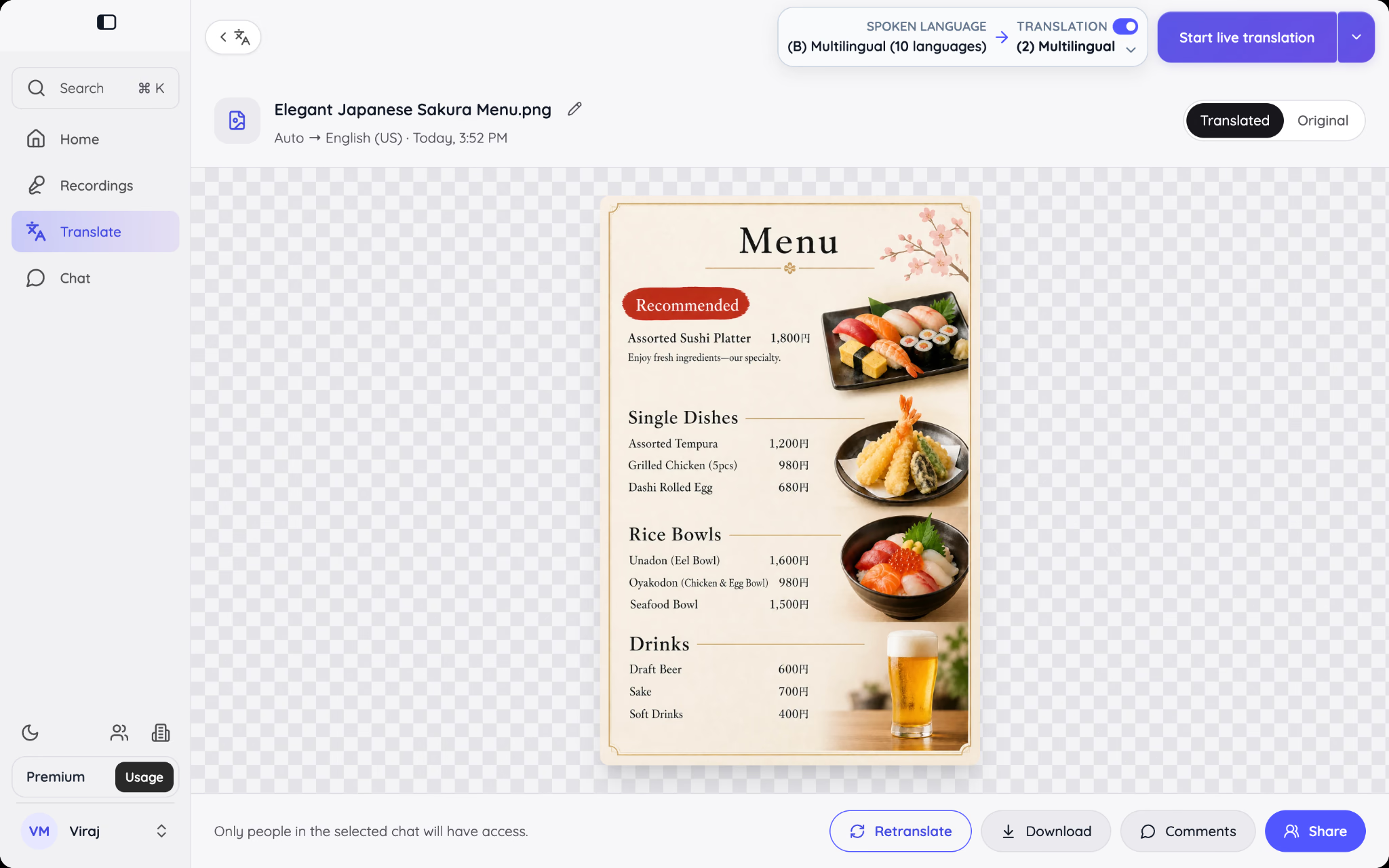
Translation gives you:
Assorted sushi platter
JotMe’s image translation feature can extract text from an image, translate it, and re-render the translated text. That makes it more useful for situations where the words aren't available as selectable text in the first place.
However, remember that transliteration and translation can work together, and you don't always have to choose one or the other.
Sometimes the most useful result is:
Original:
東京
Romanization:
Tōkyō
English:
Tokyo
Or:
Original:
こんにちは
Romanization:
Konnichiwa
English:
Hello
The same source can require both romanization and translation when readers need to recognize the original term and understand its meaning.
This is particularly useful for language learning, travel, cultural content, academic writing, and situations where readers need both the original term and its meaning.
| If you need to... | Use... |
|---|---|
| Read a word written in another script | Transliteration |
| Represent or approximate the pronunciation of a foreign name or term | Transliteration or a pronunciation guide |
| Understand what a sentence means | Translation |
| Understand a live conversation | Live translation |
| Translate an email or message | Text translation |
| Translate a PDF or presentation | Document translation |
| Understand text in a photo | Image translation |
| Preserve both the original term and its meaning | Transliteration + translation |
So if “How do I write this in another script?” is the question, transliteration is probably what you need.
If the question is “What does this person/text actually mean?”, you need translation.
If the goal is understanding a conversation, email, document, image, audio, or video, you don't necessarily need to transliterate first. An AI translation app can work directly with the content you have. JotMe supports text, documents, images, audio, video, and live translation, so the workflow can start with the content you actually have.
Try JotMe today and start translating written or spoken words effortlessly!
FAQs
What's the simpler way to express "Transliteration"?
In simple terms, transliteration means writing a word from one script using another script while keeping the original word recognizable.
For example:
नमस्ते → namaste
The word is still the Hindi/Sanskrit term, but only its written form has changed.
What is the purpose of transliteration?
The purpose of transliteration is to make words written in an unfamiliar script usable in another script without replacing the original term with a translated equivalent.
It can help readers:
- pronounce names and terms
- enter words using a different keyboard
- search multilingual databases
- standardize names and records
- read geographic and cultural terms
- preserve source-language identity across scripts
How can I transliterate from English directly to another language but still stay Romanized?
If the target is another language but you want the output to remain in the Latin alphabet, you are generally looking for a romanized representation of the target-language text.
For example, Japanese can be represented in Latin script as konnichiwa rather than in Japanese characters こんにちは.
This involves translation first and romanization second. Simply changing the spelling of ‘hello’ is not transliteration.
The important distinction is that simply changing the English spelling is not transliteration. You first need the target-language expression, then its accepted romanized form.
How to transliterate?
Start with the original text and identify the source and target scripts. Then choose the appropriate transliteration or romanization system for that language pair and apply its rules consistently.
For a quick manual example:
Москва → Moskva
For production work involving names, legal records, catalogs, or large datasets, do not rely on ad hoc spelling. Define the convention first and check whether an established official spelling already exists.
How to get Arabic to English transliteration accurate and easy?
Start with the exact Arabic text, identify the transliteration standard or convention you need, and keep the system consistent.
For casual reading, a simplified form such as marhaba may be easier. For academic or cataloging work, use the specified standard and preserve its diacritics and conventions.
For example:
مرحبا → marhaba
The correct choice depends on whether your priority is everyday readability, pronunciation, searchability, or reversible/standardized representation.
Does JotMe transliterate or translate?
As of October 2026, JotMe does not transliterate and is primarily an AI translation tool. It focuses on translating text, documents, images, audio, video, and live conversations. If you need to understand what foreign-language content means, you can translate it directly instead of transliterating it first.
Last updated on
April 14, 2026
Follow us on social media: